 Add to Chrome
 Add to Firefox
 Add to Edge
RT-Focuser: A Real-Time Lightweight Model for Edge-side Image Deblurring
Dec 26, 2025
Motion blur caused by camera or object movement severely degrades image quality and poses challenges for real-time applications such as autonomous driving, UAV perception, and medical imaging. In this paper, a lightweight U-shaped network tailored for real-time deblurring is presented and named RT-Focuser. To balance speed and accuracy, we design three key components: Lightweight Deblurring Block (LD) for edge-aware feature extraction, Multi-Level Integrated Aggregation module (MLIA) for encoder integration, and Cross-source Fusion Block (X-Fuse) for progressive decoder refinement. Trained on a single blurred input, RT-Focuser achieves 30.67 dB PSNR with only 5.85M parameters and 15.76 GMACs. It runs 6ms per frame on GPU and mobile, exceeds 140 FPS on both, showing strong potential for deployment on the edge. The official code and usage are available on: https://github.com/ReaganWu/RT-Focuser.

NTU4DRadLM: 4D Radar-centric Multi-Modal Dataset for Localization and Mapping
Sep 02, 2023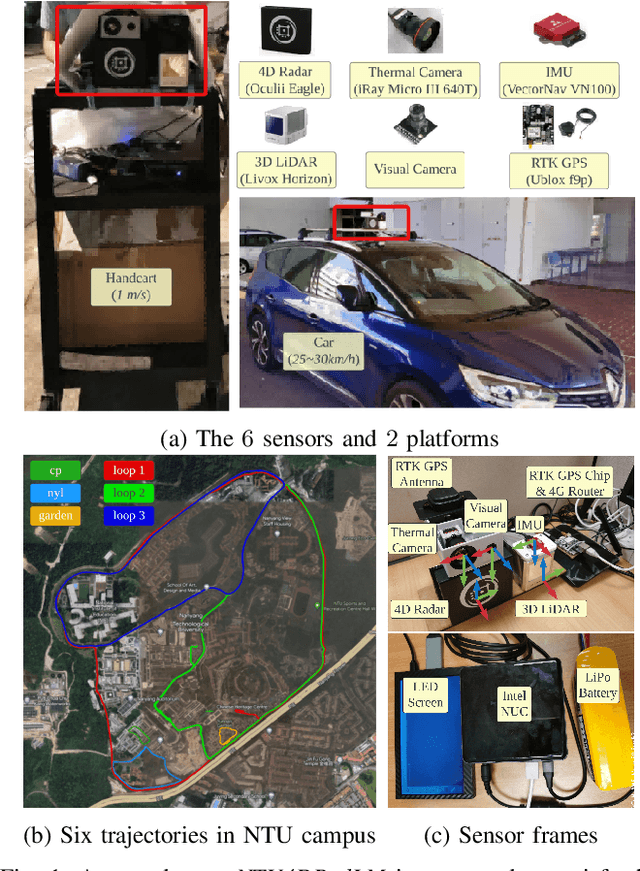
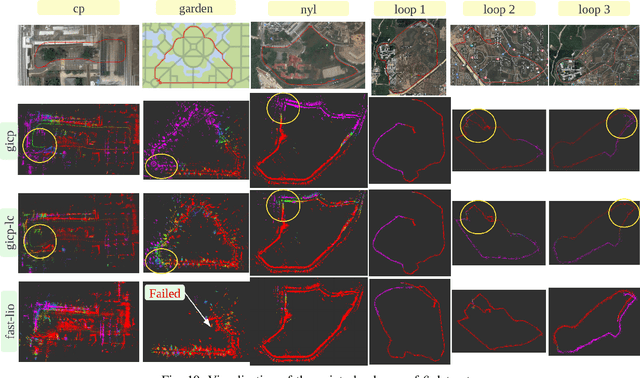
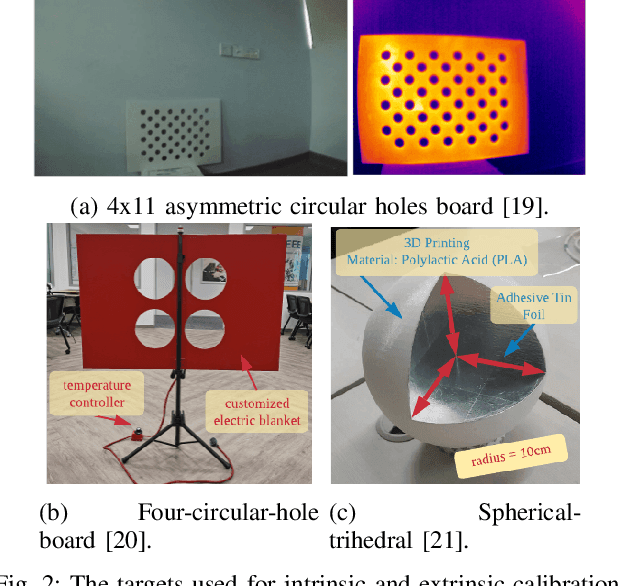
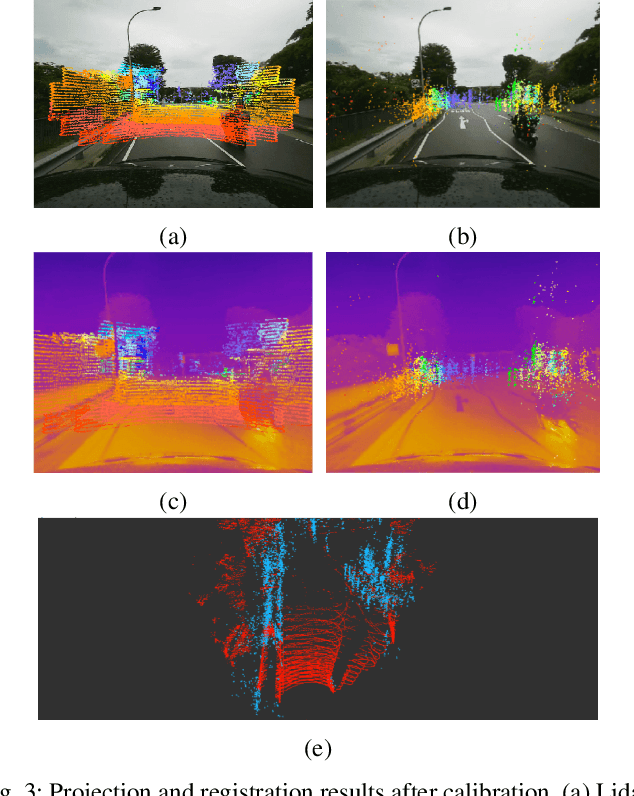
Simultaneous Localization and Mapping (SLAM) is moving towards a robust perception age. However, LiDAR- and visual- SLAM may easily fail in adverse conditions (rain, snow, smoke and fog, etc.). In comparison, SLAM based on 4D Radar, thermal camera and IMU can work robustly. But only a few literature can be found. A major reason is the lack of related datasets, which seriously hinders the research. Even though some datasets are proposed based on 4D radar in past four years, they are mainly designed for object detection, rather than SLAM. Furthermore, they normally do not include thermal camera. Therefore, in this paper, NTU4DRadLM is presented to meet this requirement. The main characteristics are: 1) It is the only dataset that simultaneously includes all 6 sensors: 4D radar, thermal camera, IMU, 3D LiDAR, visual camera and RTK GPS. 2) Specifically designed for SLAM tasks, which provides fine-tuned ground truth odometry and intentionally formulated loop closures. 3) Considered both low-speed robot platform and fast-speed unmanned vehicle platform. 4) Covered structured, unstructured and semi-structured environments. 5) Considered both middle- and large- scale outdoor environments, i.e., the 6 trajectories range from 246m to 6.95km. 6) Comprehensively evaluated three types of SLAM algorithms. Totally, the dataset is around 17.6km, 85mins, 50GB and it will be accessible from this link: https://github.com/junzhang2016/NTU4DRadLM