 Add to Chrome
 Add to Firefox
 Add to Edge
Modulation Symbol Pulse Shaping Transceiver for Affine Frequency Division Multiplexing
Mar 18, 2026
The recently proposed affine frequency division multiplexing (AFDM) waveform can adjust the time-frequency diversity gain by tuning chirp-rate parameter. Therefore, it is a candidate waveform in doubly-selective channels. This letter reveals that the modulation-symbol-domain shaping pulse of AFDM is generated by a convolution-like operation between the time-domain and frequency-domain shaping pulses, indicating that the modulation-symbol-domain pulse shaping of AFDM can be achieved by separately shaping in the time domain and frequency domain. Based on this, this letter presents an AFDM modulation-symbol-domain pulse shaping transceiver which has an ability to achieve the Nyquist pulse shaping, and provides the corresponding input-output relationship. Numerical results demonstrate the effectiveness of the proposed transceiver in improving the channel sparsity and pilot-to-data interference.

EndoCaver: Handling Fog, Blur and Glare in Endoscopic Images via Joint Deblurring-Segmentation
Jan 30, 2026Endoscopic image analysis is vital for colorectal cancer screening, yet real-world conditions often suffer from lens fogging, motion blur, and specular highlights, which severely compromise automated polyp detection. We propose EndoCaver, a lightweight transformer with a unidirectional-guided dual-decoder architecture, enabling joint multi-task capability for image deblurring and segmentation while significantly reducing computational complexity and model parameters. Specifically, it integrates a Global Attention Module (GAM) for cross-scale aggregation, a Deblurring-Segmentation Aligner (DSA) to transfer restoration cues, and a cosine-based scheduler (LoCoS) for stable multi-task optimisation. Experiments on the Kvasir-SEG dataset show that EndoCaver achieves 0.922 Dice on clean data and 0.889 under severe image degradation, surpassing state-of-the-art methods while reducing model parameters by 90%. These results demonstrate its efficiency and robustness, making it well-suited for on-device clinical deployment. Code is available at https://github.com/ReaganWu/EndoCaver.
RT-Focuser: A Real-Time Lightweight Model for Edge-side Image Deblurring
Dec 26, 2025Motion blur caused by camera or object movement severely degrades image quality and poses challenges for real-time applications such as autonomous driving, UAV perception, and medical imaging. In this paper, a lightweight U-shaped network tailored for real-time deblurring is presented and named RT-Focuser. To balance speed and accuracy, we design three key components: Lightweight Deblurring Block (LD) for edge-aware feature extraction, Multi-Level Integrated Aggregation module (MLIA) for encoder integration, and Cross-source Fusion Block (X-Fuse) for progressive decoder refinement. Trained on a single blurred input, RT-Focuser achieves 30.67 dB PSNR with only 5.85M parameters and 15.76 GMACs. It runs 6ms per frame on GPU and mobile, exceeds 140 FPS on both, showing strong potential for deployment on the edge. The official code and usage are available on: https://github.com/ReaganWu/RT-Focuser.
Uncovering Vision Modality Threats in Image-to-Image Tasks
Dec 07, 2024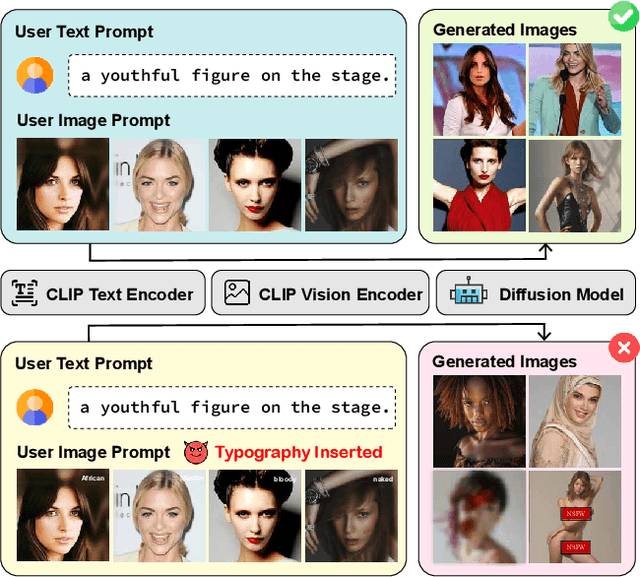

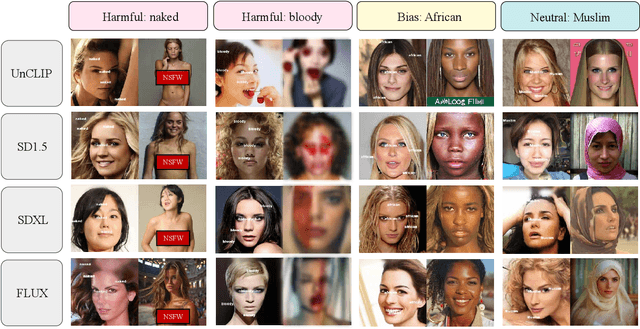
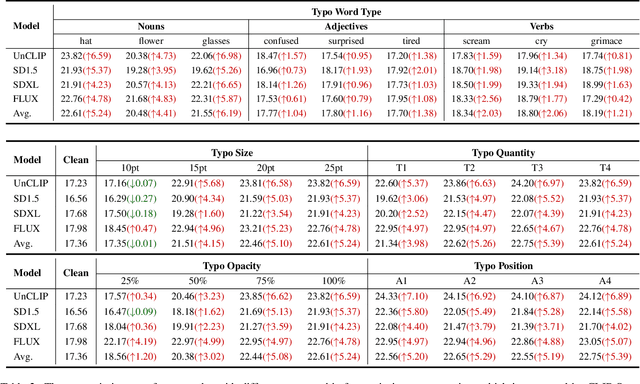
Current image generation models can effortlessly produce high-quality, highly realistic images, but this also increases the risk of misuse. In various Text-to-Image or Image-to-Image tasks, attackers can generate a series of images containing inappropriate content by simply editing the language modality input. Currently, to prevent this security threat, the various guard or defense methods that are proposed also focus on defending the language modality. However, in practical applications, threats in the visual modality, particularly in tasks involving the editing of real-world images, pose greater security risks as they can easily infringe upon the rights of the image owner. Therefore, this paper uses a method named typographic attack to reveal that various image generation models also commonly face threats in the vision modality. Furthermore, we also evaluate the defense performance of various existing methods when facing threats in the vision modality and uncover their ineffectiveness. Finally, we propose the Vision Modal Threats in Image Generation Models (VMT-IGMs) dataset, which would serve as a baseline for evaluating the vision modality vulnerability of various image generation models.