 Add to Chrome
 Add to Firefox
 Add to Edge
InstOptima: Evolutionary Multi-objective Instruction Optimization via Large Language Model-based Instruction Operators
Oct 26, 2023
Instruction-based language modeling has received significant attention in pretrained language models. However, the efficiency of instruction engineering remains low and hinders the development of instruction studies. Recent studies have focused on automating instruction generation, but they primarily aim to improve performance without considering other crucial objectives that impact instruction quality, such as instruction length and perplexity. Therefore, we propose a novel approach (i.e., InstOptima) that treats instruction generation as an evolutionary multi-objective optimization problem. In contrast to text edition-based methods, our approach utilizes a large language model (LLM) to simulate instruction operators, including mutation and crossover. Furthermore, we introduce an objective-guided mechanism for these operators, allowing the LLM to comprehend the objectives and enhance the quality of the generated instructions. Experimental results demonstrate improved fine-tuning performance and the generation of a diverse set of high-quality instructions.

Improving Adaptive Online Learning Using Refined Discretization
Sep 27, 2023We study unconstrained Online Linear Optimization with Lipschitz losses. The goal is to simultaneously achieve ($i$) second order gradient adaptivity; and ($ii$) comparator norm adaptivity also known as "parameter freeness" in the literature. Existing regret bounds (Cutkosky and Orabona, 2018; Mhammedi and Koolen, 2020; Jacobsen and Cutkosky, 2022) have the suboptimal $O(\sqrt{V_T\log V_T})$ dependence on the gradient variance $V_T$, while the present work improves it to the optimal rate $O(\sqrt{V_T})$ using a novel continuous-time-inspired algorithm, without any impractical doubling trick. This result can be extended to the setting with unknown Lipschitz constant, eliminating the range ratio problem from prior works (Mhammedi and Koolen, 2020). Concretely, we first show that the aimed simultaneous adaptivity can be achieved fairly easily in a continuous time analogue of the problem, where the environment is modeled by an arbitrary continuous semimartingale. Then, our key innovation is a new discretization argument that preserves such adaptivity in the discrete time adversarial setting. This refines a non-gradient-adaptive discretization argument from (Harvey et al., 2023), both algorithmically and analytically, which could be of independent interest.
SIM-Sync: From Certifiably Optimal Synchronization over the 3D Similarity Group to Scene Reconstruction with Learned Depth
Sep 11, 2023This paper presents SIM-Sync, a certifiably optimal algorithm that estimates camera trajectory and 3D scene structure directly from multiview image keypoints. SIM-Sync fills the gap between pose graph optimization and bundle adjustment; the former admits efficient global optimization but requires relative pose measurements and the latter directly consumes image keypoints but is difficult to optimize globally (due to camera projective geometry). The bridge to this gap is a pretrained depth prediction network. Given a graph with nodes representing monocular images taken at unknown camera poses and edges containing pairwise image keypoint correspondences, SIM-Sync first uses a pretrained depth prediction network to lift the 2D keypoints into 3D scaled point clouds, where the scaling of the per-image point cloud is unknown due to the scale ambiguity in monocular depth prediction. SIM-Sync then seeks to synchronize jointly the unknown camera poses and scaling factors (i.e., over the 3D similarity group). The SIM-Sync formulation, despite nonconvex, allows designing an efficient certifiably optimal solver that is almost identical to the SE-Sync algorithm. We demonstrate the tightness, robustness, and practical usefulness of SIM-Sync in both simulated and real experiments. In simulation, we show (i) SIM-Sync compares favorably with SE-Sync in scale-free synchronization, and (ii) SIM-Sync can be used together with robust estimators to tolerate a high amount of outliers. In real experiments, we show (a) SIM-Sync achieves similar performance as Ceres on bundle adjustment datasets, and (b) SIM-Sync performs on par with ORB-SLAM3 on the TUM dataset with zero-shot depth prediction.
Topology-Aware Resilient Routing Protocol for FANETs: An Adaptive Q-Learning Approach
Jun 30, 2023Flying ad hoc networks (FANETs) play a crucial role in numerous military and civil applications since it shortens mission duration and enhances coverage significantly compared with a single unmanned aerial vehicle (UAV). Whereas, designing an energy-efficient FANET routing protocol with a high packet delivery rate (PDR) and low delay is challenging owing to the dynamic topology changes. In this article, we propose a topology-aware resilient routing strategy based on adaptive Q-learning (TARRAQ) to accurately capture topology changes with low overhead and make routing decisions in a distributed and autonomous way. First, we analyze the dynamic behavior of UAV nodes via the queuing theory, and then the closed-form solutions of neighbors' change rate (NCR) and neighbors' change interarrival time (NCIT) distribution are derived. Based on the real-time NCR and NCIT, a resilient sensing interval (SI) is determined by defining the expected sensing delay of network events. Besides, we also present an adaptive Q-learning approach that enables UAVs to make distributed, autonomous, and adaptive routing decisions, where the above SI ensures that the action space can be updated in time at a low cost. The simulation results verify the accuracy of the topology dynamic analysis model and also prove that our TARRAQ outperforms the Q-learning-based topology-aware routing (QTAR), mobility prediction-based virtual routing (MPVR), and greedy perimeter stateless routing based on energy-efficient hello (EE-Hello) in terms of 25.23%, 20.24%, and 13.73% lower overhead, 9.41%, 14.77%, and 16.70% higher PDR, and 5.12%, 15.65%, and 11.31% lower energy consumption, respectively.
* 18 pages, 11 figure, 5 tables
Toward Intelligent and Efficient 6G Networks: JCSC Enabled On-Purpose Machine Communications
Jun 30, 2023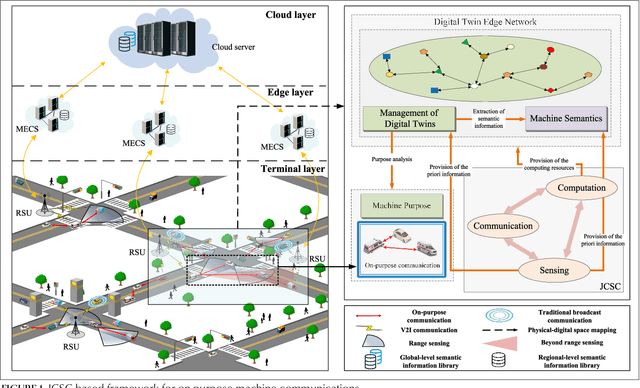
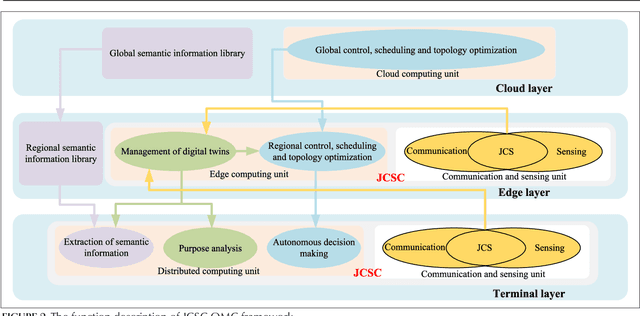
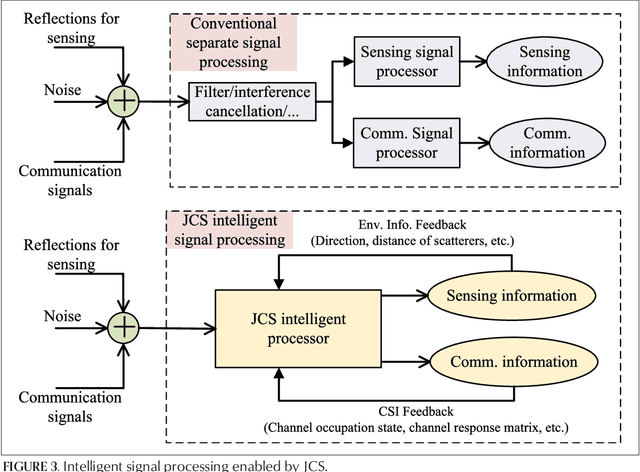
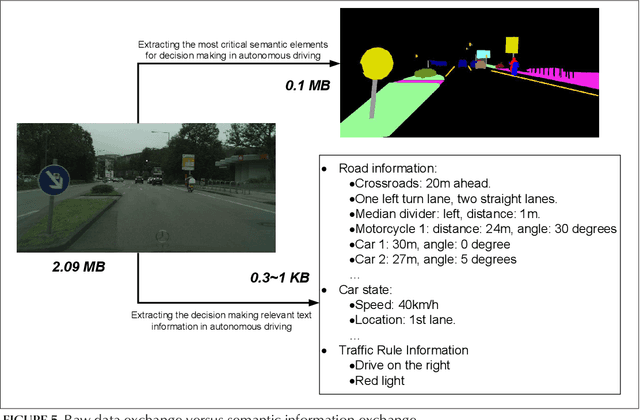
Driven by the vision of "intelligent connection of everything" toward 6G, the collective intelligence of networked machines can be fully exploited to improve system efficiency by shifting the paradigm of wireless communication design from naive maximalist approaches to intelligent value-based approaches. In this article, we propose an on-purpose machine communication framework enabled by joint communication, sensing, and computation (JCSC) technology, which employs machine semantics as the interactive information flow. Naturally, there are potential technical barriers to be solved before the widespread adoption of on-purpose communications, including the conception of machine purpose, fast and concise networking strategy, and semantics-aware information exchange mechanism during the process of task-oriented cooperation. Hence, we discuss enabling technologies complemented by a range of open challenges. The simulation result shows that the proposed framework can significantly reduce networking overhead and improve communication efficiency.
* 8 pages, 6 figures
Adapt and Align to Improve Zero-Shot Sketch-Based Image Retrieval
May 18, 2023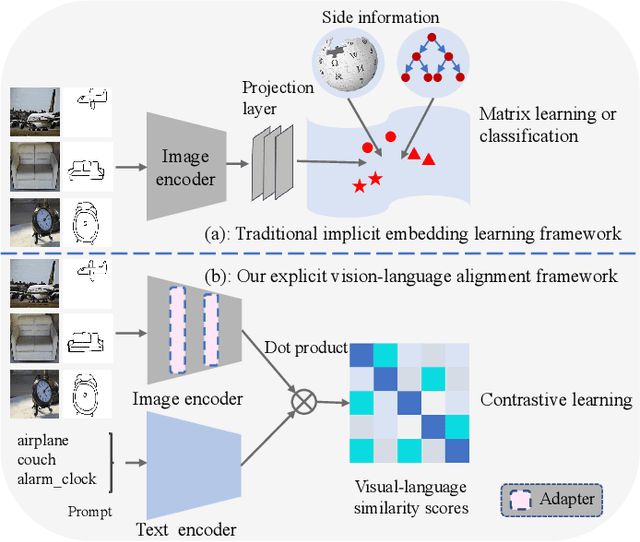
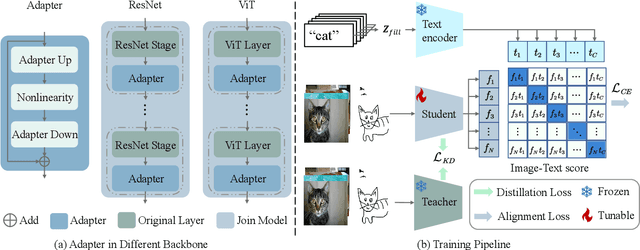
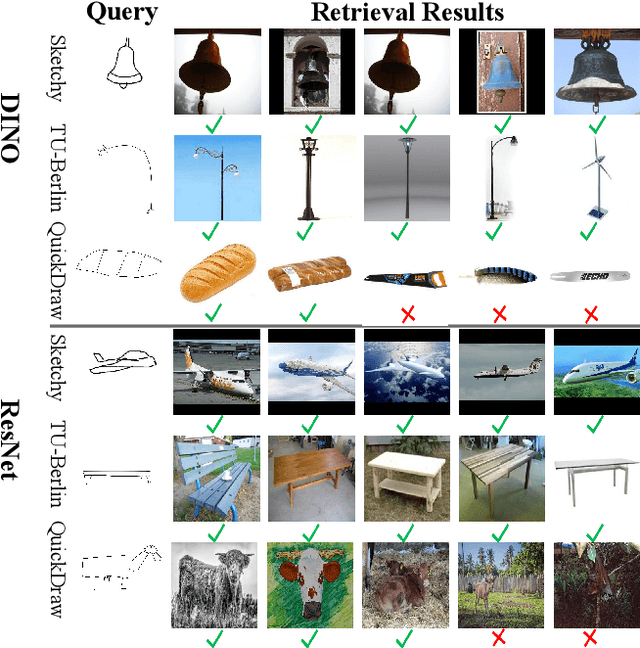
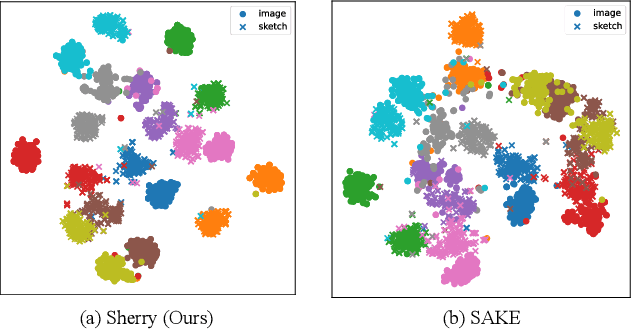
Zero-shot sketch-based image retrieval (ZS-SBIR) is challenging due to the cross-domain nature of sketches and photos, as well as the semantic gap between seen and unseen image distributions. Previous methods fine-tune pre-trained models with various side information and learning strategies to learn a compact feature space that is shared between the sketch and photo domains and bridges seen and unseen classes. However, these efforts are inadequate in adapting domains and transferring knowledge from seen to unseen classes. In this paper, we present an effective ``Adapt and Align'' approach to address the key challenges. Specifically, we insert simple and lightweight domain adapters to learn new abstract concepts of the sketch domain and improve cross-domain representation capabilities. Inspired by recent advances in image-text foundation models (e.g., CLIP) on zero-shot scenarios, we explicitly align the learned image embedding with a more semantic text embedding to achieve the desired knowledge transfer from seen to unseen classes. Extensive experiments on three benchmark datasets and two popular backbones demonstrate the superiority of our method in terms of retrieval accuracy and flexibility.
Reactive Perturbation Defocusing for Textual Adversarial Defense
May 06, 2023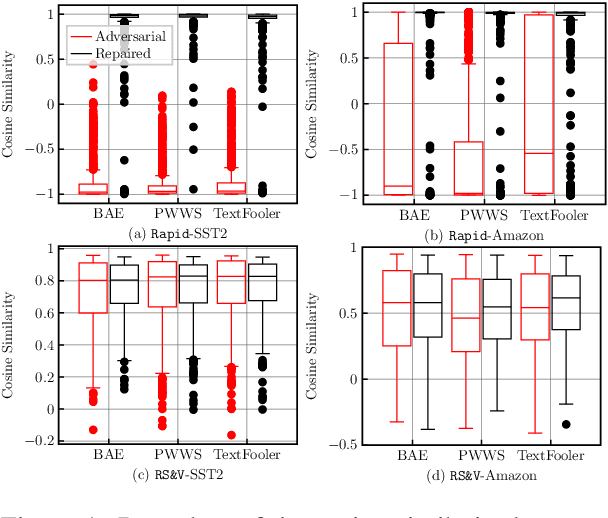
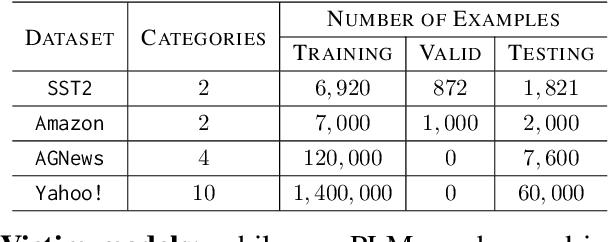
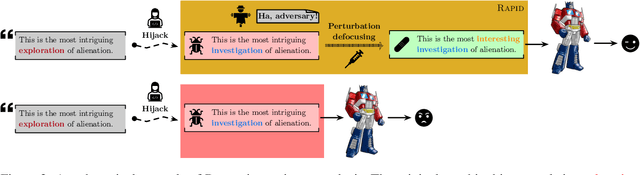
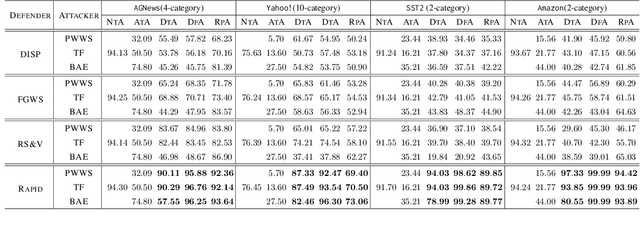
Recent studies have shown that large pre-trained language models are vulnerable to adversarial attacks. Existing methods attempt to reconstruct the adversarial examples. However, these methods usually have limited performance in defense against adversarial examples, while also negatively impacting the performance on natural examples. To overcome this problem, we propose a method called Reactive Perturbation Defocusing (RPD). RPD uses an adversarial detector to identify adversarial examples and reduce false defenses on natural examples. Instead of reconstructing the adversaries, RPD injects safe perturbations into adversarial examples to distract the objective models from the malicious perturbations. Our experiments on three datasets, two objective models, and various adversarial attacks show that our proposed framework successfully repairs up to approximately 97% of correctly identified adversarial examples with only about a 2% performance decrease on natural examples. We also provide a demo of adversarial detection and repair based on our work.
Object Pose Estimation with Statistical Guarantees: Conformal Keypoint Detection and Geometric Uncertainty Propagation
Mar 22, 2023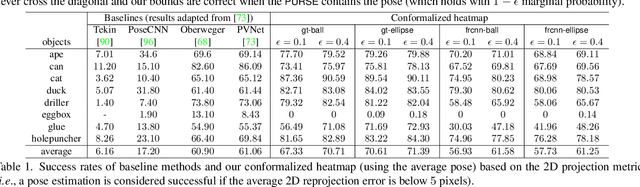
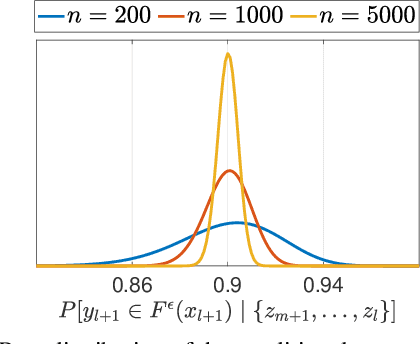
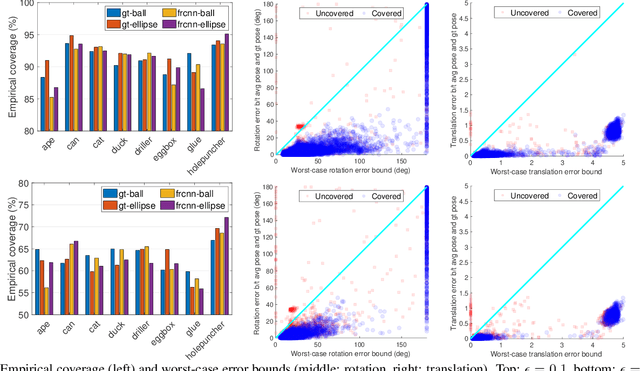
The two-stage object pose estimation paradigm first detects semantic keypoints on the image and then estimates the 6D pose by minimizing reprojection errors. Despite performing well on standard benchmarks, existing techniques offer no provable guarantees on the quality and uncertainty of the estimation. In this paper, we inject two fundamental changes, namely conformal keypoint detection and geometric uncertainty propagation, into the two-stage paradigm and propose the first pose estimator that endows an estimation with provable and computable worst-case error bounds. On one hand, conformal keypoint detection applies the statistical machinery of inductive conformal prediction to convert heuristic keypoint detections into circular or elliptical prediction sets that cover the groundtruth keypoints with a user-specified marginal probability (e.g., 90%). Geometric uncertainty propagation, on the other, propagates the geometric constraints on the keypoints to the 6D object pose, leading to a Pose UnceRtainty SEt (PURSE) that guarantees coverage of the groundtruth pose with the same probability. The PURSE, however, is a nonconvex set that does not directly lead to estimated poses and uncertainties. Therefore, we develop RANdom SAmple averaGing (RANSAG) to compute an average pose and apply semidefinite relaxation to upper bound the worst-case errors between the average pose and the groundtruth. On the LineMOD Occlusion dataset we demonstrate: (i) the PURSE covers the groundtruth with valid probabilities; (ii) the worst-case error bounds provide correct uncertainty quantification; and (iii) the average pose achieves better or similar accuracy as representative methods based on sparse keypoints.
Verification and Synthesis of Robust Control Barrier Functions: Multilevel Polynomial Optimization and Semidefinite Relaxation
Mar 17, 2023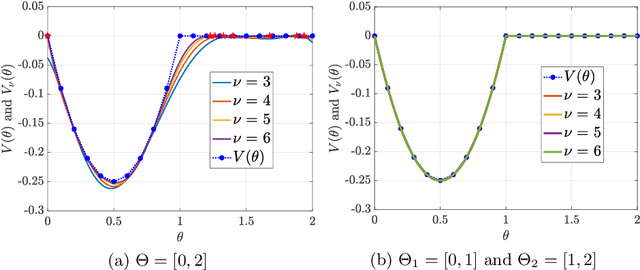
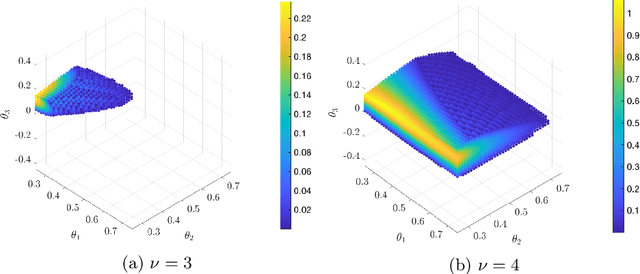
We study the problem of verification and synthesis of robust control barrier functions (CBF) for control-affine polynomial systems with bounded additive uncertainty and convex polynomial constraints on the control. We first formulate robust CBF verification and synthesis as multilevel polynomial optimization problems (POP), where verification optimizes -- in three levels -- the uncertainty, control, and state, while synthesis additionally optimizes the parameter of a chosen parametric CBF candidate. We then show that, by invoking the KKT conditions of the inner optimizations over uncertainty and control, the verification problem can be simplified as a single-level POP and the synthesis problem reduces to a min-max POP. This reduction leads to multilevel semidefinite relaxations. For the verification problem, we apply Lasserre's hierarchy of moment relaxations. For the synthesis problem, we draw connections to existing relaxation techniques for robust min-max POP, which first use sum-of-squares programming to find increasingly tight polynomial lower bounds to the unknown value function of the verification POP, and then call Lasserre's hierarchy again to maximize the lower bounds. Both semidefinite relaxations guarantee asymptotic global convergence to optimality. We provide an in-depth study of our framework on the controlled Van der Pol Oscillator, both with and without additive uncertainty.
Joint Communication, Sensing and Computation enabled 6G Intelligent Machine System
Feb 21, 2023With the rapid development of the smart city, high-level autonomous driving, intelligent manufacturing, and etc., the stringent industrial-level requirements of the extremely low latency and high reliability for communication and new trends for sub-centimeter sensing have transcended the abilities of 5G and call for the development of 6G. Based on analyzing the function design of the communication, sensing and the emerging intelligent computation systems, we propose the joint communication, sensing and computation (JCSC) framework for 6G intelligent machine-type communication (IMTC) network to realize low latency and high reliability of communication, highly accurate sensing and fast environment adaption. In the proposed JCSC framework, the communication, sensing and computation abilities cooperate to benefit each other by utilizing the unified hardware, resource and protocol design. Sensing information is exploited as priori information to enhance the reliability and latency performance of wireless communication and to optimize the resource utilization of the communication network, which further improves the distributed computation and cooperative sensing ability. We propose the promising enabling technologies such as joint communication and sensing (JCS) technique, JCSC wireless networking techniques and intelligent computation techniques. We also summarize the challenges to achieve the JCSC framework. Then, we introduce the intelligent flexible manufacturing as a typical use case of the IMTC with JCSC framework, where the enabling technologies are deployed. Finally, we present the simulation results to prove the feasibility of the JCSC framework by evaluating the JCS waveform, the JCSC enabled neighbor discovery (ND) and medium access control (MAC).
* 9 pages, 6 figures, published by IEEE Network