 Add to Chrome
 Add to Firefox
 Add to Edge
Speculative Rollback Correction for Quality-Diverse Web Agent Imitation
Jun 10, 2026
Training interactive web agents through imitation learning from expert trajectories has emerged as a highly effective approach. However, determining the optimal timing for expert intervention presents a critical challenge in this context. Delayed intervention often leads to the accumulation of early-stage errors, pushing the page state into an irrecoverable regime. Conversely, premature or excessive intervention causes the agent to become overly reliant on expert policies, trapping the model in local optima characterized by a single, rigid trajectory. We propose Speculative Rollback Correction (SRC), a branch-level imitation framework for resettable agent environments. Instead of requesting teacher labels at every visited state or correcting only after a completed trajectory, SRC uses fixed-horizon branch review: the student executes a short speculative segment before teacher review, and the teacher localizes the first harmful deviation only when local progress breaks. Rollback preserves useful prefixes, while successful rollouts are filtered by a hard verifier and retained in a lightweight quality-diversity archive. The resulting data supports next-action supervised fine-tuning on both localized corrections and verifier-passing trajectories. On WebArena-Infinity, SRC collects 977 verifier-passing trajectories and 9,183 next-action examples; fixed-horizon review improves the recovery-versus-query tradeoff over step-level review while retaining verifier-passing solution variants. Code is available at https://github.com/LongkunHao/SRC_gui_agent.

StainFlow: Entity-Stain Tracking and Evidence Linking for Process Rewards in GUI Agents
Jun 05, 2026Reinforcement Learning (RL) has become a promising approach for improving GUI Agents in long-horizon, stochastic digital environments, but trajectory-level success feedback is too sparse to provide reliable credit assignment for intermediate exploration steps. To mitigate this issue, recent studies introduce Process Reward Models (PRMs), which provide finer-grained training feedback through global milestone verification or local step-level evaluation. However, these methods still suffer from two level-specific limitations: global milestone decomposition is subjective and singular, making it difficult to accommodate the multiple valid execution paths in real GUI tasks, while fixed local judging windows may miss long-range key evidence or dilute the decision signal with irrelevant frames. Inspired by stain-tracing mechanisms in network flow analysis, we propose StainFlow, an entity-stain-flow process reward model for GUI Agents. To reduce the subjectivity of global partitioning, we introduce the Global Entity Stain Tracking module, which extracts visually verifiable task entities and tracks how their stain concentrations and states evolve along the trajectory, allowing task phases to be objectively separated by changes in the entity evidence flow. To improve the accuracy of local verification, we introduce the Local Stain Evidence Linking module. Centered on the triggering entities of each candidate key node, it retrieves relevant steps based on their stain concentrations and state changes, and dynamically constructs high-density evidence windows for verifying true key nodes. Extensive experiments on AndroidWorld and OGRBench show that StainFlow relatively improves online RL success by 3.2% and trajectory completion judgment accuracy by 1.8%.
MIRAGE: Mobile Agents with Implicit Reasoning and Generative World Models
Jun 03, 2026Mobile agents are increasingly expected to operate everyday applications from screenshots and language goals, where reliable control requires reasoning over screen affordances, multi-step navigation, and future state changes. However, many agents externalize this computation as long textual chains of thought, which slows interaction, increases supervision cost, and complicates deployment. We introduce MIRAGE, a framework that learns continuous latent reasoning representations from visible textual reasoning traces. MIRAGE transfers explicit reasoning into compact hidden states, enabling the agent to reason internally without decoding long rationales. It also incorporates a generative world-model objective: latent reasoning vectors are aligned with future screenshots, encouraging the agent to anticipate upcoming interface states before acting. This turns hidden computation into both a compressed thought representation and a forward-looking model of environment dynamics. At inference time, MIRAGE reasons in continuous latent space, reducing token generation while improving execution efficiency. On AndroidWorld, MIRAGE matches explicit chain-of-thought supervised fine-tuning in the 4B ablation with a 3-5x lower decoded-token budget and improves a comparable instruction-tuned baseline by 10.2 points; on AndroidControl, it improves action grounding while generating over 75% fewer tokens.
Vision-fused Attack: Advancing Aggressive and Stealthy Adversarial Text against Neural Machine Translation
Sep 08, 2024


While neural machine translation (NMT) models achieve success in our daily lives, they show vulnerability to adversarial attacks. Despite being harmful, these attacks also offer benefits for interpreting and enhancing NMT models, thus drawing increased research attention. However, existing studies on adversarial attacks are insufficient in both attacking ability and human imperceptibility due to their sole focus on the scope of language. This paper proposes a novel vision-fused attack (VFA) framework to acquire powerful adversarial text, i.e., more aggressive and stealthy. Regarding the attacking ability, we design the vision-merged solution space enhancement strategy to enlarge the limited semantic solution space, which enables us to search for adversarial candidates with higher attacking ability. For human imperceptibility, we propose the perception-retained adversarial text selection strategy to align the human text-reading mechanism. Thus, the finally selected adversarial text could be more deceptive. Extensive experiments on various models, including large language models (LLMs) like LLaMA and GPT-3.5, strongly support that VFA outperforms the comparisons by large margins (up to 81%/14% improvements on ASR/SSIM).
BinaryDM: Towards Accurate Binarization of Diffusion Model
Apr 08, 2024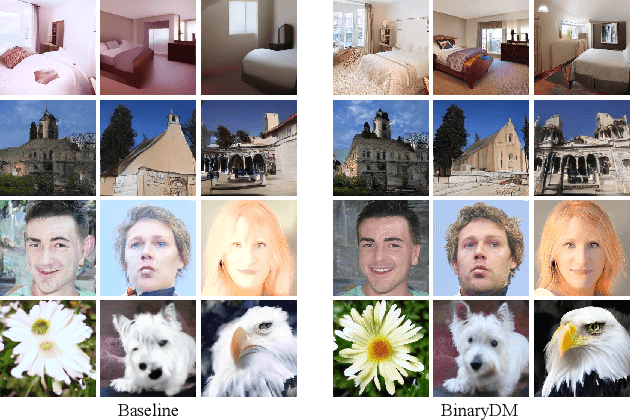
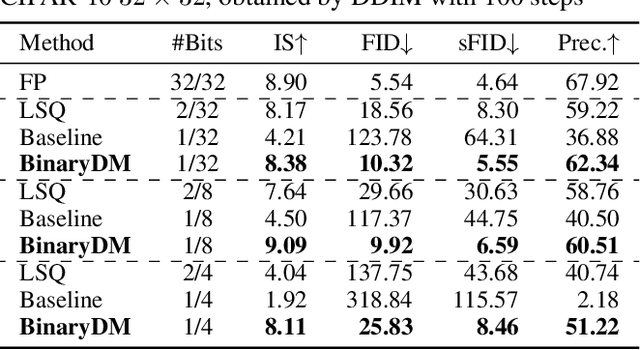
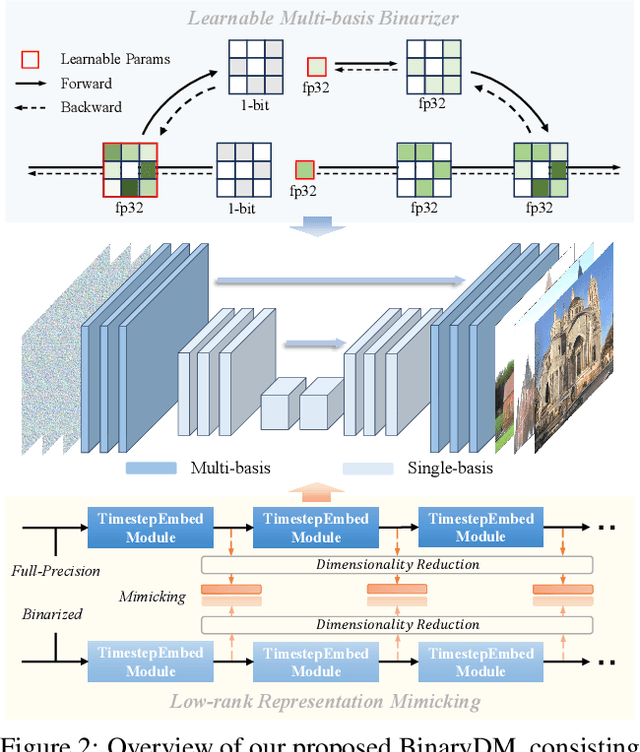

With the advancement of diffusion models (DMs) and the substantially increased computational requirements, quantization emerges as a practical solution to obtain compact and efficient low-bit DMs. However, the highly discrete representation leads to severe accuracy degradation, hindering the quantization of diffusion models to ultra-low bit-widths. In this paper, we propose BinaryDM, a novel accurate quantization-aware training approach to push the weights of diffusion models towards the limit of 1-bit. Firstly, we present a Learnable Multi-basis Binarizer (LMB) to recover the representations generated by the binarized DM, which improves the information in details of representations crucial to the DM. Secondly, a Low-rank Representation Mimicking (LRM) is applied to enhance the binarization-aware optimization of the DM, alleviating the optimization direction ambiguity caused by fine-grained alignment. Moreover, a progressive initialization strategy is applied to training DMs to avoid convergence difficulties. Comprehensive experiments demonstrate that BinaryDM achieves significant accuracy and efficiency gains compared to SOTA quantization methods of DMs under ultra-low bit-widths. As the first binarization method for diffusion models, BinaryDM achieves impressive 16.0 times FLOPs and 27.1 times storage savings with 1-bit weight and 4-bit activation, showcasing its substantial advantages and potential for deploying DMs on resource-limited scenarios.