 Add to Chrome
 Add to Firefox
 Add to Edge
Clarus: Coordinating Autonomous Research Agents toward Web-Scale Scientific Collaboration
Jun 29, 2026
Existing autonomous research agents can support parts of the research process, but most systems still treat research as either an isolated assistant task or a closed workflow. Therefore, autonomous science needs a collaboration infrastructure that coordinates projects, agents, and digital and physical resources. We identify this as a shift from code-centered execution loops to research-oriented collaboration processes, where questions, evidence, participants, and resources must be coordinated under uncertainty. In this framing, an agent may be an AI system, a human researcher, a team, a laboratory, or an organization-backed participant. To this end, we present Clarus, a collaboration infrastructure for coordinating autonomous research agents toward web-scale scientific collaboration. Clarus reformulates research as an open, auditable, attributable, and resource-aware multi-phase collaboration process. It defines a minimal project-agent-resource object model and organizes scientific collaboration through four layers including Research Application, Digital Collaboration, Physical Substrate, and Physical World. Core modules are implemented as pluggable mechanisms, allowing Clarus to adapt to task risk, collaboration structure, and resource constraints. Through a controlled paper-generation case study, we show that Clarus can organize a research goal into a traceable, reviewable, attributable, and accumulative collaboration network across phases, tasks, and participants. Together, the object model, collaboration protocol, trust mechanisms, and prototype validation provide an initial foundation for open research networks. Clarus is now available at clarus.holosai.io.

VisoGender: A dataset for benchmarking gender bias in image-text pronoun resolution
Jun 21, 2023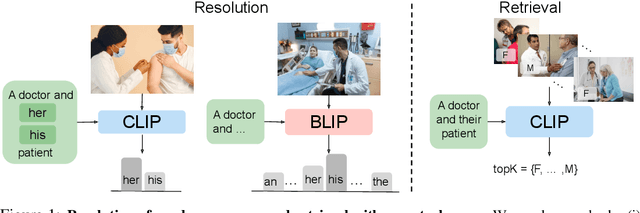
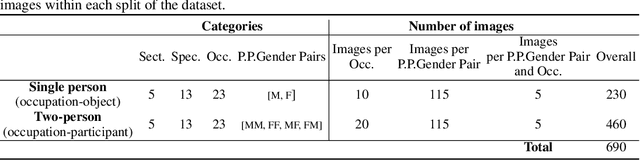
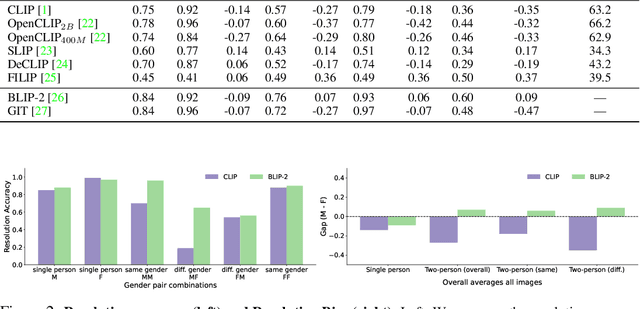
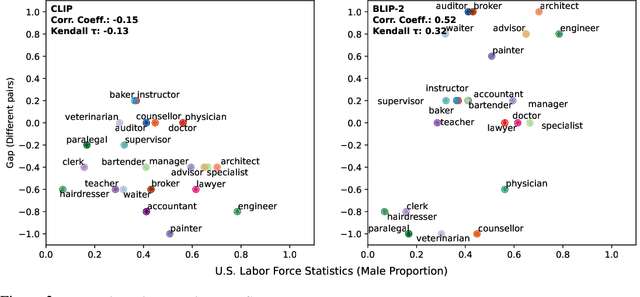
We introduce VisoGender, a novel dataset for benchmarking gender bias in vision-language models. We focus on occupation-related gender biases, inspired by Winograd and Winogender schemas, where each image is associated with a caption containing a pronoun relationship of subjects and objects in the scene. VisoGender is balanced by gender representation in professional roles, supporting bias evaluation in two ways: i) resolution bias, where we evaluate the difference between gender resolution accuracies for men and women and ii) retrieval bias, where we compare ratios of male and female professionals retrieved for a gender-neutral search query. We benchmark several state-of-the-art vision-language models and find that they lack the reasoning abilities to correctly resolve gender in complex scenes. While the direction and magnitude of gender bias depends on the task and the model being evaluated, captioning models generally are more accurate and less biased than CLIP-like models. Dataset and code are available at https://github.com/oxai/visogender