 Add to Chrome
 Add to Firefox
 Add to Edge
CURV: Enhancing Chart Understanding Through Curriculum Visual Grounded Reasoning
Aug 03, 2026
Chart question answering (CQA) requires multimodal large language models (MLLMs) to integrate visual comprehension with logical reasoning, yet current models struggle with accurate visual grounding and coherent reasoning chains. While extrinsic chain-of-thought prompting and visual cues significantly improve performance, current MLLMs lack intrinsic visual grounded reasoning capabilities, leading to inaccurate perception and reasoning disconnected from visual evidence. To address these limitations, we propose CURV, a curriculum learning framework that develops intrinsic visual reasoning capabilities by reformulating CQA as multi-step visual grounded reasoning, where each step coordinates logical reasoning with dynamic visual grounding through spatial attention concentration. To assist model learning, we further introduce CCQA, a three-level curriculum dataset with scalable synthetic generation across diverse chart types and reasoning patterns. Our curriculum systematically progresses from basic single-operation reasoning to complex multi-chart compositional tasks. Experiments demonstrate that CURV achieves up to $\uparrow20.50\%$ improvements over baselines and is generalizable to real-world benchmarks (up to $\uparrow12.30\%$) and out-of-domain multimodal reasoning tasks (up to $\uparrow10.20\%$), validating the effectiveness of internalizing visual reasoning with dynamic grounding for enhanced chart understanding capabilities. Code is available at: https://xhguo7.github.io/CURV/.

Neural Encoding and Decoding at Scale
Apr 14, 2025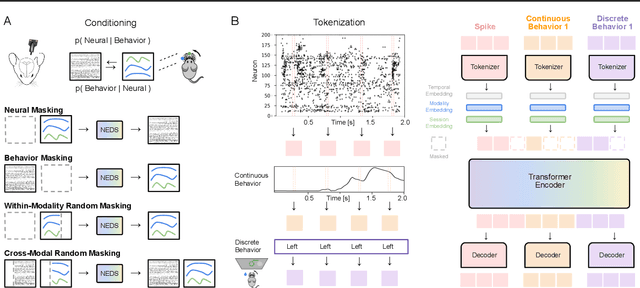
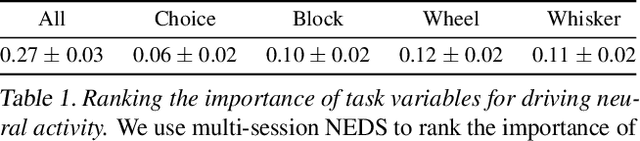
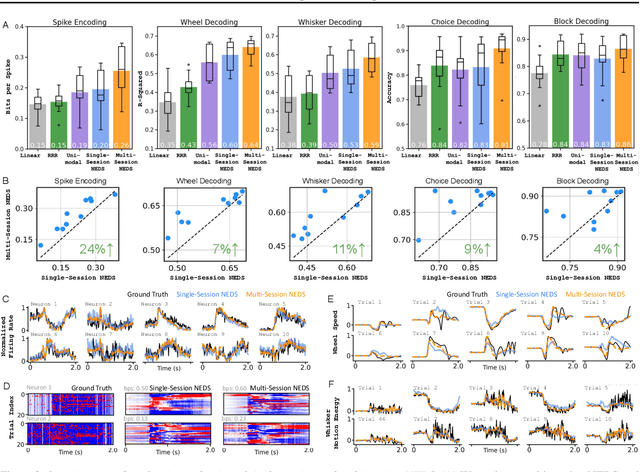
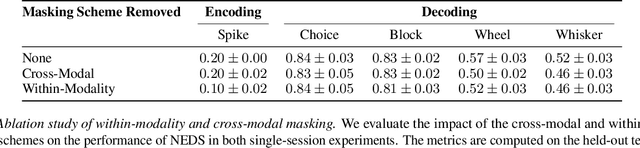
Recent work has demonstrated that large-scale, multi-animal models are powerful tools for characterizing the relationship between neural activity and behavior. Current large-scale approaches, however, focus exclusively on either predicting neural activity from behavior (encoding) or predicting behavior from neural activity (decoding), limiting their ability to capture the bidirectional relationship between neural activity and behavior. To bridge this gap, we introduce a multimodal, multi-task model that enables simultaneous Neural Encoding and Decoding at Scale (NEDS). Central to our approach is a novel multi-task-masking strategy, which alternates between neural, behavioral, within-modality, and cross-modality masking. We pretrain our method on the International Brain Laboratory (IBL) repeated site dataset, which includes recordings from 83 animals performing the same visual decision-making task. In comparison to other large-scale models, we demonstrate that NEDS achieves state-of-the-art performance for both encoding and decoding when pretrained on multi-animal data and then fine-tuned on new animals. Surprisingly, NEDS's learned embeddings exhibit emergent properties: even without explicit training, they are highly predictive of the brain regions in each recording. Altogether, our approach is a step towards a foundation model of the brain that enables seamless translation between neural activity and behavior.
Data Acquisition: A New Frontier in Data-centric AI
Nov 22, 2023
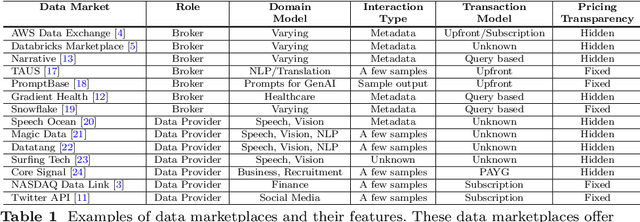
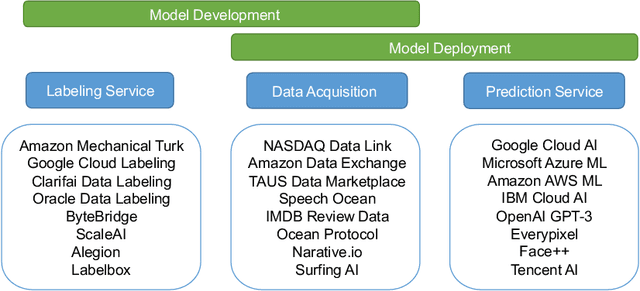

As Machine Learning (ML) systems continue to grow, the demand for relevant and comprehensive datasets becomes imperative. There is limited study on the challenges of data acquisition due to ad-hoc processes and lack of consistent methodologies. We first present an investigation of current data marketplaces, revealing lack of platforms offering detailed information about datasets, transparent pricing, standardized data formats. With the objective of inciting participation from the data-centric AI community, we then introduce the DAM challenge, a benchmark to model the interaction between the data providers and acquirers. The benchmark was released as a part of DataPerf. Our evaluation of the submitted strategies underlines the need for effective data acquisition strategies in ML.