 Add to Chrome
 Add to Firefox
 Add to Edge
Anthropogenic Regional Adaptation in Multimodal Vision-Language Model
Apr 13, 2026
While the field of vision-language (VL) has achieved remarkable success in integrating visual and textual information across multiple languages and domains, there is still no dedicated framework for assessing human-centric alignment in vision-language systems. We offer two contributions to address this gap. First, we introduce Anthropogenic Regional Adaptation: a novel paradigm that aims to optimize model relevance to specific regional contexts while ensuring the retention of global generalization capabilities. Second, we present a simple, but effective adaptation method named Geographical-generalization-made-easy (GG-EZ), which utilizes regional data filtering and model merging. Through comprehensive experiments on 3 VL architectures: large vision-language models, text-to-image diffusion models, and vision-language embedding models, and a case study in Southeast Asia (SEA) regional adaptation, we demonstrate the importance of Anthropogenic Regional Adaptation and the effectiveness of GG-EZ, showing 5-15% gains in cultural relevance metrics across SEA while maintaining over 98% of global performance and even occasionally surpassing it. Our findings establish Anthropogenic Regional Alignment as a foundational paradigm towards applicability of multimodal vision-language models in diverse regions and demonstrate a simple-yet-effective baseline method that optimizes regional value alignment while preserving global generalization.

PingPong: A Natural Benchmark for Multi-Turn Code-Switching Dialogues
Jan 24, 2026Code-switching is a widespread practice among the world's multilingual majority, yet few benchmarks accurately reflect its complexity in everyday communication. We present PingPong, a benchmark for natural multi-party code-switching dialogues covering five language-combination variations, some of which are trilingual. Our dataset consists of human-authored conversations among 2 to 4 participants covering authentic, multi-threaded structures where replies frequently reference much earlier points in the dialogue. We demonstrate that our data is significantly more natural and structurally diverse than machine-generated alternatives, offering greater variation in message length, speaker dominance, and reply distance. Based on these dialogues, we define three downstream tasks: Question Answering, Dialogue Summarization, and Topic Classification. Evaluations of several state-of-the-art language models on PingPong reveal that performance remains limited on code-switched inputs, underscoring the urgent need for more robust NLP systems capable of addressing the intricacies of real-world multilingual discourse.
Crowdsource, Crawl, or Generate? Creating SEA-VL, a Multicultural Vision-Language Dataset for Southeast Asia
Mar 10, 2025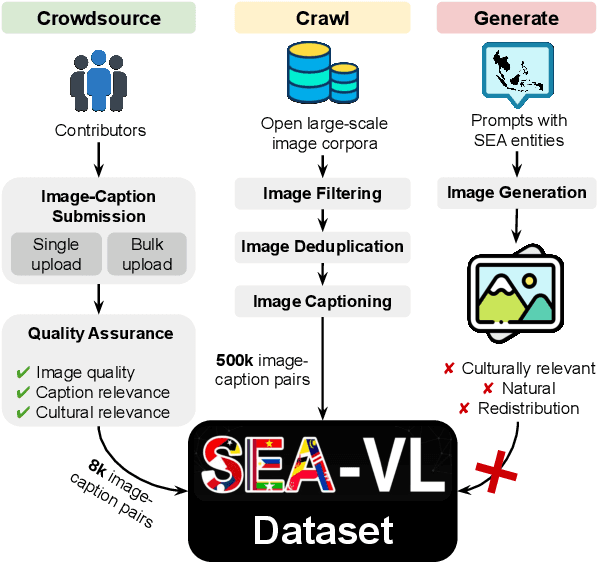
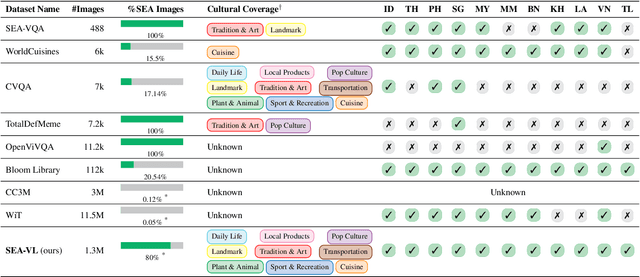
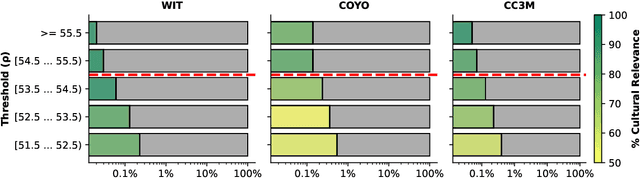
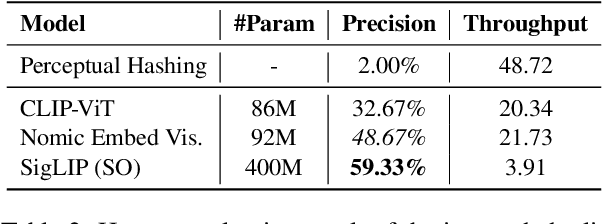
Southeast Asia (SEA) is a region of extraordinary linguistic and cultural diversity, yet it remains significantly underrepresented in vision-language (VL) research. This often results in artificial intelligence (AI) models that fail to capture SEA cultural nuances. To fill this gap, we present SEA-VL, an open-source initiative dedicated to developing high-quality, culturally relevant data for SEA languages. By involving contributors from SEA countries, SEA-VL aims to ensure better cultural relevance and diversity, fostering greater inclusivity of underrepresented languages in VL research. Beyond crowdsourcing, our initiative goes one step further in the exploration of the automatic collection of culturally relevant images through crawling and image generation. First, we find that image crawling achieves approximately ~85% cultural relevance while being more cost- and time-efficient than crowdsourcing. Second, despite the substantial progress in generative vision models, synthetic images remain unreliable in accurately reflecting SEA cultures. The generated images often fail to reflect the nuanced traditions and cultural contexts of the region. Collectively, we gather 1.28M SEA culturally-relevant images, more than 50 times larger than other existing datasets. Through SEA-VL, we aim to bridge the representation gap in SEA, fostering the development of more inclusive AI systems that authentically represent diverse cultures across SEA.
BRIGHTER: BRIdging the Gap in Human-Annotated Textual Emotion Recognition Datasets for 28 Languages
Feb 17, 2025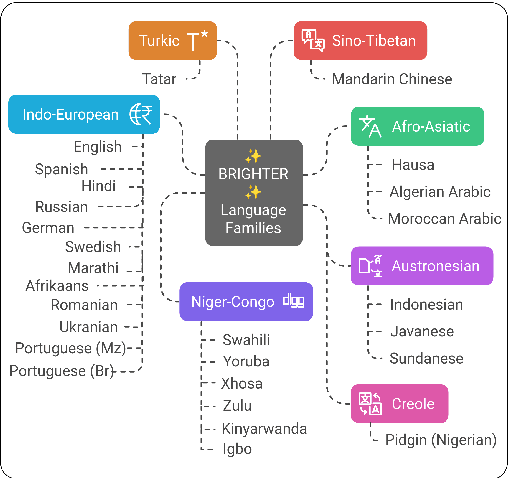
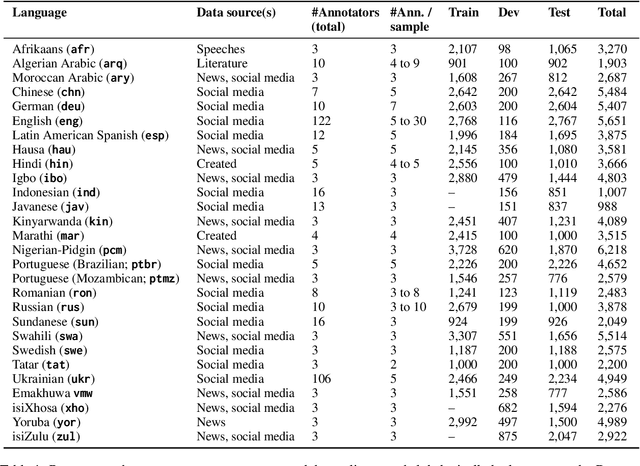
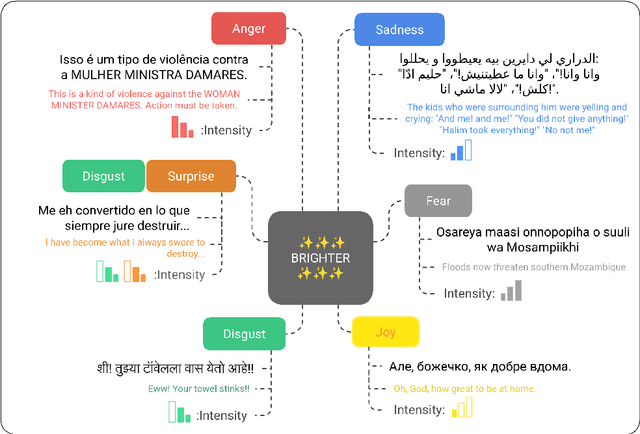
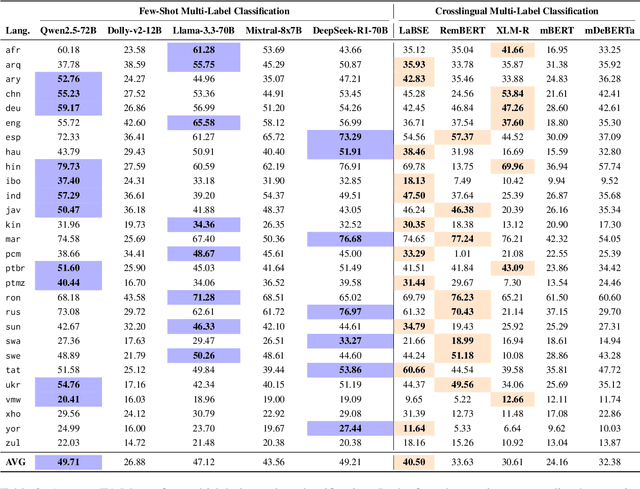
People worldwide use language in subtle and complex ways to express emotions. While emotion recognition -- an umbrella term for several NLP tasks -- significantly impacts different applications in NLP and other fields, most work in the area is focused on high-resource languages. Therefore, this has led to major disparities in research and proposed solutions, especially for low-resource languages that suffer from the lack of high-quality datasets. In this paper, we present BRIGHTER-- a collection of multilabeled emotion-annotated datasets in 28 different languages. BRIGHTER covers predominantly low-resource languages from Africa, Asia, Eastern Europe, and Latin America, with instances from various domains annotated by fluent speakers. We describe the data collection and annotation processes and the challenges of building these datasets. Then, we report different experimental results for monolingual and crosslingual multi-label emotion identification, as well as intensity-level emotion recognition. We investigate results with and without using LLMs and analyse the large variability in performance across languages and text domains. We show that BRIGHTER datasets are a step towards bridging the gap in text-based emotion recognition and discuss their impact and utility.