 Add to Chrome
 Add to Firefox
 Add to Edge
Cross-lingual robustness of LLM-brain alignment and its computational roots
May 20, 2026
Large language models (LLMs) reliably predict neural activity during language comprehension and transformer depth has been interpreted as mirroring hierarchical cortical organization. However, it remains unclear whether such alignment extends to subcortical regions, overlaps spatially across languages, and what the computational roots of such alignment are. Here, we used a multilingual, whole-brain encoding framework to examine brain-LLM alignment across three typologically distinct languages: Mandarin, English, and French during naturalistic story listening. Our results show that across languages, transformer-based models predicted activity in a distributed landscape spanning widely distributed cortical functional networks like limbic, ventral attention, default mode network, and subcortical structures. Spatial alignment patterns showed substantial cross-linguistic overlap and remained largely stable across model layers, with limited layer progression consistent with functional cortical hierarchies. Contrary to previous evidence, contextual embeddings did not outperform static embeddings. To test candidate computational explanations, we examined whether layer-wise brain scores reflect surprisal and intrinsic dimensionality, and thereby predictive processing and information compression. Neither of these two computational metrics mirrored neural alignment profiles. Our findings suggest that brain-LLM alignment is spatially robust and cross-linguistically stable but not explainable from predictive uncertainty or representational geometry. Rather than directly reflecting shared hierarchical computation, neural predictivity may primarily arise from distributed lexical-semantic correspondences that generalize across languages.

When Models Judge Themselves: Unsupervised Self-Evolution for Multimodal Reasoning
Mar 22, 2026Recent progress in multimodal large language models has led to strong performance on reasoning tasks, but these improvements largely rely on high-quality annotated data or teacher-model distillation, both of which are costly and difficult to scale.To address this, we propose an unsupervised self-evolution training framework for multimodal reasoning that achieves stable performance improvements without using human-annotated answers or external reward models. For each input, we sample multiple reasoning trajectories and jointly model their within group structure.We use the Actor's self-consistency signal as a training prior, and introduce a bounded Judge based modulation to continuously reweight trajectories of different quality.We further model the modulated scores as a group level distribution and convert absolute scores into relative advantages within each group, enabling more robust policy updates. Trained with Group Relative Policy Optimization (GRPO) on unlabeled data, our method consistently improves reasoning performance and generalization on five mathematical reasoning benchmarks, offering a scalable path toward self-evolving multimodal models.The code are available at https://dingwu1021.github.io/SelfJudge/.
Coherence in the brain unfolds across separable temporal regimes
Dec 24, 2025Coherence in language requires the brain to satisfy two competing temporal demands: gradual accumulation of meaning across extended context and rapid reconfiguration of representations at event boundaries. Despite their centrality to language and thought, how these processes are implemented in the human brain during naturalistic listening remains unclear. Here, we tested whether these two processes can be captured by annotation-free drift and shift signals and whether their neural expression dissociates across large-scale cortical systems. These signals were derived from a large language model (LLM) and formalized contextual drift and event shifts directly from the narrative input. To enable high-precision voxelwise encoding models with stable parameter estimates, we densely sampled one healthy adult across more than 7 hours of listening to thirteen crime stories while collecting ultra high-field (7T) BOLD data. We then modeled the feature-informed hemodynamic response using a regularized encoding framework validated on independent stories. Drift predictions were prevalent in default-mode network hubs, whereas shift predictions were evident bilaterally in the primary auditory cortex and language association cortex. Furthermore, activity in default-mode and parietal networks was best explained by a signal capturing how meaning accumulates and gradually fades over the course of the narrative. Together, these findings show that coherence during language comprehension is implemented through dissociable neural regimes of slow contextual integration and rapid event-driven reconfiguration, offering a mechanistic entry point for understanding disturbances of language coherence in psychiatric disorders.
Review-Instruct: A Review-Driven Multi-Turn Conversations Generation Method for Large Language Models
May 16, 2025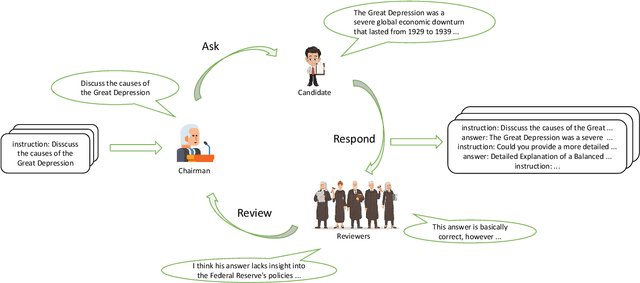
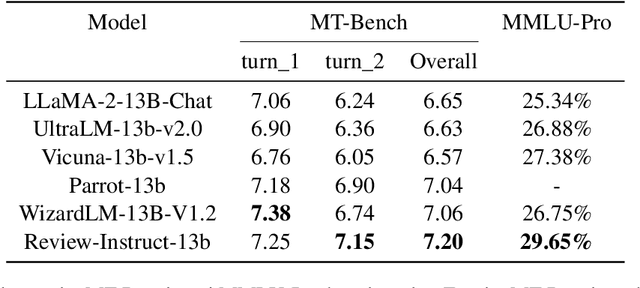
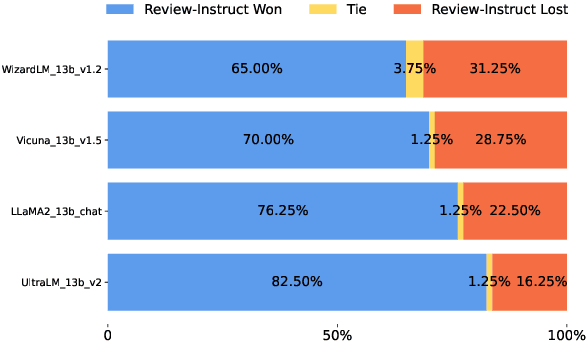
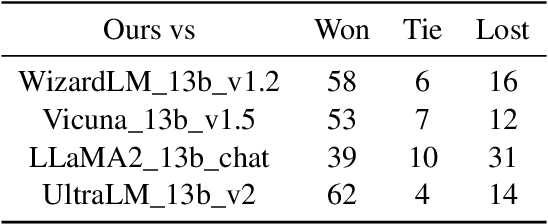
The effectiveness of large language models (LLMs) in conversational AI is hindered by their reliance on single-turn supervised fine-tuning (SFT) data, which limits contextual coherence in multi-turn dialogues. Existing methods for generating multi-turn dialogue data struggle to ensure both diversity and quality in instructions. To address this, we propose Review-Instruct, a novel framework that synthesizes multi-turn conversations through an iterative "Ask-Respond-Review" process involving three agent roles: a Candidate, multiple Reviewers, and a Chairman. The framework iteratively refines instructions by incorporating Reviewer feedback, enhancing dialogue diversity and difficulty. We construct a multi-turn dataset using the Alpaca dataset and fine-tune the LLaMA2-13B model. Evaluations on MT-Bench, MMLU-Pro, and Auto-Arena demonstrate significant improvements, achieving absolute gains of 2.9\% on MMLU-Pro and 2\% on MT-Bench compared to prior state-of-the-art models based on LLaMA2-13B. Ablation studies confirm the critical role of the Review stage and the use of multiple Reviewers in boosting instruction diversity and difficulty. Our work highlights the potential of review-driven, multi-agent frameworks for generating high-quality conversational data at scale.