 Add to Chrome
 Add to Firefox
 Add to Edge
UniGen-AR: Unifying Visual Generation with Auto-Regressive Modeling
Jul 27, 2026
Modern computer vision pipelines remain fragmented, with tasks such as text-to-image generation, editing, restoration, and classical perception handled by separate models. We study Unified Visual Generation (UVG), where a single model produces diverse image-valued outputs through a unified multimodal interface. While diffusion-based systems dominate UVG due to strong quality and controllability, their iterative sampling incurs substantial inference latency, limiting practical deployment. To address these limitations, we propose UniGen-AR, a framework that pairs a general-purpose multi-modal language model (MLLM) with an efficient next-scale visual auto-regressive (VAR) decoder. This design retains the flexibility of MLLM-based conditioning while leveraging the sampling efficiency and latent unification properties of VAR models. In our framework, the MLLM encodes free-form instructions and control signals into a unified sequence, which guides the VAR decoder to generate image-valued outputs for over 15 tasks spanning four families. Empirically, UniGen-AR achieves up to $19 \times$ lower inference latency than diffusion-based baselines while maintaining or improving output quality. Our ablations further reveal that VQ-VAE tokenizer design, particularly codebook size and hierarchy, is a critical factor for VAR scalability in UVG. These results establish visual auto-regressive modeling as a compelling and efficient backbone for unified visual generation. Our project page is at https://zpbao.github.io/projects/unigenar.

DinoLink: A Token-Centric Representation Compression Framework for Bandwidth-Constrained Collaborative V2X Perception
Jun 24, 2026High-precision remote perception is often hindered by the severe bandwidth constraints of Vehicle-to-Everything (V2X) networks. We propose \textit{DinoLink}, a token-centric compression framework that replaces raw pixel streaming with discrete semantic communication for vehicle-cloud collaborative inference. DinoLink employs a dual-sparsity architecture: a saliency-aware selector prunes redundant background tokens, while a Residual Vector Quantization (RVQ) module collapses features into compact codebook indices. By transmitting only lightweight indices and positional priors, DinoLink achieves a $139\times$ bitrate reduction compared to uncompressed transmission while maintaining a competitive 32.8\% mAP on the nuScenes dataset. Deployment simulations further demonstrate a $34.5\times$ acceleration in narrow-band environments, such as LoRa. Our results substantiate DinoLink as a robust, bandwidth-efficient frontend for high-fidelity remote perception in constrained V2X scenarios. The code is publicly available at https://github.com/UGA-MOBILITY-LAB/dino_link.
CABLE: Cloud-Assisted Bandwidth-efficient LMM-based Encoding for V2X Systems
Jun 17, 2026Cloud-hosted large multimodal models (LMMs) can provide strong open-vocabulary perception for Vehicle-to-Everything systems, but naively transmitting full-resolution frames from edge to cloud causes severe communication overhead and high cloud-side prefill latency. We present CABLE, a cloud-assisted bandwidth-efficient LMM-based encoding framework for edge-cloud perception. CABLE propagates the previous cloud segmentation mask on the edge using ego-motion compensation, refines it with residual-motion cues, and consolidates disconnected regions via a corridor envelope to form a robust region of interest (ROI). Only ROI-masked images are uploaded, while the cloud segmentation output is fed back as the prior for the next frame, forming a mask-to-ROI-to-LMM feedback loop. Experiments on five datasets (nuScenes, WOD-ZB, Waymo, KITTI, and CADC) show consistent communication savings while largely preserving perception, achieving $73$--$87\%$ ROI pixel-coverage reduction with $5$--$8\times$ estimated LMM prefill speedup at a modest detection-quality trade-off relative to full-frame inference.
BlazeEdit: Generalist Image Editing on Mobile Devices with Image-to-Image Diffusion Models
May 27, 2026The remarkable generation quality of modern diffusion models often comes at the cost of massive parameter counts, which necessitate server-side inference with significant computational costs and potential privacy risks. Consequently, there is growing momentum toward developing efficient on-device alternatives. While recent efforts have optimized text-to-image models for mobile hardware, they remain relatively bulky, typically ranging from 0.5B to 1B parameters. We present BlazeEdit, a highly efficient, generalist image-to-image diffusion model tailored for on-device deployment. By identifying that many practical image editing tasks do not require text-based guidance, we eliminate the text-conditioning components and develop a multi-task architecture that consolidates object removal, outpainting, tone correction, relighting, and sticker generation into a single, compact model of only 195M parameters. BlazeEdit achieves a substantial reduction in download size and memory overhead while maintaining competitive generation quality. It completes a full inference pass in just 290ms on a Pixel 10, delivering a seamless, privacy-preserving, and lightning-fast experience for generalist image editing on the edge.
Walk through Paintings: Egocentric World Models from Internet Priors
Jan 21, 2026What if a video generation model could not only imagine a plausible future, but the correct one, accurately reflecting how the world changes with each action? We address this question by presenting the Egocentric World Model (EgoWM), a simple, architecture-agnostic method that transforms any pretrained video diffusion model into an action-conditioned world model, enabling controllable future prediction. Rather than training from scratch, we repurpose the rich world priors of Internet-scale video models and inject motor commands through lightweight conditioning layers. This allows the model to follow actions faithfully while preserving realism and strong generalization. Our approach scales naturally across embodiments and action spaces, ranging from 3-DoF mobile robots to 25-DoF humanoids, where predicting egocentric joint-angle-driven dynamics is substantially more challenging. The model produces coherent rollouts for both navigation and manipulation tasks, requiring only modest fine-tuning. To evaluate physical correctness independently of visual appearance, we introduce the Structural Consistency Score (SCS), which measures whether stable scene elements evolve consistently with the provided actions. EgoWM improves SCS by up to 80 percent over prior state-of-the-art navigation world models, while achieving up to six times lower inference latency and robust generalization to unseen environments, including navigation inside paintings.
Large Language Model-assisted Autonomous Vehicle Recovery from Immobilization
Oct 29, 2025Despite significant advancements in recent decades, autonomous vehicles (AVs) continue to face challenges in navigating certain traffic scenarios where human drivers excel. In such situations, AVs often become immobilized, disrupting overall traffic flow. Current recovery solutions, such as remote intervention (which is costly and inefficient) and manual takeover (which excludes non-drivers and limits AV accessibility), are inadequate. This paper introduces StuckSolver, a novel Large Language Model (LLM) driven recovery framework that enables AVs to resolve immobilization scenarios through self-reasoning and/or passenger-guided decision-making. StuckSolver is designed as a plug-in add-on module that operates on top of the AV's existing perception-planning-control stack, requiring no modification to its internal architecture. Instead, it interfaces with standard sensor data streams to detect immobilization states, interpret environmental context, and generate high-level recovery commands that can be executed by the AV's native planner. We evaluate StuckSolver on the Bench2Drive benchmark and in custom-designed uncertainty scenarios. Results show that StuckSolver achieves near-state-of-the-art performance through autonomous self-reasoning alone and exhibits further improvements when passenger guidance is incorporated.
Your Ride, Your Rules: Psychology and Cognition Enabled Automated Driving Systems
Jun 13, 2025Despite rapid advances in autonomous driving, current autonomous vehicles (AVs) lack effective bidirectional communication with occupants, limiting personalization and recovery from immobilization. This reduces comfort and trust, potentially slowing broader AV adoption. We propose PACE-ADS (Psychology and Cognition Enabled Automated Driving Systems), a human-centered autonomy framework that enables AVs to sense, interpret, and respond to both external traffic and internal occupant states. PACE-ADS comprises three foundation model-based agents: a Driver Agent that analyzes the driving context, a Psychologist Agent that interprets occupant psychological signals (e.g., EEG, heart rate, facial expressions) and cognitive commands (e.g., speech), and a Coordinator Agent that integrates these inputs to produce high-level behavior decisions and operational parameters. Rather than replacing existing AV modules, PACE-ADS complements them by operating at the behavioral level, delegating low-level control to native AV systems. This separation enables closed-loop adaptation and supports integration across diverse platforms. We evaluate PACE-ADS in simulation across varied scenarios involving traffic lights, pedestrians, work zones, and car following. Results show that PACE-ADS adapts driving styles to occupant states, improves ride comfort, and enables safe recovery from immobilization via autonomous reasoning or human guidance. Our findings highlight the promise of LLM-based frameworks for bridging the gap between machine autonomy and human-centered driving.
Diff-2-in-1: Bridging Generation and Dense Perception with Diffusion Models
Nov 07, 2024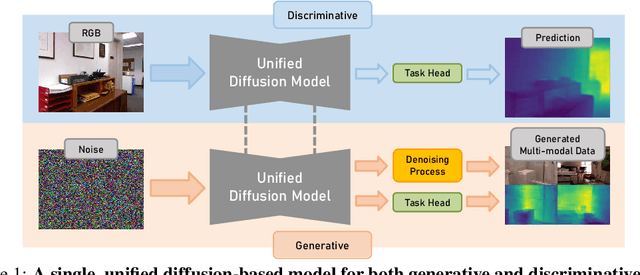
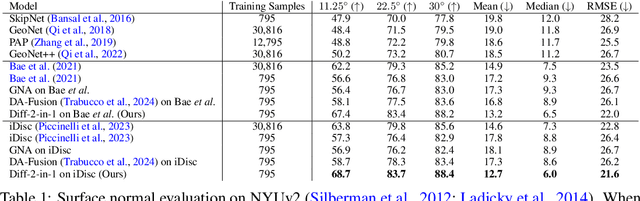
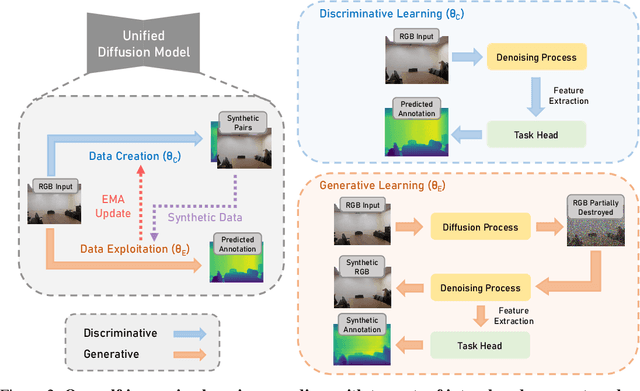
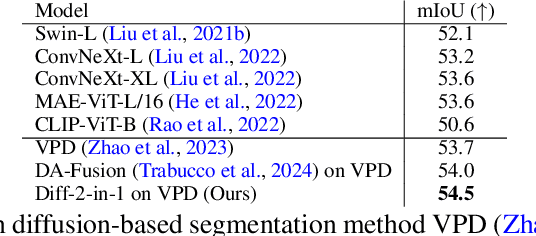
Beyond high-fidelity image synthesis, diffusion models have recently exhibited promising results in dense visual perception tasks. However, most existing work treats diffusion models as a standalone component for perception tasks, employing them either solely for off-the-shelf data augmentation or as mere feature extractors. In contrast to these isolated and thus sub-optimal efforts, we introduce a unified, versatile, diffusion-based framework, Diff-2-in-1, that can simultaneously handle both multi-modal data generation and dense visual perception, through a unique exploitation of the diffusion-denoising process. Within this framework, we further enhance discriminative visual perception via multi-modal generation, by utilizing the denoising network to create multi-modal data that mirror the distribution of the original training set. Importantly, Diff-2-in-1 optimizes the utilization of the created diverse and faithful data by leveraging a novel self-improving learning mechanism. Comprehensive experimental evaluations validate the effectiveness of our framework, showcasing consistent performance improvements across various discriminative backbones and high-quality multi-modal data generation characterized by both realism and usefulness.
ReferEverything: Towards Segmenting Everything We Can Speak of in Videos
Oct 30, 2024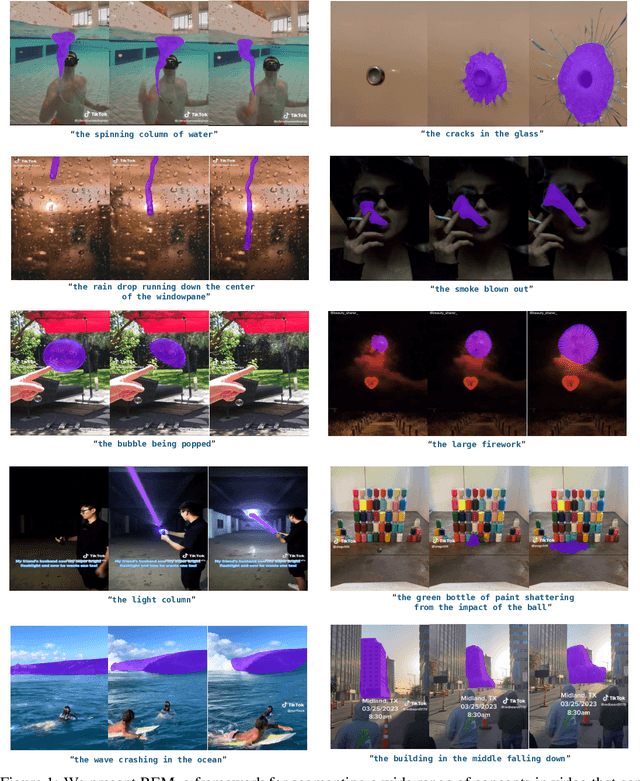


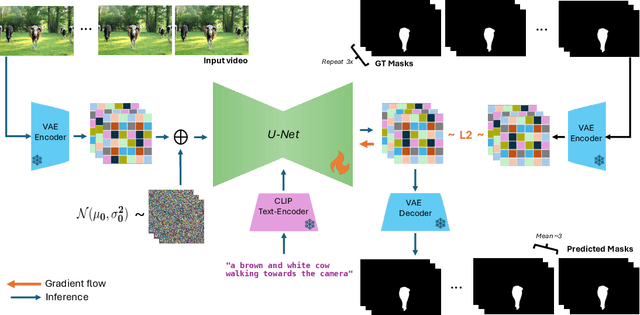
We present REM, a framework for segmenting a wide range of concepts in video that can be described through natural language. Our method capitalizes on visual-language representations learned by video diffusion models on Internet-scale datasets. A key insight of our approach is preserving as much of the generative model's original representation as possible, while fine-tuning it on narrow-domain Referral Object Segmentation datasets. As a result, our framework can accurately segment and track rare and unseen objects, despite being trained on object masks from a limited set of categories. Additionally, it can generalize to non-object dynamic concepts, such as waves crashing in the ocean, as demonstrated in our newly introduced benchmark for Referral Video Process Segmentation (Ref-VPS). Our experiments show that REM performs on par with state-of-the-art approaches on in-domain datasets, like Ref-DAVIS, while outperforming them by up to twelve points in terms of region similarity on out-of-domain data, leveraging the power of Internet-scale pre-training.
Lexicon3D: Probing Visual Foundation Models for Complex 3D Scene Understanding
Sep 05, 2024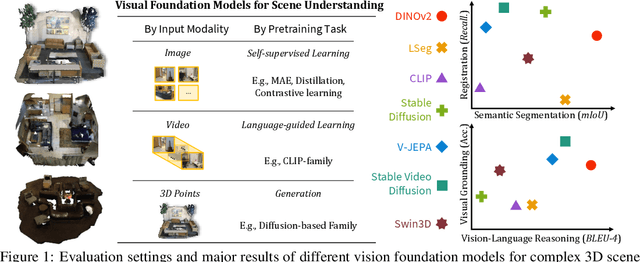
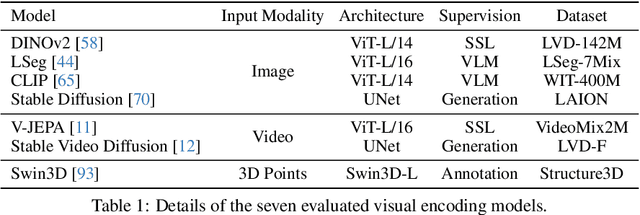
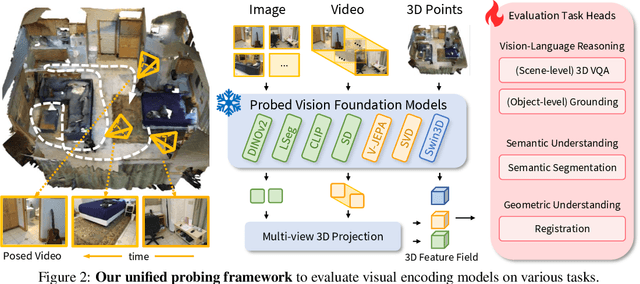
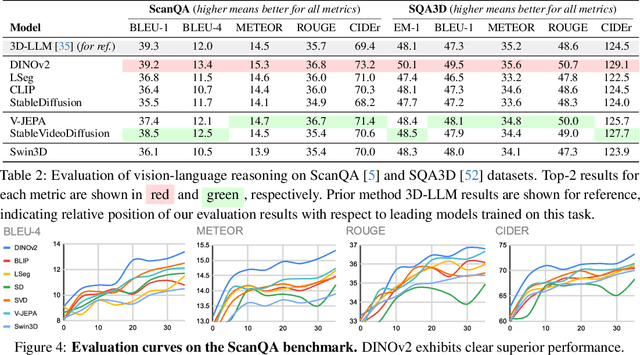
Complex 3D scene understanding has gained increasing attention, with scene encoding strategies playing a crucial role in this success. However, the optimal scene encoding strategies for various scenarios remain unclear, particularly compared to their image-based counterparts. To address this issue, we present a comprehensive study that probes various visual encoding models for 3D scene understanding, identifying the strengths and limitations of each model across different scenarios. Our evaluation spans seven vision foundation encoders, including image-based, video-based, and 3D foundation models. We evaluate these models in four tasks: Vision-Language Scene Reasoning, Visual Grounding, Segmentation, and Registration, each focusing on different aspects of scene understanding. Our evaluations yield key findings: DINOv2 demonstrates superior performance, video models excel in object-level tasks, diffusion models benefit geometric tasks, and language-pretrained models show unexpected limitations in language-related tasks. These insights challenge some conventional understandings, provide novel perspectives on leveraging visual foundation models, and highlight the need for more flexible encoder selection in future vision-language and scene-understanding tasks.