 Add to Chrome
 Add to Firefox
 Add to Edge
Sparse Evidence Can Suffice: Agentic Evidence Seeking for Multimodal Video Misinformation Detection
Jul 20, 2026
Multimodal video misinformation detection is commonly formulated as a holistic video-understanding task, where the entire video and its associated content are processed and judged in a single pass. However, real-world misinformation often exhibits a sparse and compositional evidence structure: a reliable decision may depend on only a few coupled clues, while most video content contributes limited additional information. Exhaustive multimodal reasoning may therefore introduce substantial redundancy and obscure decisive evidence. This motivates decoupling evidence acquisition from verification: first identifying sparse, decision-relevant clues and then judging veracity based on the acquired evidence. Accordingly, we propose SIEVE, a framework for Sparse Interactive Evidence Verification via Extraction in multimodal video misinformation detection. An evidence-seeking agent actively explores the available multimodal evidence and constructs a compact evidence package, which is then used by a verifier to determine veracity. The agent is trained with supervised evidence-seeking trajectories and an evidence-aware reinforcement learning objective that promotes informative evidence acquisition while discouraging unnecessary or invalid interactions. Experiments on multiple video misinformation benchmarks show that SIEVE consistently outperforms the evaluated baselines and supports reliable verification using compact evidence packages. Moreover, the resulting acquisition process provides an explicit and inspectable evidence trail, improving the transparency and groundedness of multimodal misinformation detection.

3D Brainformer: 3D Fusion Transformer for Brain Tumor Segmentation
Apr 28, 2023

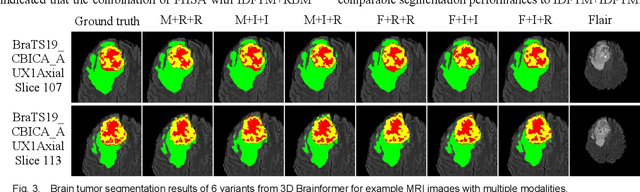
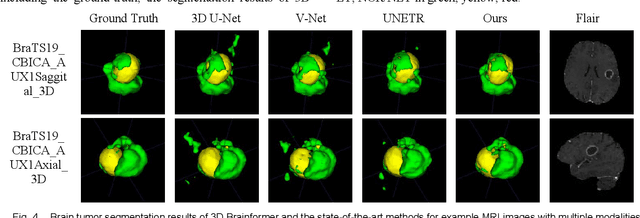
Magnetic resonance imaging (MRI) is critically important for brain mapping in both scientific research and clinical studies. Precise segmentation of brain tumors facilitates clinical diagnosis, evaluations, and surgical planning. Deep learning has recently emerged to improve brain tumor segmentation and achieved impressive results. Convolutional architectures are widely used to implement those neural networks. By the nature of limited receptive fields, however, those architectures are subject to representing long-range spatial dependencies of the voxel intensities in MRI images. Transformers have been leveraged recently to address the above limitations of convolutional networks. Unfortunately, the majority of current Transformers-based methods in segmentation are performed with 2D MRI slices, instead of 3D volumes. Moreover, it is difficult to incorporate the structures between layers because each head is calculated independently in the Multi-Head Self-Attention mechanism (MHSA). In this work, we proposed a 3D Transformer-based segmentation approach. We developed a Fusion-Head Self-Attention mechanism (FHSA) to combine each attention head through attention logic and weight mapping, for the exploration of the long-range spatial dependencies in 3D MRI images. We implemented a plug-and-play self-attention module, named the Infinite Deformable Fusion Transformer Module (IDFTM), to extract features on any deformable feature maps. We applied our approach to the task of brain tumor segmentation, and assessed it on the public BRATS datasets. The experimental results demonstrated that our proposed approach achieved superior performance, in comparison to several state-of-the-art segmentation methods.