 Add to Chrome
 Add to Firefox
 Add to Edge
DANCE: Dynamic, Available, Neighbor-gated Condensation for Federated Text-Attributed Graphs
Jan 23, 2026
Federated graph learning (FGL) enables collaborative training on graph data across multiple clients. With the rise of large language models (LLMs), textual attributes in FGL graphs are gaining attention. Text-attributed graph federated learning (TAG-FGL) improves FGL by explicitly leveraging LLMs to process and integrate these textual features. However, current TAG-FGL methods face three main challenges: \textbf{(1) Overhead.} LLMs for processing long texts incur high token and computation costs. To make TAG-FGL practical, we introduce graph condensation (GC) to reduce computation load, but this choice also brings new issues. \textbf{(2) Suboptimal.} To reduce LLM overhead, we introduce GC into TAG-FGL by compressing multi-hop texts/neighborhoods into a condensed core with fixed LLM surrogates. However, this one-shot condensation is often not client-adaptive, leading to suboptimal performance. \textbf{(3) Interpretability.} LLM-based condensation further introduces a black-box bottleneck: summaries lack faithful attribution and clear grounding to specific source spans, making local inspection and auditing difficult. To address the above issues, we propose \textbf{DANCE}, a new TAG-FGL paradigm with GC. To improve \textbf{suboptimal} performance, DANCE performs round-wise, model-in-the-loop condensation refresh using the latest global model. To enhance \textbf{interpretability}, DANCE preserves provenance by storing locally inspectable evidence packs that trace predictions to selected neighbors and source text spans. Across 8 TAG datasets, DANCE improves accuracy by \textbf{2.33\%} at an \textbf{8\%} condensation ratio, with \textbf{33.42\%} fewer tokens than baselines.

BoostFGL: Boosting Fairness in Federated Graph Learning
Jan 23, 2026Federated graph learning (FGL) enables collaborative training of graph neural networks (GNNs) across decentralized subgraphs without exposing raw data. While existing FGL methods often achieve high overall accuracy, we show that this average performance can conceal severe degradation on disadvantaged node groups. From a fairness perspective, these disparities arise systematically from three coupled sources: label skew toward majority patterns, topology confounding in message propagation, and aggregation dilution of updates from hard clients. To address this, we propose \textbf{BoostFGL}, a boosting-style framework for fairness-aware FGL. BoostFGL introduces three coordinated mechanisms: \ding{182} \emph{Client-side node boosting}, which reshapes local training signals to emphasize systematically under-served nodes; \ding{183} \emph{Client-side topology boosting}, which reallocates propagation emphasis toward reliable yet underused structures and attenuates misleading neighborhoods; and \ding{184} \emph{Server-side model boosting}, which performs difficulty- and reliability-aware aggregation to preserve informative updates from hard clients while stabilizing the global model. Extensive experiments on 9 datasets show that BoostFGL delivers substantial fairness gains, improving Overall-F1 by 8.43\%, while preserving competitive overall performance against strong FGL baselines.
Theoretically and Practically Efficient Resistance Distance Computation on Large Graphs
Jan 16, 2026The computation of resistance distance is pivotal in a wide range of graph analysis applications, including graph clustering, link prediction, and graph neural networks. Despite its foundational importance, efficient algorithms for computing resistance distances on large graphs are still lacking. Existing state-of-the-art (SOTA) methods, including power iteration-based algorithms and random walk-based local approaches, often struggle with slow convergence rates, particularly when the condition number of the graph Laplacian matrix, denoted by $κ$, is large. To tackle this challenge, we propose two novel and efficient algorithms inspired by the classic Lanczos method: Lanczos Iteration and Lanczos Push, both designed to reduce dependence on $κ$. Among them, Lanczos Iteration is a near-linear time global algorithm, whereas Lanczos Push is a local algorithm with a time complexity independent of the size of the graph. More specifically, we prove that the time complexity of Lanczos Iteration is $\tilde{O}(\sqrtκ m)$ ($m$ is the number of edges of the graph and $\tilde{O}$ means the complexity omitting the $\log$ terms) which achieves a speedup of $\sqrtκ$ compared to previous power iteration-based global methods. For Lanczos Push, we demonstrate that its time complexity is $\tilde{O}(κ^{2.75})$ under certain mild and frequently established assumptions, which represents a significant improvement of $κ^{0.25}$ over the SOTA random walk-based local algorithms. We validate our algorithms through extensive experiments on eight real-world datasets of varying sizes and statistical properties, demonstrating that Lanczos Iteration and Lanczos Push significantly outperform SOTA methods in terms of both efficiency and accuracy.
FedBook: A Unified Federated Graph Foundation Codebook with Intra-domain and Inter-domain Knowledge Modeling
Oct 09, 2025Foundation models have shown remarkable cross-domain generalization in language and vision, inspiring the development of graph foundation models (GFMs). However, existing GFMs typically assume centralized access to multi-domain graphs, which is often infeasible due to privacy and institutional constraints. Federated Graph Foundation Models (FedGFMs) address this limitation, but their effectiveness fundamentally hinges on constructing a robust global codebook that achieves intra-domain coherence by consolidating mutually reinforcing semantics within each domain, while also maintaining inter-domain diversity by retaining heterogeneous knowledge across domains. To this end, we propose FedBook, a unified federated graph foundation codebook that systematically aggregates clients' local codebooks during server-side federated pre-training. FedBook follows a two-phase process: (1) Intra-domain Collaboration, where low-frequency tokens are refined by referencing more semantically reliable high-frequency tokens across clients to enhance domain-specific coherence; and (2) Inter-domain Integration, where client contributions are weighted by the semantic distinctiveness of their codebooks during the aggregation of the global GFM, thereby preserving cross-domain diversity. Extensive experiments on 8 benchmarks across multiple domains and tasks demonstrate that FedBook consistently outperforms 21 baselines, including isolated supervised learning, FL/FGL, federated adaptations of centralized GFMs, and FedGFM techniques.
Two Sides of the Same Optimization Coin: Model Degradation and Representation Collapse in Graph Foundation Models
Sep 11, 2025Graph foundation models, inspired by the success of LLMs, are designed to learn the optimal embedding from multi-domain TAGs for the downstream cross-task generalization capability. During our investigation, graph VQ-MAE stands out among the increasingly diverse landscape of GFM architectures. This is attributed to its ability to jointly encode topology and textual attributes from multiple domains into discrete embedding spaces with clear semantic boundaries. Despite its potential, domain generalization conflicts cause imperceptible pitfalls. In this paper, we instantiate two of them, and they are just like two sides of the same GFM optimization coin - Side 1 Model Degradation: The encoder and codebook fail to capture the diversity of inputs; Side 2 Representation Collapse: The hidden embedding and codebook vector fail to preserve semantic separability due to constraints from narrow representation subspaces. These two pitfalls (sides) collectively impair the decoder and generate the low-quality reconstructed supervision, causing the GFM optimization dilemma during pre-training (coin). Through empirical investigation, we attribute the above challenges to Information Bottleneck and Regularization Deficit. To address them, we propose MoT (Mixture-of-Tinkers) - (1) Information Tinker for Two Pitfalls, which utilizes an edge-wise semantic fusion strategy and a mixture-of-codebooks with domain-aware routing to improve information capacity. (2) Regularization Tinker for Optimization Coin, which utilizes two additional regularizations to further improve gradient supervision in our proposed Information Tinker. Notably, as a flexible architecture, MoT adheres to the scaling laws of GFM, offering a controllable model scale. Compared to SOTA baselines, experiments on 22 datasets across 6 domains demonstrate that MoT achieves significant improvements in supervised, few-shot, and zero-shot scenarios.
Efficient Exact Resistance Distance Computation on Small-Treewidth Graphs: a Labelling Approach
Sep 05, 2025Resistance distance computation is a fundamental problem in graph analysis, yet existing random walk-based methods are limited to approximate solutions and suffer from poor efficiency on small-treewidth graphs (e.g., road networks). In contrast, shortest-path distance computation achieves remarkable efficiency on such graphs by leveraging cut properties and tree decompositions. Motivated by this disparity, we first analyze the cut property of resistance distance. While a direct generalization proves impractical due to costly matrix operations, we overcome this limitation by integrating tree decompositions, revealing that the resistance distance $r(s,t)$ depends only on labels along the paths from $s$ and $t$ to the root of the decomposition. This insight enables compact labelling structures. Based on this, we propose \treeindex, a novel index method that constructs a resistance distance labelling of size $O(n \cdot h_{\mathcal{G}})$ in $O(n \cdot h_{\mathcal{G}}^2 \cdot d_{\max})$ time, where $h_{\mathcal{G}}$ (tree height) and $d_{\max}$ (maximum degree) behave as small constants in many real-world small-treewidth graphs (e.g., road networks). Our labelling supports exact single-pair queries in $O(h_{\mathcal{G}})$ time and single-source queries in $O(n \cdot h_{\mathcal{G}})$ time. Extensive experiments show that TreeIndex substantially outperforms state-of-the-art approaches. For instance, on the full USA road network, it constructs a $405$ GB labelling in $7$ hours (single-threaded) and answers exact single-pair queries in $10^{-3}$ seconds and single-source queries in $190$ seconds--the first exact method scalable to such large graphs.
Graph-Based Feature Augmentation for Predictive Tasks on Relational Datasets
Aug 28, 2025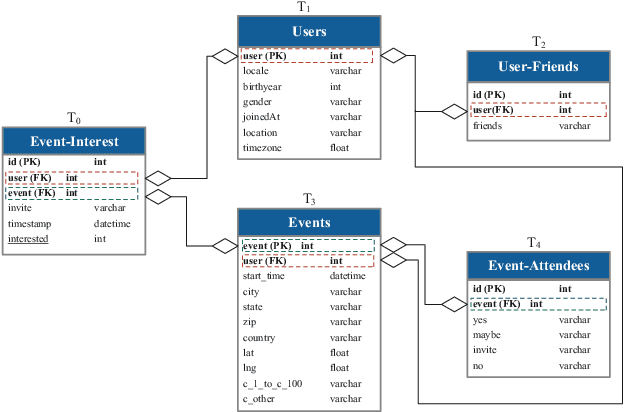
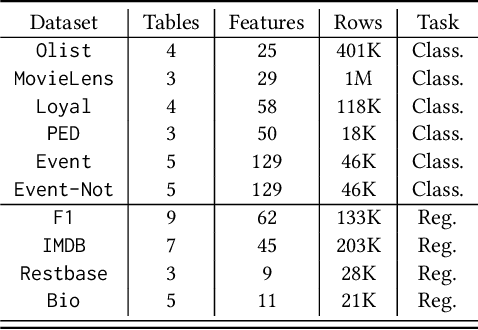
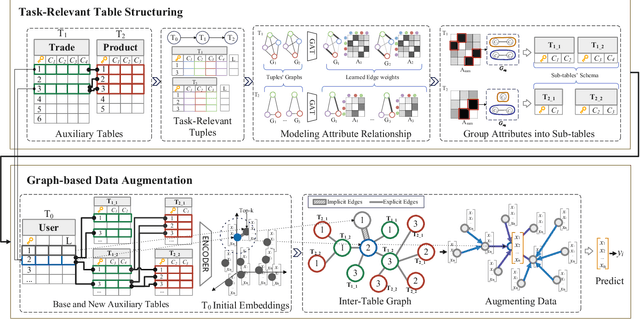
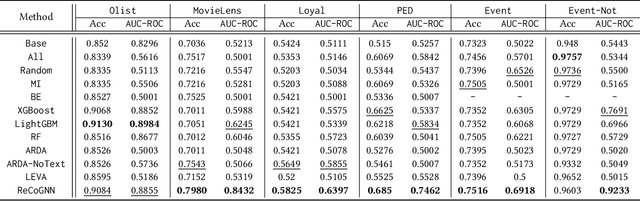
Data has become a foundational asset driving innovation across domains such as finance, healthcare, and e-commerce. In these areas, predictive modeling over relational tables is commonly employed, with increasing emphasis on reducing manual effort through automated machine learning (AutoML) techniques. This raises an interesting question: can feature augmentation itself be automated and identify and utilize task-related relational signals? To address this challenge, we propose an end-to-end automated feature augmentation framework, ReCoGNN, which enhances initial datasets using features extracted from multiple relational tables to support predictive tasks. ReCoGNN first captures semantic dependencies within each table by modeling intra-table attribute relationships, enabling it to partition tables into structured, semantically coherent segments. It then constructs a heterogeneous weighted graph that represents inter-row relationships across all segments. Finally, ReCoGNN leverages message-passing graph neural networks to propagate information through the graph, guiding feature selection and augmenting the original dataset. Extensive experiments conducted on ten real-life and synthetic datasets demonstrate that ReCoGNN consistently outperforms existing methods on both classification and regression tasks.
HIAL: A New Paradigm for Hypergraph Active Learning via Influence Maximization
Jul 28, 2025In recent years, Hypergraph Neural Networks (HNNs) have demonstrated immense potential in handling complex systems with high-order interactions. However, acquiring large-scale, high-quality labeled data for these models is costly, making Active Learning (AL) a critical technique. Existing Graph Active Learning (GAL) methods, when applied to hypergraphs, often rely on techniques like "clique expansion," which destroys the high-order structural information crucial to a hypergraph's success, thereby leading to suboptimal performance. To address this challenge, we introduce HIAL (Hypergraph Active Learning), a native active learning framework designed specifically for hypergraphs. We innovatively reformulate the Hypergraph Active Learning (HAL) problem as an Influence Maximization task. The core of HIAL is a dual-perspective influence function that, based on our novel "High-Order Interaction-Aware (HOI-Aware)" propagation mechanism, synergistically evaluates a node's feature-space coverage (via Magnitude of Influence, MoI) and its topological influence (via Expected Diffusion Value, EDV). We prove that this objective function is monotone and submodular, thus enabling the use of an efficient greedy algorithm with a formal (1-1/e) approximation guarantee. Extensive experiments on seven public datasets demonstrate that HIAL significantly outperforms state-of-the-art baselines in terms of performance, efficiency, generality, and robustness, establishing an efficient and powerful new paradigm for active learning on hypergraphs.
A Comprehensive Data-centric Overview of Federated Graph Learning
Jul 22, 2025In the era of big data applications, Federated Graph Learning (FGL) has emerged as a prominent solution that reconcile the tradeoff between optimizing the collective intelligence between decentralized datasets holders and preserving sensitive information to maximum. Existing FGL surveys have contributed meaningfully but largely focus on integrating Federated Learning (FL) and Graph Machine Learning (GML), resulting in early stage taxonomies that emphasis on methodology and simulated scenarios. Notably, a data centric perspective, which systematically examines FGL methods through the lens of data properties and usage, remains unadapted to reorganize FGL research, yet it is critical to assess how FGL studies manage to tackle data centric constraints to enhance model performances. This survey propose a two-level data centric taxonomy: Data Characteristics, which categorizes studies based on the structural and distributional properties of datasets used in FGL, and Data Utilization, which analyzes the training procedures and techniques employed to overcome key data centric challenges. Each taxonomy level is defined by three orthogonal criteria, each representing a distinct data centric configuration. Beyond taxonomy, this survey examines FGL integration with Pretrained Large Models, showcases realistic applications, and highlights future direction aligned with emerging trends in GML.
When LLMs meet open-world graph learning: a new perspective for unlabeled data uncertainty
May 21, 2025Recently, large language models (LLMs) have significantly advanced text-attributed graph (TAG) learning. However, existing methods inadequately handle data uncertainty in open-world scenarios, especially concerning limited labeling and unknown-class nodes. Prior solutions typically rely on isolated semantic or structural approaches for unknown-class rejection, lacking effective annotation pipelines. To address these limitations, we propose Open-world Graph Assistant (OGA), an LLM-based framework that combines adaptive label traceability, which integrates semantics and topology for unknown-class rejection, and a graph label annotator to enable model updates using newly annotated nodes. Comprehensive experiments demonstrate OGA's effectiveness and practicality.