 Add to Chrome
 Add to Firefox
 Add to Edge
Not All Instances Are Equally Valuable: Towards Influence-Weighted Dataset Distillation
Oct 31, 2025
Dataset distillation condenses large datasets into synthetic subsets, achieving performance comparable to training on the full dataset while substantially reducing storage and computation costs. Most existing dataset distillation methods assume that all real instances contribute equally to the process. In practice, real-world datasets contain both informative and redundant or even harmful instances, and directly distilling the full dataset without considering data quality can degrade model performance. In this work, we present Influence-Weighted Distillation IWD, a principled framework that leverages influence functions to explicitly account for data quality in the distillation process. IWD assigns adaptive weights to each instance based on its estimated impact on the distillation objective, prioritizing beneficial data while downweighting less useful or harmful ones. Owing to its modular design, IWD can be seamlessly integrated into diverse dataset distillation frameworks. Our empirical results suggest that integrating IWD tends to improve the quality of distilled datasets and enhance model performance, with accuracy gains of up to 7.8%.

Graph-Based Feature Augmentation for Predictive Tasks on Relational Datasets
Aug 28, 2025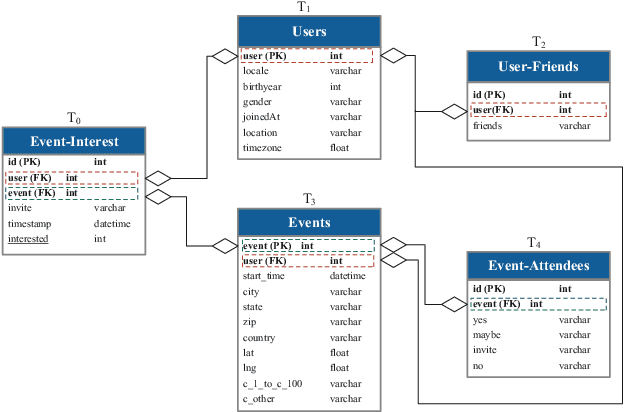
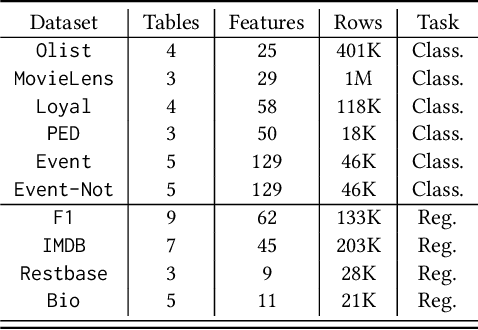
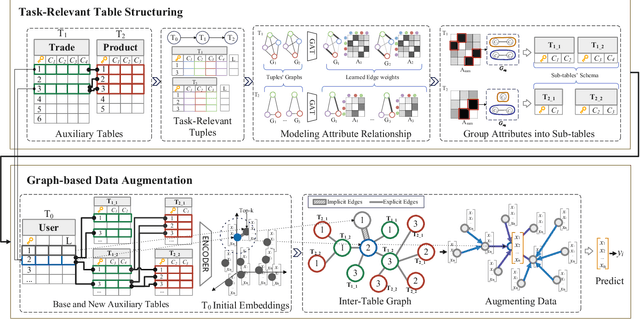
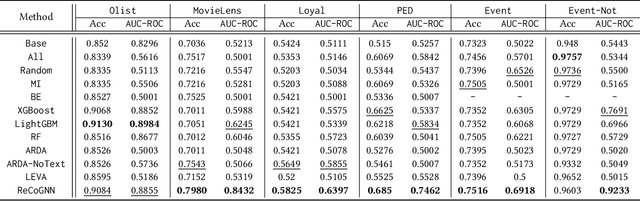
Data has become a foundational asset driving innovation across domains such as finance, healthcare, and e-commerce. In these areas, predictive modeling over relational tables is commonly employed, with increasing emphasis on reducing manual effort through automated machine learning (AutoML) techniques. This raises an interesting question: can feature augmentation itself be automated and identify and utilize task-related relational signals? To address this challenge, we propose an end-to-end automated feature augmentation framework, ReCoGNN, which enhances initial datasets using features extracted from multiple relational tables to support predictive tasks. ReCoGNN first captures semantic dependencies within each table by modeling intra-table attribute relationships, enabling it to partition tables into structured, semantically coherent segments. It then constructs a heterogeneous weighted graph that represents inter-row relationships across all segments. Finally, ReCoGNN leverages message-passing graph neural networks to propagate information through the graph, guiding feature selection and augmenting the original dataset. Extensive experiments conducted on ten real-life and synthetic datasets demonstrate that ReCoGNN consistently outperforms existing methods on both classification and regression tasks.