 Add to Chrome
 Add to Firefox
 Add to Edge
Beyond State Consistency: Behavior Consistency in Text-Based World Models
Apr 15, 2026
World models have been emerging as critical components for assessing the consequences of actions generated by interactive agents in online planning and offline evaluation. In text-based environments, world models are typically evaluated and trained with single-step metrics such as Exact Match, aiming to improve the similarity between predicted and real-world states, but such metrics have been shown to be insufficient for capturing actual agent behavior. To address this issue, we introduce a new behavior-aligned training paradigm aimed at improving the functional consistency between the world model and the real environment. This paradigm focuses on optimizing a tractable step-level metric named Behavior Consistency Reward (BehR), which measures how much the likelihood of a logged next action changes between the real state and the world-model-predicted state under a frozen Reference Agent. Experiments on WebShop and TextWorld show that BehR-based training improves long-term alignment in several settings, with the clearest gains in WebShop and less movement in near-ceiling regimes, while preserving or improving single-step prediction quality in three of four settings. World models trained with BehR also achieve lower false positives in offline surrogate evaluation and show modest but encouraging gains in inference-time lookahead planning.

FaithLens: Detecting and Explaining Faithfulness Hallucination
Dec 23, 2025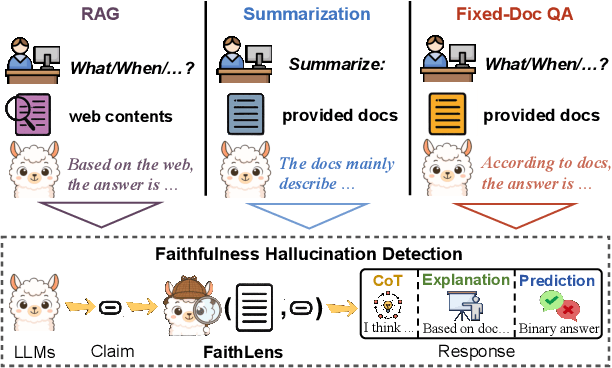
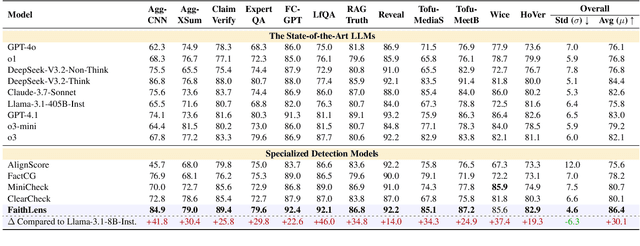
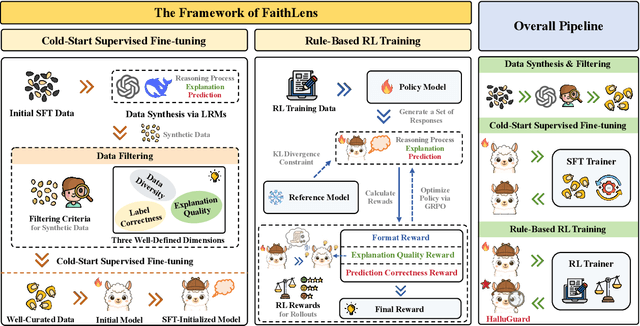
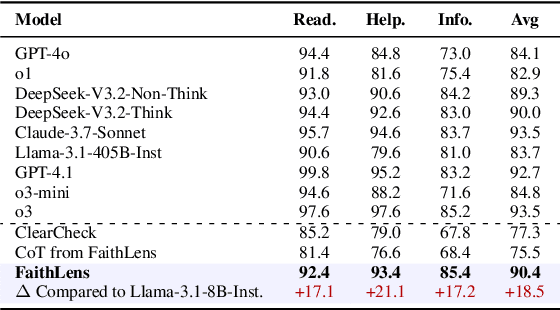
Recognizing whether outputs from large language models (LLMs) contain faithfulness hallucination is crucial for real-world applications, e.g., retrieval-augmented generation and summarization. In this paper, we introduce FaithLens, a cost-efficient and effective faithfulness hallucination detection model that can jointly provide binary predictions and corresponding explanations to improve trustworthiness. To achieve this, we first synthesize training data with explanations via advanced LLMs and apply a well-defined data filtering strategy to ensure label correctness, explanation quality, and data diversity. Subsequently, we fine-tune the model on these well-curated training data as a cold start and further optimize it with rule-based reinforcement learning, using rewards for both prediction correctness and explanation quality. Results on 12 diverse tasks show that the 8B-parameter FaithLens outperforms advanced models such as GPT-4.1 and o3. Also, FaithLens can produce high-quality explanations, delivering a distinctive balance of trustworthiness, efficiency, and effectiveness.