 Add to Chrome
 Add to Firefox
 Add to Edge
Apodex Discovery: Reality Benchmarks and Environments for Evaluating and Building Discoverative Artificial Intelligence
Aug 11, 2026
Apollo did not reach the Moon merely because its engineers could solve difficult equations. It succeeded by turning a distant ambition into a mission architecture of explicit objectives, simulation, verification, and repeated correction. AI now faces a similar transition: frontier models can solve difficult tasks once the problem, tools, and success criteria are specified, yet consequential real-world challenges rarely arrive in an executable or verifiable form. We introduce Apodex Discovery, a framework for building and evaluating discoverative AI through the heavy-duty solver, a system comprising a foundation model, harness, tools, and control policies that pursues extended, stateful, verifiable investigations. It has three core components. First, a problem-scouting process surveyed 561 industries across 16 sectors, assembled 423 high-value real-world problems, and selected 20 for the initial release. Second, a common environment-task-episode abstraction provides data, tools, constraints, feedback, trajectory recording, and verification of intermediate artifacts and final submissions. Third, HDS6 evaluates Tools, Repair, Alternatives, Coherence, Evidence, and Scope independently of final-task success. In AAV capsid design, Apodex surpassed the published state of the art by 7% across viability, tropism, structure prediction, and generative design. In drug repurposing and reformulation, a task-specific biomedical environment improved the mean normalized prediction score of GPT-5.5 and GPT-5.6-sol by 2.5 and 7.6 points over the same closed-book backbone. Controlled ablations show that the fixed TRACES episode interface enables attribution of performance differences to specific solver components. Apodex Discovery moves AI evaluation beyond predefined benchmarks toward verifiable investigations aimed at genuine discovery.

GMC: Grid Based Motion Clustering in Dynamic Environment
Feb 25, 2019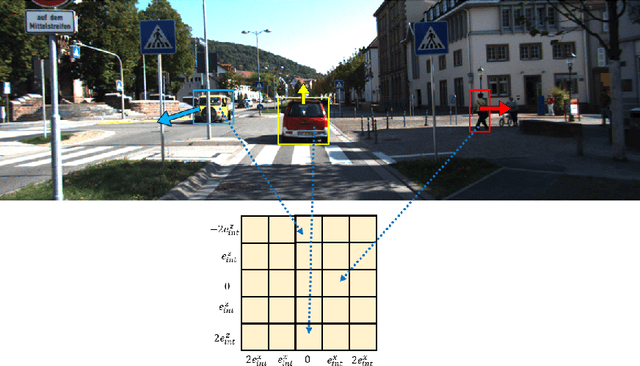
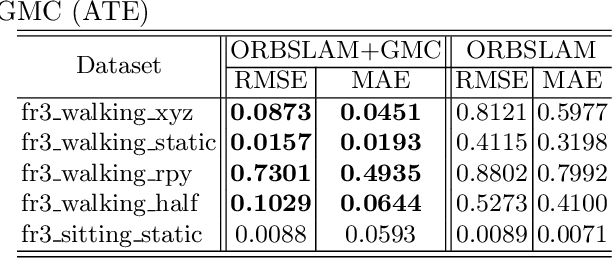
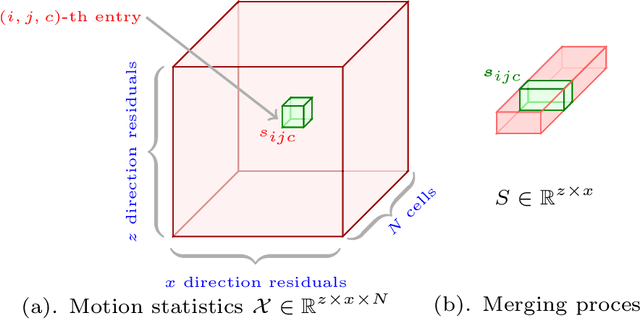
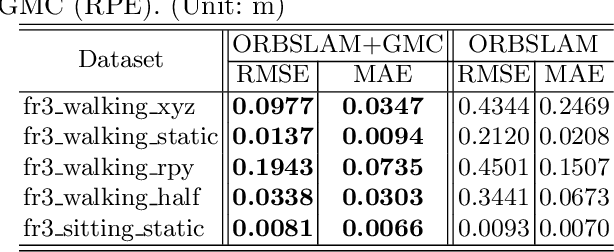
Conventional SLAM algorithms takes a strong assumption of scene motionlessness, which limits the application in real environments. This paper tries to tackle the challenging visual SLAM issue of moving objects in dynamic environments. We present GMC, grid-based motion clustering approach, a lightweight dynamic object filtering method that is free from high-power and expensive processors. GMC encapsulates motion consistency as the statistical likelihood of detected key points within a certain region. Using this method can we provide real-time and robust correspondence algorithm that can differentiate dynamic objects with static backgrounds. We evaluate our system in public TUM dataset. To compare with the state-of-the-art methods, our system can provide more accurate results by detecting dynamic objects.
Ultra-Wideband Aided Fast Localization and Mapping System
Sep 30, 2017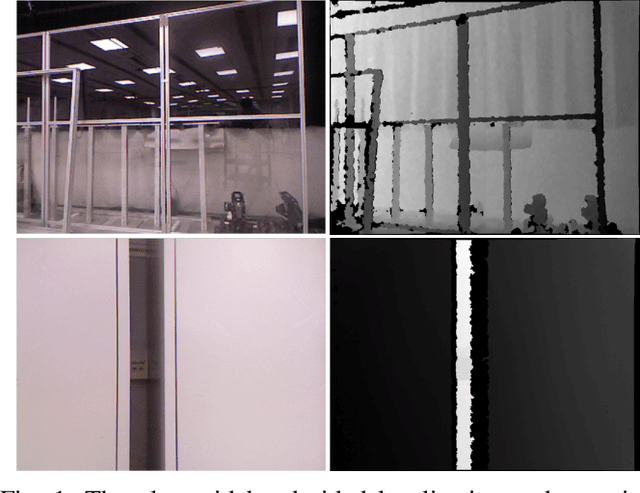
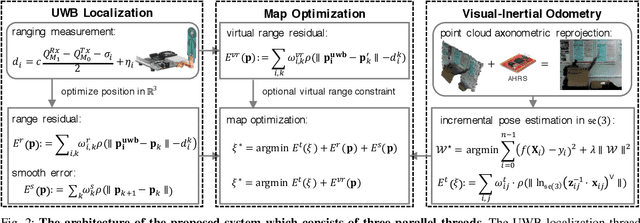
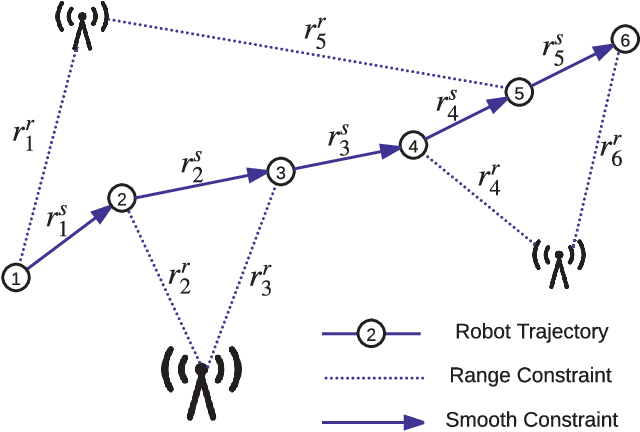
This paper proposes an ultra-wideband (UWB) aided localization and mapping system that leverages on inertial sensor and depth camera. Inspired by the fact that visual odometry (VO) system, regardless of its accuracy in the short term, still faces challenges with accumulated errors in the long run or under unfavourable environments, the UWB ranging measurements are fused to remove the visual drift and improve the robustness. A general framework is developed which consists of three parallel threads, two of which carry out the visual-inertial odometry (VIO) and UWB localization respectively. The other mapping thread integrates visual tracking constraints into a pose graph with the proposed smooth and virtual range constraints, such that an optimization is performed to provide robust trajectory estimation. Experiments show that the proposed system is able to create dense drift-free maps in real-time even running on an ultra-low power processor in featureless environments.