 Add to Chrome
 Add to Firefox
 Add to Edge
DLEBench: Evaluating Small-scale Object Editing Ability for Instruction-based Image Editing Model
Feb 27, 2026
Significant progress has been made in the field of Instruction-based Image Editing Models (IIEMs). However, while these models demonstrate plausible adherence to instructions and strong reasoning ability on current benchmarks, their ability to edit small objects remains underexplored, despite its importance for precise local editing and refining details in both real and generated images. In this paper, we introduce DeepLookEditBench (DLEBench), the first benchmark dedicated to assessing the abilities of IIEMs in editing small-scale objects. Specifically, we construct a challenging testbed comprising 1889 samples across seven instruction types. In these samples, target objects occupy only 1%-10% of the image area, covering complex scenarios such as partial occlusion and multi-object editing. To ensure robust evaluation on this benchmark, we propose an evaluation protocol with refined score rubrics to minimize subjectivity and ambiguity in two criteria: Instruction Following and Visual Consistency. This protocol also introduces a dual-mode evaluation framework (Tool-driven and Oracle-guided Modes) addressing the misalignment between LMM-as-a-Judge and human judgements on DLEBench. Empirical results on 10 IIEMs reveal significant performance gaps in small-scale object editing, highlighting the need for specialized benchmarks to advance this ability.

Meta-Learning Triplet Network with Adaptive Margins for Few-Shot Named Entity Recognition
Feb 14, 2023
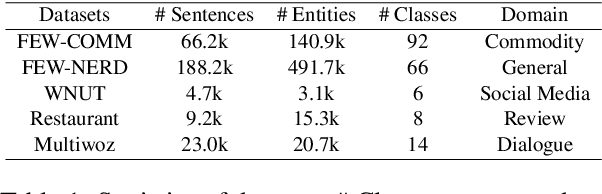

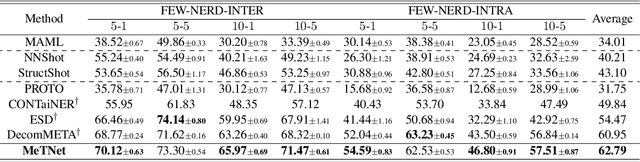
Meta-learning methods have been widely used in few-shot named entity recognition (NER), especially prototype-based methods. However, the Other(O) class is difficult to be represented by a prototype vector because there are generally a large number of samples in the class that have miscellaneous semantics. To solve the problem, we propose MeTNet, which generates prototype vectors for entity types only but not O-class. We design an improved triplet network to map samples and prototype vectors into a low-dimensional space that is easier to be classified and propose an adaptive margin for each entity type. The margin plays as a radius and controls a region with adaptive size in the low-dimensional space. Based on the regions, we propose a new inference procedure to predict the label of a query instance. We conduct extensive experiments in both in-domain and cross-domain settings to show the superiority of MeTNet over other state-of-the-art methods. In particular, we release a Chinese few-shot NER dataset FEW-COMM extracted from a well-known e-commerce platform. To the best of our knowledge, this is the first Chinese few-shot NER dataset. All the datasets and codes are provided at https://github.com/hccngu/MeTNet.