 Add to Chrome
 Add to Firefox
 Add to Edge
SketchFaceGS: Real-Time Sketch-Driven Face Editing and Generation with Gaussian Splatting
Apr 21, 2026
3D Gaussian representations have emerged as a powerful paradigm for digital head modeling, achieving photorealistic quality with real-time rendering. However, intuitive and interactive creation or editing of 3D Gaussian head models remains challenging. Although 2D sketches provide an ideal interaction modality for fast, intuitive conceptual design, they are sparse, depth-ambiguous, and lack high-frequency appearance cues, making it difficult to infer dense, geometrically consistent 3D Gaussian structures from strokes - especially under real-time constraints. To address these challenges, we propose SketchFaceGS, the first sketch-driven framework for real-time generation and editing of photorealistic 3D Gaussian head models from 2D sketches. Our method uses a feed-forward, coarse-to-fine architecture. A Transformer-based UV feature-prediction module first reconstructs a coarse but geometrically consistent UV feature map from the input sketch, and then a 3D UV feature enhancement module refines it with high-frequency, photorealistic detail to produce a high-fidelity 3D head. For editing, we introduce a UV Mask Fusion technique combined with a layer-by-layer feature-fusion strategy, enabling precise, real-time, free-viewpoint modifications. Extensive experiments show that SketchFaceGS outperforms existing methods in both generation fidelity and editing flexibility, producing high-quality, editable 3D heads from sketches in a single forward pass.

IM-Animation: An Implicit Motion Representation for Identity-decoupled Character Animation
Feb 07, 2026Recent progress in video diffusion models has markedly advanced character animation, which synthesizes motioned videos by animating a static identity image according to a driving video. Explicit methods represent motion using skeleton, DWPose or other explicit structured signals, but struggle to handle spatial mismatches and varying body scales. %proportions. Implicit methods, on the other hand, capture high-level implicit motion semantics directly from the driving video, but suffer from identity leakage and entanglement between motion and appearance. To address the above challenges, we propose a novel implicit motion representation that compresses per-frame motion into compact 1D motion tokens. This design relaxes strict spatial constraints inherent in 2D representations and effectively prevents identity information leakage from the motion video. Furthermore, we design a temporally consistent mask token-based retargeting module that enforces a temporal training bottleneck, mitigating interference from the source images' motion and improving retargeting consistency. Our methodology employs a three-stage training strategy to enhance the training efficiency and ensure high fidelity. Extensive experiments demonstrate that our implicit motion representation and the propose IM-Animation's generative capabilities are achieve superior or competitive performance compared with state-of-the-art methods.
SketchVideo: Sketch-based Video Generation and Editing
Mar 30, 2025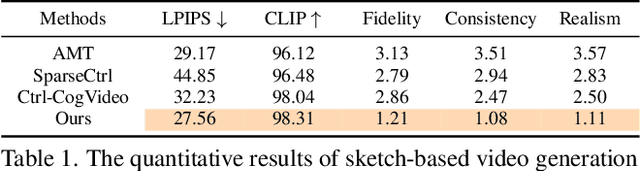
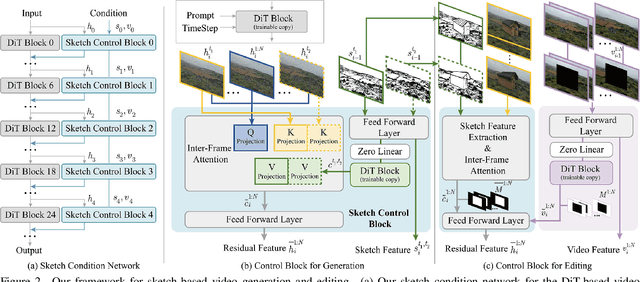
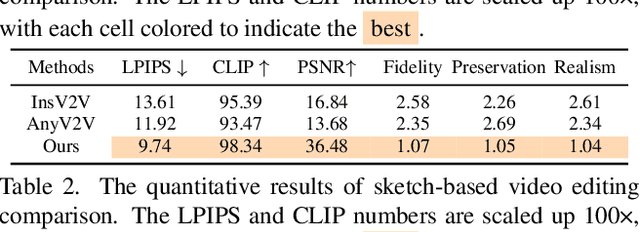
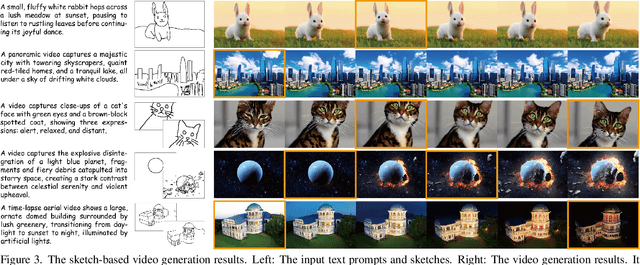
Video generation and editing conditioned on text prompts or images have undergone significant advancements. However, challenges remain in accurately controlling global layout and geometry details solely by texts, and supporting motion control and local modification through images. In this paper, we aim to achieve sketch-based spatial and motion control for video generation and support fine-grained editing of real or synthetic videos. Based on the DiT video generation model, we propose a memory-efficient control structure with sketch control blocks that predict residual features of skipped DiT blocks. Sketches are drawn on one or two keyframes (at arbitrary time points) for easy interaction. To propagate such temporally sparse sketch conditions across all frames, we propose an inter-frame attention mechanism to analyze the relationship between the keyframes and each video frame. For sketch-based video editing, we design an additional video insertion module that maintains consistency between the newly edited content and the original video's spatial feature and dynamic motion. During inference, we use latent fusion for the accurate preservation of unedited regions. Extensive experiments demonstrate that our SketchVideo achieves superior performance in controllable video generation and editing.
NeRFFaceEditing: Disentangled Face Editing in Neural Radiance Fields
Nov 15, 2022


Recent methods for synthesizing 3D-aware face images have achieved rapid development thanks to neural radiance fields, allowing for high quality and fast inference speed. However, existing solutions for editing facial geometry and appearance independently usually require retraining and are not optimized for the recent work of generation, thus tending to lag behind the generation process. To address these issues, we introduce NeRFFaceEditing, which enables editing and decoupling geometry and appearance in the pretrained tri-plane-based neural radiance field while retaining its high quality and fast inference speed. Our key idea for disentanglement is to use the statistics of the tri-plane to represent the high-level appearance of its corresponding facial volume. Moreover, we leverage a generated 3D-continuous semantic mask as an intermediary for geometry editing. We devise a geometry decoder (whose output is unchanged when the appearance changes) and an appearance decoder. The geometry decoder aligns the original facial volume with the semantic mask volume. We also enhance the disentanglement by explicitly regularizing rendered images with the same appearance but different geometry to be similar in terms of color distribution for each facial component separately. Our method allows users to edit via semantic masks with decoupled control of geometry and appearance. Both qualitative and quantitative evaluations show the superior geometry and appearance control abilities of our method compared to existing and alternative solutions.