 Add to Chrome
 Add to Firefox
 Add to Edge
StreamFlow: Dynamic Memory Flows for Streaming Video Understanding
Aug 11, 2026
Streaming video understanding requires multimodal large language models (MLLMs) to preserve relevant evidence from continuously evolving streams under strict causality and bounded memory. Yet existing paradigms remain limited: model-based methods require intrusive backbone updates, while memory-based methods expend substantial visual-encoding computation on temporally redundant content and rely on rigid access to visual history. To address these limitations, we introduce StreamFlow, an efficient visual memory framework that enables dynamic, on-demand access to historical visual information. StreamFlow combines a lightweight, dynamics-aware mid-term memory that filters temporal redundancy before visual encoding with a latent long-term memory that consolidates historical video content into visual latents accessible to subsequent reasoning. During generation, an attention-guided retrieval mechanism injects relevant visual latents when the model's reliance on visual evidence weakens. StreamFlow achieves state-of-the-art streaming video understanding performance, reaching 67.73% overall accuracy on StreamingBench, while also delivering strong performance on offline long-video benchmarks. Relative to the vanilla setting, it improves the visual attention score (VAS) by 59.1% while reducing end-to-end latency and peak memory by 50.4% and 21.1%, respectively, enabling more visually grounded and efficient reasoning.

Efficient Event-based Semantic Segmentation with Spike-driven Lightweight Transformer-based Networks
Dec 17, 2024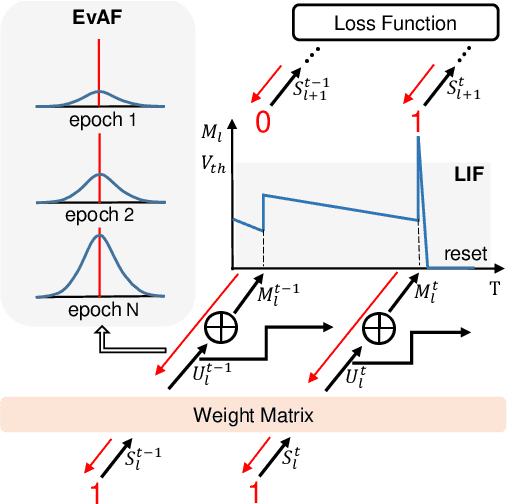
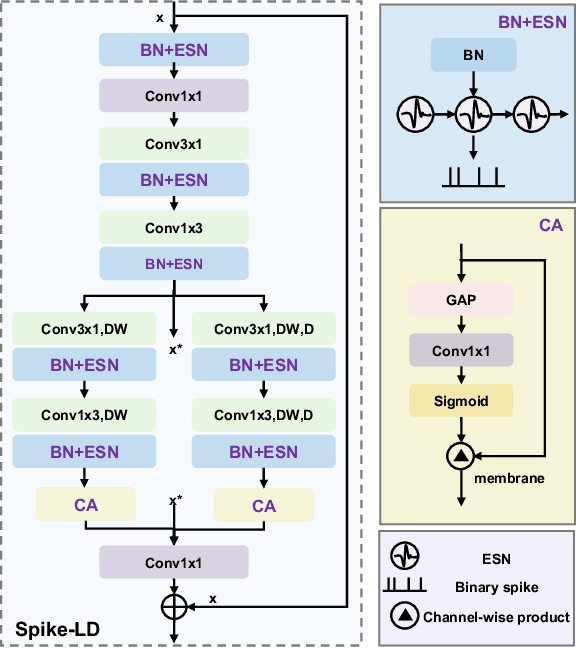
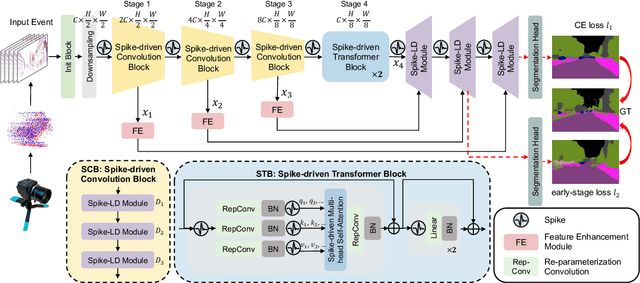
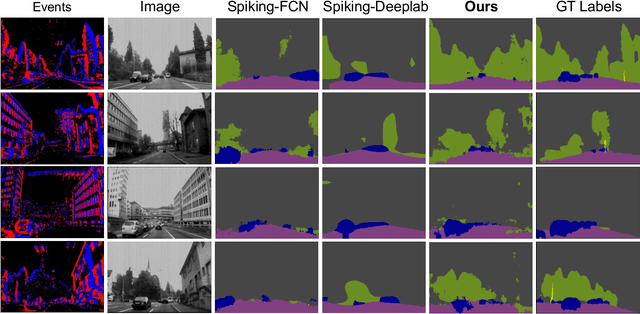
Event-based semantic segmentation has great potential in autonomous driving and robotics due to the advantages of event cameras, such as high dynamic range, low latency, and low power cost. Unfortunately, current artificial neural network (ANN)-based segmentation methods suffer from high computational demands, the requirements for image frames, and massive energy consumption, limiting their efficiency and application on resource-constrained edge/mobile platforms. To address these problems, we introduce SLTNet, a spike-driven lightweight transformer-based network designed for event-based semantic segmentation. Specifically, SLTNet is built on efficient spike-driven convolution blocks (SCBs) to extract rich semantic features while reducing the model's parameters. Then, to enhance the long-range contextural feature interaction, we propose novel spike-driven transformer blocks (STBs) with binary mask operations. Based on these basic blocks, SLTNet employs a high-efficiency single-branch architecture while maintaining the low energy consumption of the Spiking Neural Network (SNN). Finally, extensive experiments on DDD17 and DSEC-Semantic datasets demonstrate that SLTNet outperforms state-of-the-art (SOTA) SNN-based methods by at least 7.30% and 3.30% mIoU, respectively, with extremely 5.48x lower energy consumption and 1.14x faster inference speed.