 Add to Chrome
 Add to Firefox
 Add to Edge
BRIGHT: A Collaborative Generalist-Specialist Foundation Model for Breast Pathology
Mar 03, 2026
Generalist pathology foundation models (PFMs), pretrained on large-scale multi-organ datasets, have demonstrated remarkable predictive capabilities across diverse clinical applications. However, their proficiency on the full spectrum of clinically essential tasks within a specific organ system remains an open question due to the lack of large-scale validation cohorts for a single organ as well as the absence of a tailored training paradigm that can effectively translate broad histomorphological knowledge into the organ-specific expertise required for specialist-level interpretation. In this study, we propose BRIGHT, the first PFM specifically designed for breast pathology, trained on approximately 210 million histopathology tiles from over 51,000 breast whole-slide images derived from a cohort of over 40,000 patients across 19 hospitals. BRIGHT employs a collaborative generalist-specialist framework to capture both universal and organ-specific features. To comprehensively evaluate the performance of PFMs on breast oncology, we curate the largest multi-institutional cohorts to date for downstream task development and evaluation, comprising over 25,000 WSIs across 10 hospitals. The validation cohorts cover the full spectrum of breast pathology across 24 distinct clinical tasks spanning diagnosis, biomarker prediction, treatment response and survival prediction. Extensive experiments demonstrate that BRIGHT outperforms three leading generalist PFMs, achieving state-of-the-art (SOTA) performance in 21 of 24 internal validation tasks and in 5 of 10 external validation tasks with excellent heatmap interpretability. By evaluating on large-scale validation cohorts, this study not only demonstrates BRIGHT's clinical utility in breast oncology but also validates a collaborative generalist-specialist paradigm, providing a scalable template for developing PFMs on a specific organ system.

HSI: A Holistic Style Injector for Arbitrary Style Transfer
Feb 05, 2025Attention-based arbitrary style transfer methods have gained significant attention recently due to their impressive ability to synthesize style details. However, the point-wise matching within the attention mechanism may overly focus on local patterns such that neglect the remarkable global features of style images. Additionally, when processing large images, the quadratic complexity of the attention mechanism will bring high computational load. To alleviate above problems, we propose Holistic Style Injector (HSI), a novel attention-style transformation module to deliver artistic expression of target style. Specifically, HSI performs stylization only based on global style representation that is more in line with the characteristics of style transfer, to avoid generating local disharmonious patterns in stylized images. Moreover, we propose a dual relation learning mechanism inside the HSI to dynamically render images by leveraging semantic similarity in content and style, ensuring the stylized images preserve the original content and improve style fidelity. Note that the proposed HSI achieves linear computational complexity because it establishes feature mapping through element-wise multiplication rather than matrix multiplication. Qualitative and quantitative results demonstrate that our method outperforms state-of-the-art approaches in both effectiveness and efficiency.
Generative AI for Deep Reinforcement Learning: Framework, Analysis, and Use Cases
May 31, 2024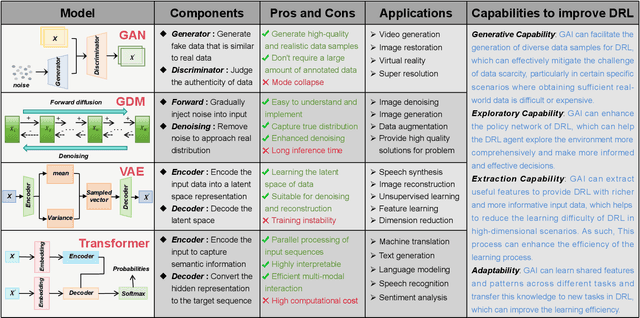
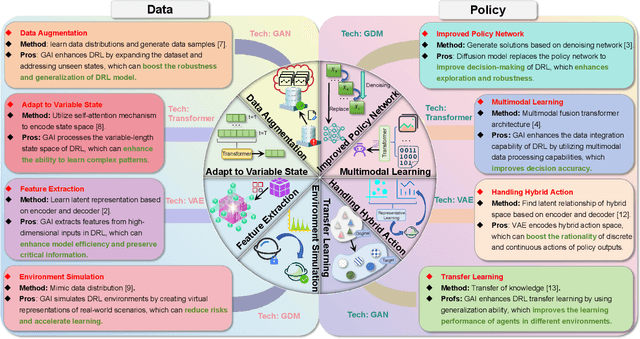
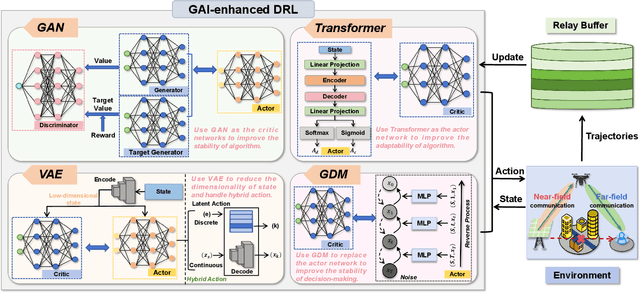
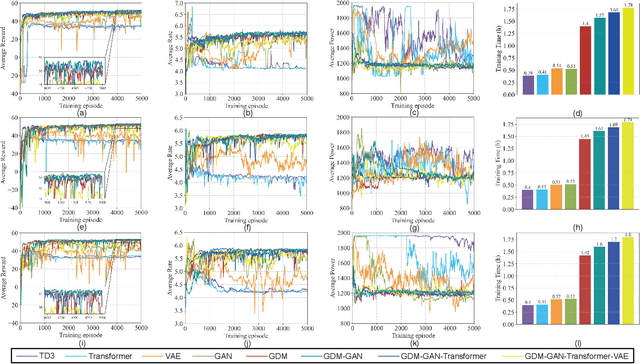
As a form of artificial intelligence (AI) technology based on interactive learning, deep reinforcement learning (DRL) has been widely applied across various fields and has achieved remarkable accomplishments. However, DRL faces certain limitations, including low sample efficiency and poor generalization. Therefore, we present how to leverage generative AI (GAI) to address these issues above and enhance the performance of DRL algorithms in this paper. We first introduce several classic GAI and DRL algorithms and demonstrate the applications of GAI-enhanced DRL algorithms. Then, we discuss how to use GAI to improve DRL algorithms from the data and policy perspectives. Subsequently, we introduce a framework that demonstrates an actual and novel integration of GAI with DRL, i.e., GAI-enhanced DRL. Additionally, we provide a case study of the framework on UAV-assisted integrated near-field/far-field communication to validate the performance of the proposed framework. Moreover, we present several future directions. Finally, the related code is available at: https://xiewenwen22.github.io/GAI-enhanced-DRL.