 Add to Chrome
 Add to Firefox
 Add to Edge
MemPro: Agentic Memory Systems as Evolvable Programs
May 30, 2026
Long-horizon autonomous agents require memory systems to retain historical information, track evolving states, and reuse relevant knowledge beyond finite context windows. Existing agentic memory systems typically follow a memory construction-retrieval (MCR) pipeline, but often adapt mainly the memory bank while keeping the surrounding pipeline fixed after deployment. This fixed-pipeline design struggles to handle heterogeneous task-specific failure modes and can become misaligned with memory banks that evolve in scale and structure over time. To address these limitations, we propose MemPro, a system-level evolution framework that treats the entire MCR pipeline as an evolvable program rather than adapting only the memory bank or prompt text. MemPro maintains a version tree of runnable memory-system implementations, where an Evolving Agent iteratively selects promising versions, diagnoses recurring failures, and creates improved child versions through failure-mode-guided edit-debug refinement. Experiments on LongMemEval, LoCoMo, HotpotQA, and NarrativeQA show that MemPro consistently outperforms strong static and prompt-level evolving baselines within a few iterations, continues to improve with evolution, and achieves a favorable performance-cost trade-off. Code is available at https://github.com/wanghai673/MemPro.

BRIGHT: A Collaborative Generalist-Specialist Foundation Model for Breast Pathology
Mar 03, 2026Generalist pathology foundation models (PFMs), pretrained on large-scale multi-organ datasets, have demonstrated remarkable predictive capabilities across diverse clinical applications. However, their proficiency on the full spectrum of clinically essential tasks within a specific organ system remains an open question due to the lack of large-scale validation cohorts for a single organ as well as the absence of a tailored training paradigm that can effectively translate broad histomorphological knowledge into the organ-specific expertise required for specialist-level interpretation. In this study, we propose BRIGHT, the first PFM specifically designed for breast pathology, trained on approximately 210 million histopathology tiles from over 51,000 breast whole-slide images derived from a cohort of over 40,000 patients across 19 hospitals. BRIGHT employs a collaborative generalist-specialist framework to capture both universal and organ-specific features. To comprehensively evaluate the performance of PFMs on breast oncology, we curate the largest multi-institutional cohorts to date for downstream task development and evaluation, comprising over 25,000 WSIs across 10 hospitals. The validation cohorts cover the full spectrum of breast pathology across 24 distinct clinical tasks spanning diagnosis, biomarker prediction, treatment response and survival prediction. Extensive experiments demonstrate that BRIGHT outperforms three leading generalist PFMs, achieving state-of-the-art (SOTA) performance in 21 of 24 internal validation tasks and in 5 of 10 external validation tasks with excellent heatmap interpretability. By evaluating on large-scale validation cohorts, this study not only demonstrates BRIGHT's clinical utility in breast oncology but also validates a collaborative generalist-specialist paradigm, providing a scalable template for developing PFMs on a specific organ system.
Eye tracking guided deep multiple instance learning with dual cross-attention for fundus disease detection
Apr 25, 2023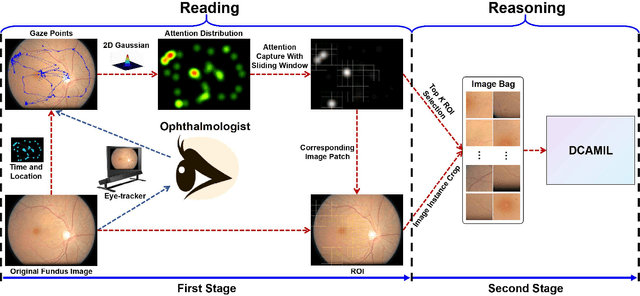
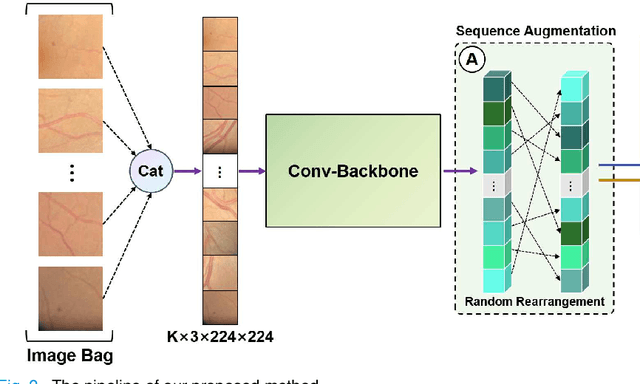
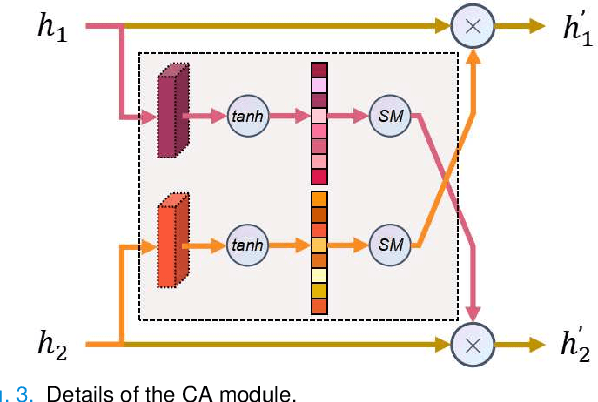
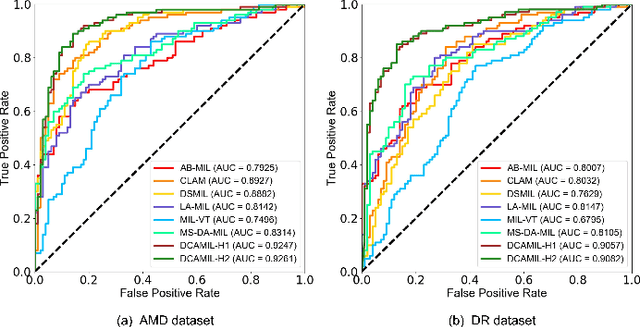
Deep neural networks (DNNs) have promoted the development of computer aided diagnosis (CAD) systems for fundus diseases, helping ophthalmologists reduce missed diagnosis and misdiagnosis rate. However, the majority of CAD systems are data-driven but lack of medical prior knowledge which can be performance-friendly. In this regard, we innovatively proposed a human-in-the-loop (HITL) CAD system by leveraging ophthalmologists' eye-tracking information, which is more efficient and accurate. Concretely, the HITL CAD system was implemented on the multiple instance learning (MIL), where eye-tracking gaze maps were beneficial to cherry-pick diagnosis-related instances. Furthermore, the dual-cross-attention MIL (DCAMIL) network was utilized to curb the adverse effects of noisy instances. Meanwhile, both sequence augmentation module and domain adversarial module were introduced to enrich and standardize instances in the training bag, respectively, thereby enhancing the robustness of our method. We conduct comparative experiments on our newly constructed datasets (namely, AMD-Gaze and DR-Gaze), respectively for the AMD and early DR detection. Rigorous experiments demonstrate the feasibility of our HITL CAD system and the superiority of the proposed DCAMIL, fully exploring the ophthalmologists' eye-tracking information. These investigations indicate that physicians' gaze maps, as medical prior knowledge, is potential to contribute to the CAD systems of clinical diseases.