 Add to Chrome
 Add to Firefox
 Add to Edge
iDiff: Interpretable Difference-aware Framework for Pairwise Image Quality Assessment
May 19, 2026
Pairwise image quality assessment (IQA) in professional photography requires a model not only to identify the preferred image between two candidates, but also to provide convincing and image-grounded reasoning. In the NTIRE 2026 RAIM challenge, this requirement is further emphasized by jointly evaluating preference prediction and rationale generation. To address this task, we propose iDiff, an Interpretable Difference-aware framework for pairwise image quality assessment. Our method adopts a dual-branch design consisting of an Answer Model and a Thinking Model. The Answer Model performs robust preference prediction by explicitly decomposing each sample into left/right global and local views, followed by content-aware specialization for person and scene images and ensemble-based aggregation across backbones. The Thinking Model focuses on rationale generation and is progressively enhanced with expert-style templates, multi-source quality features, and answer-aware supervision conditioned on the Answer Model prediction. In this way, iDiff jointly models discriminative decision making and structured explanation, improving both robustness and interpretability. Extensive experiments demonstrate the effectiveness of the proposed framework on both accuracy and reasoning-quality metrics. Our method achieved first place in the NTIRE 2026 RAIM challenge, showing the effectiveness of integrating explicit difference modeling with structured multimodal reasoning for pairwise IQA.

From User Interface to Agent Interface: Efficiency Optimization of UI Representations for LLM Agents
Dec 15, 2025
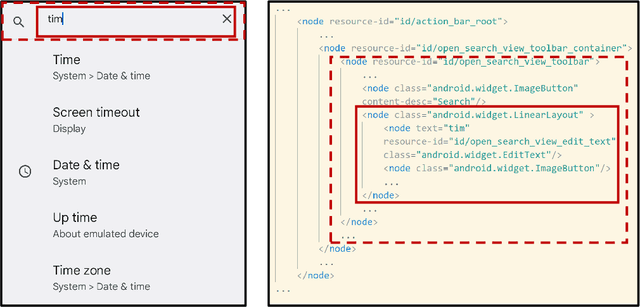
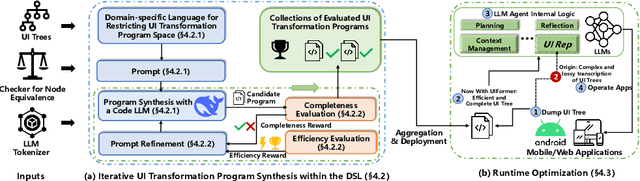
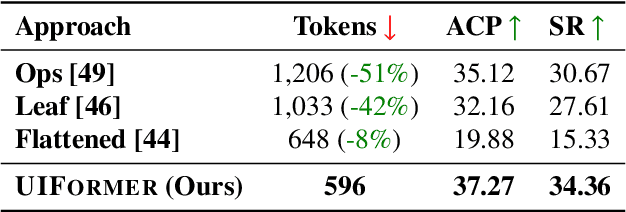
While Large Language Model (LLM) agents show great potential for automated UI navigation such as automated UI testing and AI assistants, their efficiency has been largely overlooked. Our motivating study reveals that inefficient UI representation creates a critical performance bottleneck. However, UI representation optimization, formulated as the task of automatically generating programs that transform UI representations, faces two unique challenges. First, the lack of Boolean oracles, which traditional program synthesis uses to decisively validate semantic correctness, poses a fundamental challenge to co-optimization of token efficiency and completeness. Second, the need to process large, complex UI trees as input while generating long, compositional transformation programs, making the search space vast and error-prone. Toward addressing the preceding limitations, we present UIFormer, the first automated optimization framework that synthesizes UI transformation programs by conducting constraint-based optimization with structured decomposition of the complex synthesis task. First, UIFormer restricts the program space using a domain-specific language (DSL) that captures UI-specific operations. Second, UIFormer conducts LLM-based iterative refinement with correctness and efficiency rewards, providing guidance for achieving the efficiency-completeness co-optimization. UIFormer operates as a lightweight plugin that applies transformation programs for seamless integration with existing LLM agents, requiring minimal modifications to their core logic. Evaluations across three UI navigation benchmarks spanning Android and Web platforms with five LLMs demonstrate that UIFormer achieves 48.7% to 55.8% token reduction with minimal runtime overhead while maintaining or improving agent performance. Real-world industry deployment at WeChat further validates the practical impact of UIFormer.
Instruction-augmented Multimodal Alignment for Image-Text and Element Matching
Apr 16, 2025With the rapid advancement of text-to-image (T2I) generation models, assessing the semantic alignment between generated images and text descriptions has become a significant research challenge. Current methods, including those based on Visual Question Answering (VQA), still struggle with fine-grained assessments and precise quantification of image-text alignment. This paper presents an improved evaluation method named Instruction-augmented Multimodal Alignment for Image-Text and Element Matching (iMatch), which evaluates image-text semantic alignment by fine-tuning multimodal large language models. We introduce four innovative augmentation strategies: First, the QAlign strategy creates a precise probabilistic mapping to convert discrete scores from multimodal large language models into continuous matching scores. Second, a validation set augmentation strategy uses pseudo-labels from model predictions to expand training data, boosting the model's generalization performance. Third, an element augmentation strategy integrates element category labels to refine the model's understanding of image-text matching. Fourth, an image augmentation strategy employs techniques like random lighting to increase the model's robustness. Additionally, we propose prompt type augmentation and score perturbation strategies to further enhance the accuracy of element assessments. Our experimental results show that the iMatch method significantly surpasses existing methods, confirming its effectiveness and practical value. Furthermore, our iMatch won first place in the CVPR NTIRE 2025 Text to Image Generation Model Quality Assessment - Track 1 Image-Text Alignment.