 Add to Chrome
 Add to Firefox
 Add to Edge
Do Clinical Models Change Treatment Decisions?
May 27, 2026
Clinical foundation models are evaluated with factual or exam-style medical QA, but treatment decisions must change when patient context changes. We introduce ClinPivot, an auditable treatment-decision benchmark built from biomedical relations and pivoted patient contexts. ClinPivot asks whether models change treatment choices when new clinical constraints shift the action space. We find that strong medical QA performance does not reliably predict decision-making performance: frontier models and task-adapted Qwen variants often fail to change decisions correctly, and model rankings shift across evaluation regimes. Decision-structured supervision improves pivot-sensitive decision-making and medical QA under matched knowledge budgets, while lightweight replay reduces losses in general assistant ability.

Forgetting in Language Models: Capacity, Optimization, and Self-Generated Replay
May 25, 2026Models trained on a new task typically degrade on prior tasks, a phenomenon known as forgetting. Traditionally, mitigating forgetting has required replaying stored exemplars from prior tasks, which is often impractical. By contrast, language models can sample from their own training distribution, and we show that these self-generated samples serve as effective replay data, nearly eliminating forgetting. We find that forgetting nonetheless persists when the model has little remaining capacity: models pretrained close to saturation cannot absorb new information without overwriting prior knowledge. When capacity is not the limiting factor, low learning rates reduce forgetting but require substantially more training steps. Replay breaks this tradeoff, enabling fast, high-learning-rate finetuning without forgetting.
Identity-Robust Language Model Generation via Content Integrity Preservation
Jan 14, 2026Large Language Model (LLM) outputs often vary across user sociodemographic attributes, leading to disparities in factual accuracy, utility, and safety, even for objective questions where demographic information is irrelevant. Unlike prior work on stereotypical or representational bias, this paper studies identity-dependent degradation of core response quality. We show empirically that such degradation arises from biased generation behavior, despite factual knowledge being robustly encoded across identities. Motivated by this mismatch, we propose a lightweight, training-free framework for identity-robust generation that selectively neutralizes non-critical identity information while preserving semantically essential attributes, thus maintaining output content integrity. Experiments across four benchmarks and 18 sociodemographic identities demonstrate an average 77% reduction in identity-dependent bias compared to vanilla prompting and a 45% reduction relative to prompt-based defenses. Our work addresses a critical gap in mitigating the impact of user identity cues in prompts on core generation quality.
Dealing with the Evil Twins: Improving Random Augmentation by Addressing Catastrophic Forgetting of Diverse Augmentations
Jun 09, 2025Data augmentation is a promising tool for enhancing out-of-distribution generalization, where the key is to produce diverse, challenging variations of the source domain via costly targeted augmentations that maximize its generalization effect. Conversely, random augmentation is inexpensive but is deemed suboptimal due to its limited effect. In this paper, we revisit random augmentation and explore methods to address its shortcomings. We show that the stochastic nature of random augmentation can produce a set of colliding augmentations that distorts the learned features, similar to catastrophic forgetting. We propose a simple solution that improves the generalization effect of random augmentation by addressing forgetting, which displays strong generalization performance across various single source domain generalization (sDG) benchmarks.
Domain Adaptation Under MNAR Missingness
Apr 01, 2025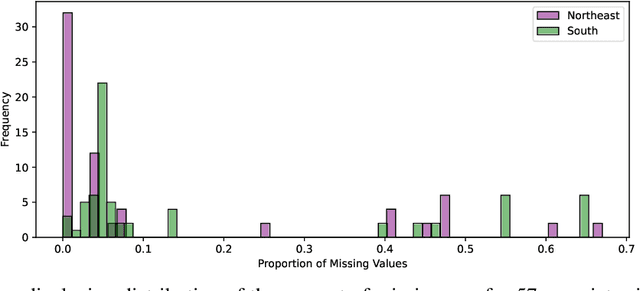
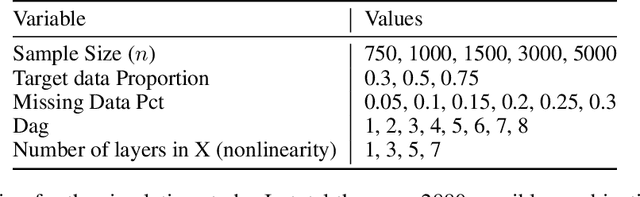
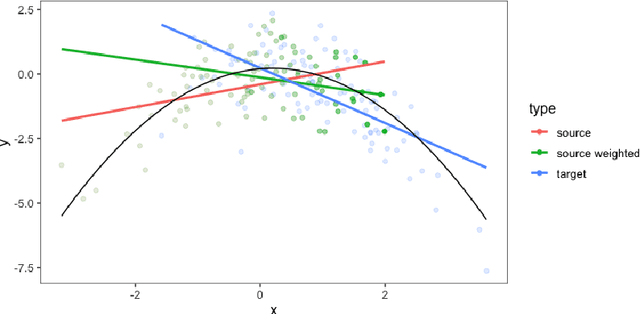
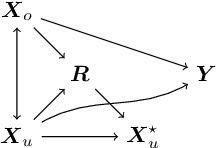
Current domain adaptation methods under missingness shift are restricted to Missing At Random (MAR) missingness mechanisms. However, in many real-world examples, the MAR assumption may be too restrictive. When covariates are Missing Not At Random (MNAR) in both source and target data, the common covariate shift solutions, including importance weighting, are not directly applicable. We show that under reasonable assumptions, the problem of MNAR missingness shift can be reduced to an imputation problem. This allows us to leverage recent methodological developments in both the traditional statistics and machine/deep-learning literature for MNAR imputation to develop a novel domain adaptation procedure for MNAR missingness shift. We further show that our proposed procedure can be extended to handle simultaneous MNAR missingness and covariate shifts. We apply our procedure to Electronic Health Record (EHR) data from two hospitals in south and northeast regions of the US. In this setting we expect different hospital networks and regions to serve different populations and to have different procedures, practices, and software for inputting and recording data, causing simultaneous missingness and covariate shifts.
Cost-Efficient Continual Learning with Sufficient Exemplar Memory
Feb 11, 2025Continual learning (CL) research typically assumes highly constrained exemplar memory resources. However, in many real-world scenarios-especially in the era of large foundation models-memory is abundant, while GPU computational costs are the primary bottleneck. In this work, we investigate CL in a novel setting where exemplar memory is ample (i.e., sufficient exemplar memory). Unlike prior methods designed for strict exemplar memory constraints, we propose a simple yet effective approach that directly operates in the model's weight space through a combination of weight resetting and averaging techniques. Our method achieves state-of-the-art performance while reducing the computational cost to a quarter or third of existing methods. These findings challenge conventional CL assumptions and provide a practical baseline for computationally efficient CL applications.
Leveraging CLIP for Inferring Sensitive Information and Improving Model Fairness
Mar 15, 2024Performance disparities across sub-populations are known to exist in deep learning-based vision recognition models, but previous work has largely addressed such fairness concerns assuming knowledge of sensitive attribute labels. To overcome this reliance, previous strategies have involved separate learning structures to expose and adjust for disparities. In this work, we explore a new paradigm that does not require sensitive attribute labels, and evades the need for extra training by leveraging the vision-language model, CLIP, as a rich knowledge source to infer sensitive information. We present sample clustering based on similarity derived from image and attribute-specified language embeddings and assess their correspondence to true attribute distribution. We train a target model by re-sampling and augmenting under-performed clusters. Extensive experiments on multiple benchmark bias datasets show clear fairness gains of the model over existing baselines, which indicate that CLIP can extract discriminative sensitive information prompted by language, and used to promote model fairness.
Disparate Effect Of Missing Mediators On Transportability of Causal Effects
Mar 13, 2024


Transported mediation effects provide an avenue to understand how upstream interventions (such as improved neighborhood conditions like green spaces) would work differently when applied to different populations as a result of factors that mediate the effects. However, when mediators are missing in the population where the effect is to be transported, these estimates could be biased. We study this issue of missing mediators, motivated by challenges in public health, wherein mediators can be missing, not at random. We propose a sensitivity analysis framework that quantifies the impact of missing mediator data on transported mediation effects. This framework enables us to identify the settings under which the conditional transported mediation effect is rendered insignificant for the subgroup with missing mediator data. Specifically, we provide the bounds on the transported mediation effect as a function of missingness. We then apply the framework to longitudinal data from the Moving to Opportunity Study, a large-scale housing voucher experiment, to quantify the effect of missing mediators on transport effect estimates of voucher receipt, an upstream intervention on living location, in childhood on subsequent risk of mental health or substance use disorder mediated through parental health across sites. Our findings provide a tangible understanding of how much missing data can be withstood for unbiased effect estimates.
Generalization in Healthcare AI: Evaluation of a Clinical Large Language Model
Feb 24, 2024Advances in large language models (LLMs) provide new opportunities in healthcare for improved patient care, clinical decision-making, and enhancement of physician and administrator workflows. However, the potential of these models importantly depends on their ability to generalize effectively across clinical environments and populations, a challenge often underestimated in early development. To better understand reasons for these challenges and inform mitigation approaches, we evaluated ClinicLLM, an LLM trained on [HOSPITAL]'s clinical notes, analyzing its performance on 30-day all-cause readmission prediction focusing on variability across hospitals and patient characteristics. We found poorer generalization particularly in hospitals with fewer samples, among patients with government and unspecified insurance, the elderly, and those with high comorbidities. To understand reasons for lack of generalization, we investigated sample sizes for fine-tuning, note content (number of words per note), patient characteristics (comorbidity level, age, insurance type, borough), and health system aspects (hospital, all-cause 30-day readmission, and mortality rates). We used descriptive statistics and supervised classification to identify features. We found that, along with sample size, patient age, number of comorbidities, and the number of words in notes are all important factors related to generalization. Finally, we compared local fine-tuning (hospital specific), instance-based augmented fine-tuning and cluster-based fine-tuning for improving generalization. Among these, local fine-tuning proved most effective, increasing AUC by 0.25% to 11.74% (most helpful in settings with limited data). Overall, this study provides new insights for enhancing the deployment of large language models in the societally important domain of healthcare, and improving their performance for broader populations.
Impact on Public Health Decision Making by Utilizing Big Data Without Domain Knowledge
Feb 08, 2024New data sources, and artificial intelligence (AI) methods to extract information from them are becoming plentiful, and relevant to decision making in many societal applications. An important example is street view imagery, available in over 100 countries, and considered for applications such as assessing built environment aspects in relation to community health outcomes. Relevant to such uses, important examples of bias in the use of AI are evident when decision-making based on data fails to account for the robustness of the data, or predictions are based on spurious correlations. To study this risk, we utilize 2.02 million GSV images along with health, demographic, and socioeconomic data from New York City. Initially, we demonstrate that built environment characteristics inferred from GSV labels at the intra-city level may exhibit inadequate alignment with the ground truth. We also find that the average individual-level behavior of physical inactivity significantly mediates the impact of built environment features by census tract, as measured through GSV. Finally, using a causal framework which accounts for these mediators of environmental impacts on health, we find that altering 10% of samples in the two lowest tertiles would result in a 4.17 (95% CI 3.84 to 4.55) or 17.2 (95% CI 14.4 to 21.3) times bigger decrease on the prevalence of obesity or diabetes, than the same proportional intervention on the number of crosswalks by census tract. This work illustrates important issues of robustness and model specification for informing effective allocation of interventions using new data sources.