 Add to Chrome
 Add to Firefox
 Add to Edge
EnergyLens: Predictive Energy-Aware Exploration for Multi-GPU LLM Inference Optimization
May 14, 2026
We present EnergyLens, an end-to-end framework for energy-aware large language model (LLM) inference optimization. As LLMs scale, predicting and reducing their energy footprint has become critical for sustainability and datacenter operations, yet existing approaches either require production-level code and expensive profiling or fail to accurately capture multi-GPU energy behavior. As a result, practitioners lack tools for deciding which optimizations to prioritize and for selecting among existing deployment configurations when exhaustive profiling is impractical. EnergyLens addresses this gap with an intuitive einsum-based interface that captures LLM specifications including fusion, parallelism, and compute-communication overlap, combined with load-imbalance-aware MoE modeling and an empirically driven communication energy model for multi-GPU settings. We validate EnergyLens on Llama3 and Qwen3-MoE across tensor-parallel and expert-parallel configurations, achieving mean absolute percentage errors (MAPEs) between 9.25% and 13.19% for multi-GPU prefill and decode energy, and 12.97% across SM allocations for Megatron-style overlap. Our energy-driven exploration reveals up to 1.47x and 52.9x energy variation across configurations in prefill and decode efficiency and motivates distributed serving. We further show that compute-communication overlap is difficult to optimize with intuition alone, but EnergyLens correctly identifies Pareto-optimal overlap configurations.

Towards Efficient Key-Value Cache Management for Prefix Prefilling in LLM Inference
May 28, 2025The increasing adoption of large language models (LLMs) with extended context windows necessitates efficient Key-Value Cache (KVC) management to optimize inference performance. Inference workloads like Retrieval-Augmented Generation (RAG) and agents exhibit high cache reusability, making efficient caching critical to reducing redundancy and improving speed. We analyze real-world KVC access patterns using publicly available traces and evaluate commercial key-value stores like Redis and state-of-the-art RDMA-based systems (CHIME [1] and Sherman [2]) for KVC metadata management. Our work demonstrates the lack of tailored storage solution for KVC prefilling, underscores the need for an efficient distributed caching system with optimized metadata management for LLM workloads, and provides insights into designing improved KVC management systems for scalable, low-latency inference.
Mind the Memory Gap: Unveiling GPU Bottlenecks in Large-Batch LLM Inference
Mar 11, 2025Large language models have been widely adopted across different tasks, but their auto-regressive generation nature often leads to inefficient resource utilization during inference. While batching is commonly used to increase throughput, performance gains plateau beyond a certain batch size, especially with smaller models, a phenomenon that existing literature typically explains as a shift to the compute-bound regime. In this paper, through an in-depth GPU-level analysis, we reveal that large-batch inference remains memory-bound, with most GPU compute capabilities underutilized due to DRAM bandwidth saturation as the primary bottleneck. To address this, we propose a Batching Configuration Advisor (BCA) that optimizes memory allocation, reducing GPU memory requirements with minimal impact on throughput. The freed memory and underutilized GPU compute capabilities can then be leveraged by concurrent workloads. Specifically, we use model replication to improve serving throughput and GPU utilization. Our findings challenge conventional assumptions about LLM inference, offering new insights and practical strategies for improving resource utilization, particularly for smaller language models.
Towards Pareto Optimal Throughput in Small Language Model Serving
Apr 04, 2024Large language models (LLMs) have revolutionized the state-of-the-art of many different natural language processing tasks. Although serving LLMs is computationally and memory demanding, the rise of Small Language Models (SLMs) offers new opportunities for resource-constrained users, who now are able to serve small models with cutting-edge performance. In this paper, we present a set of experiments designed to benchmark SLM inference at performance and energy levels. Our analysis provides a new perspective in serving, highlighting that the small memory footprint of SLMs allows for reaching the Pareto-optimal throughput within the resource capacity of a single accelerator. In this regard, we present an initial set of findings demonstrating how model replication can effectively improve resource utilization for serving SLMs.
FedCore: Straggler-Free Federated Learning with Distributed Coresets
Jan 31, 2024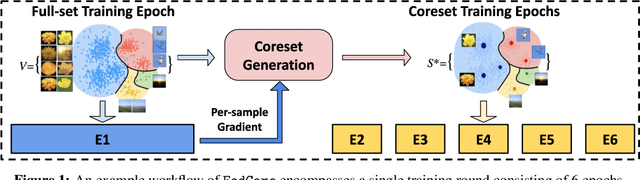


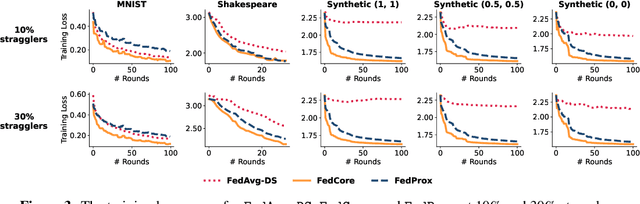
Federated learning (FL) is a machine learning paradigm that allows multiple clients to collaboratively train a shared model while keeping their data on-premise. However, the straggler issue, due to slow clients, often hinders the efficiency and scalability of FL. This paper presents FedCore, an algorithm that innovatively tackles the straggler problem via the decentralized selection of coresets, representative subsets of a dataset. Contrary to existing centralized coreset methods, FedCore creates coresets directly on each client in a distributed manner, ensuring privacy preservation in FL. FedCore translates the coreset optimization problem into a more tractable k-medoids clustering problem and operates distributedly on each client. Theoretical analysis confirms FedCore's convergence, and practical evaluations demonstrate an 8x reduction in FL training time, without compromising model accuracy. Our extensive evaluations also show that FedCore generalizes well to existing FL frameworks.