 Add to Chrome
 Add to Firefox
 Add to Edge
EnergyLens: Predictive Energy-Aware Exploration for Multi-GPU LLM Inference Optimization
May 14, 2026
We present EnergyLens, an end-to-end framework for energy-aware large language model (LLM) inference optimization. As LLMs scale, predicting and reducing their energy footprint has become critical for sustainability and datacenter operations, yet existing approaches either require production-level code and expensive profiling or fail to accurately capture multi-GPU energy behavior. As a result, practitioners lack tools for deciding which optimizations to prioritize and for selecting among existing deployment configurations when exhaustive profiling is impractical. EnergyLens addresses this gap with an intuitive einsum-based interface that captures LLM specifications including fusion, parallelism, and compute-communication overlap, combined with load-imbalance-aware MoE modeling and an empirically driven communication energy model for multi-GPU settings. We validate EnergyLens on Llama3 and Qwen3-MoE across tensor-parallel and expert-parallel configurations, achieving mean absolute percentage errors (MAPEs) between 9.25% and 13.19% for multi-GPU prefill and decode energy, and 12.97% across SM allocations for Megatron-style overlap. Our energy-driven exploration reveals up to 1.47x and 52.9x energy variation across configurations in prefill and decode efficiency and motivates distributed serving. We further show that compute-communication overlap is difficult to optimize with intuition alone, but EnergyLens correctly identifies Pareto-optimal overlap configurations.

Striped Attention: Faster Ring Attention for Causal Transformers
Nov 15, 2023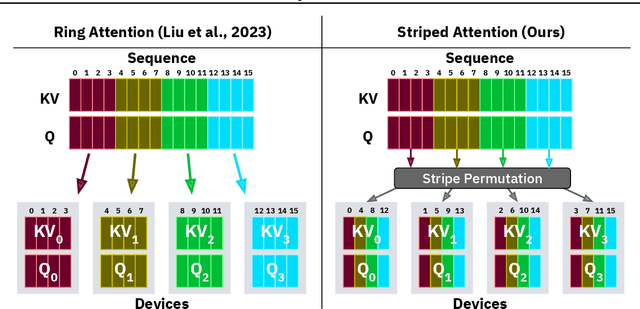
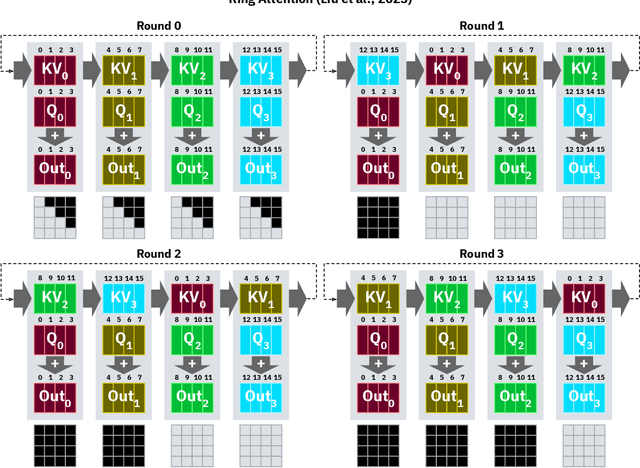
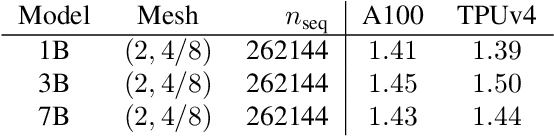
To help address the growing demand for ever-longer sequence lengths in transformer models, Liu et al. recently proposed Ring Attention, an exact attention algorithm capable of overcoming per-device memory bottle- necks by distributing self-attention across multiple devices. In this paper, we study the performance characteristics of Ring Attention in the important special case of causal transformer models, and identify a key workload imbal- ance due to triangular structure of causal attention computations. We propose a simple extension to Ring Attention, which we call Striped Attention to fix this imbalance. Instead of devices having contiguous subsequences, each device has a subset of tokens distributed uniformly throughout the sequence, which we demonstrate leads to more even workloads. In experiments running Striped Attention on A100 GPUs and TPUv4s, we are able to achieve up to 1.45x end-to-end throughput improvements over the original Ring Attention algorithm on causal transformer training at a sequence length of 256k. Furthermore, on 16 TPUv4 chips, we were able to achieve 1.65x speedups at sequence lengths of 786k. We release the code for our experiments as open source