 Add to Chrome
 Add to Firefox
 Add to Edge
Data Driven Optimization of GPU efficiency for Distributed LLM Adapter Serving
Feb 27, 2026
Large Language Model (LLM) adapters enable low-cost model specialization, but introduce complex caching and scheduling challenges in distributed serving systems where hundreds of adapters must be hosted concurrently. While prior work has largely focused on latency minimization, resource efficiency through throughput maximization remains underexplored. This paper presents a data-driven pipeline that, for a given workload, computes an adapter placement that serves the workload with the minimum number of GPUs while avoiding request starvation and GPU memory errors. To that end, the approach identifies the maximum feasible throughput attainable on each GPU by leveraging accurate performance predictions learned from real serving behavior. The proposed pipeline integrates three components: (i) a Digital Twin (DT) tailored to LLM-adapter serving, (ii) a distilled machine learning (ML) model trained on DT-generated data, and (iii) a greedy placement algorithm that exploits ML-based performance estimates to maximize GPU efficiency. The DT emulates real system dynamics with high fidelity, achieving below 5% throughput estimation error while executing up to 90 times faster than full LLM benchmarking across both predictable and unpredictable workloads. The learned ML models further accelerate performance estimation with marginal accuracy degradation, enabling scalable optimization. Experimental results demonstrate that the pipeline substantially improves GPU efficiency by reducing the number of GPUs required to sustain target workloads. Beyond GPU efficiency, the pipeline can be adapted to alternative objectives, such as latency minimization, highlighting its versatility for future large-scale LLM serving infrastructures.

Maximizing GPU Efficiency via Optimal Adapter Caching: An Analytical Approach for Multi-Tenant LLM Serving
Aug 11, 2025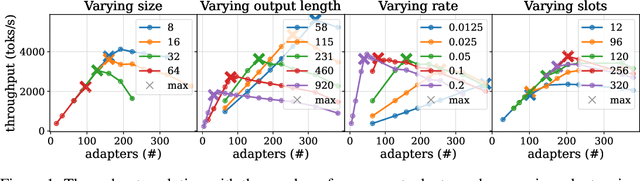
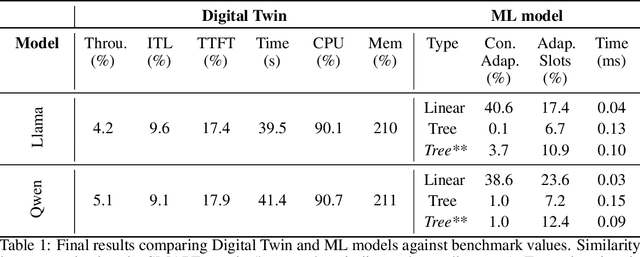
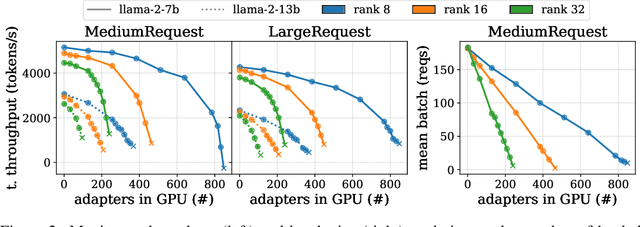
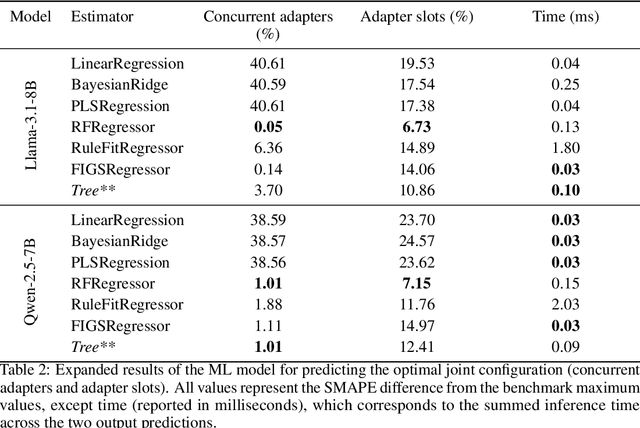
Serving LLM adapters has gained significant attention as an effective approach to adapt general-purpose language models to diverse, task-specific use cases. However, serving a wide range of adapters introduces several and substantial overheads, leading to performance degradation and challenges in optimal placement. To address these challenges, we present an analytical, AI-driven pipeline that accurately determines the optimal allocation of adapters in single-node setups. This allocation maximizes performance, effectively using GPU resources, while preventing request starvation. Crucially, the proposed allocation is given based on current workload patterns. These insights in single-node setups can be leveraged in multi-replica deployments for overall placement, load balancing and server configuration, ultimately enhancing overall performance and improving resource efficiency. Our approach builds on an in-depth analysis of LLM adapter serving, accounting for overheads and performance variability, and includes the development of the first Digital Twin capable of replicating online LLM-adapter serving systems with matching key performance metrics. The experimental results demonstrate that the Digital Twin achieves a SMAPE difference of no more than 5.5% in throughput compared to real results, and the proposed pipeline accurately predicts the optimal placement with minimal latency.
Mind the Memory Gap: Unveiling GPU Bottlenecks in Large-Batch LLM Inference
Mar 11, 2025Large language models have been widely adopted across different tasks, but their auto-regressive generation nature often leads to inefficient resource utilization during inference. While batching is commonly used to increase throughput, performance gains plateau beyond a certain batch size, especially with smaller models, a phenomenon that existing literature typically explains as a shift to the compute-bound regime. In this paper, through an in-depth GPU-level analysis, we reveal that large-batch inference remains memory-bound, with most GPU compute capabilities underutilized due to DRAM bandwidth saturation as the primary bottleneck. To address this, we propose a Batching Configuration Advisor (BCA) that optimizes memory allocation, reducing GPU memory requirements with minimal impact on throughput. The freed memory and underutilized GPU compute capabilities can then be leveraged by concurrent workloads. Specifically, we use model replication to improve serving throughput and GPU utilization. Our findings challenge conventional assumptions about LLM inference, offering new insights and practical strategies for improving resource utilization, particularly for smaller language models.