 Add to Chrome
 Add to Firefox
 Add to Edge
DFlare: Scaling Up Draft Capacity for Block Diffusion Speculative Decoding
Jun 01, 2026
Block diffusion speculative decoding accelerates LLM inference by predicting all tokens within a block simultaneously for the target model to verify in parallel. Predicting an entire block at once requires a sufficiently capable draft model and effective utilization of the target model's internal knowledge. However, the state-of-the-art method DFlash constrains all draft layers to share a single fused representation derived from only a few target layers, limiting per-layer expressiveness and hindering further scaling of draft capacity. In this paper, we present \modelname, which flares out the narrow conditioning bottleneck of DFlash through a lightweight layer-wise fusion mechanism: each draft layer attends to its own learnable combination of a broad set of target layers at negligible overhead, simultaneously injecting richer target knowledge and providing every draft layer with a distinct input. This enhanced per-layer expressiveness enables scaling the draft model to deeper architectures with consistent gains. We further scale training data from 800K to 2.4M samples to fully exploit the enlarged capacity. On six benchmarks spanning mathematical reasoning, code generation, and conversation, \modelname attains average wall-clock speedups of 5.52x on Qwen3-4B, 5.46x on Qwen3-8B, and 3.91x on GPT-OSS-20B, improving over DFlash by roughly 11\%, 8\%, and 5\% respectively. Our code is available at https://github.com/Tencent/AngelSlim.

Learning to Draft: Adaptive Speculative Decoding with Reinforcement Learning
Mar 02, 2026Speculative decoding accelerates large language model (LLM) inference by using a small draft model to generate candidate tokens for a larger target model to verify. The efficacy of this technique hinges on the trade-off between the time spent on drafting candidates and verifying them. However, current state-of-the-art methods rely on a static time allocation, while recent dynamic approaches optimize for proxy metrics like acceptance length, often neglecting the true time cost and treating the drafting and verification phases in isolation. To address these limitations, we introduce Learning to Draft (LTD), a novel method that directly optimizes for throughput of each draft-and-verify cycle. We formulate the problem as a reinforcement learning environment and train two co-adaptive policies to dynamically coordinate the draft and verification phases. This encourages the policies to adapt to each other and explicitly maximize decoding efficiency. We conducted extensive evaluations on five diverse LLMs and four distinct tasks. Our results show that LTD achieves speedup ratios ranging from 2.24x to 4.32x, outperforming the state-of-the-art method Eagle3 up to 36.4%.
Retrieval-based Full-length Wikipedia Generation for Emergent Events
Feb 28, 2024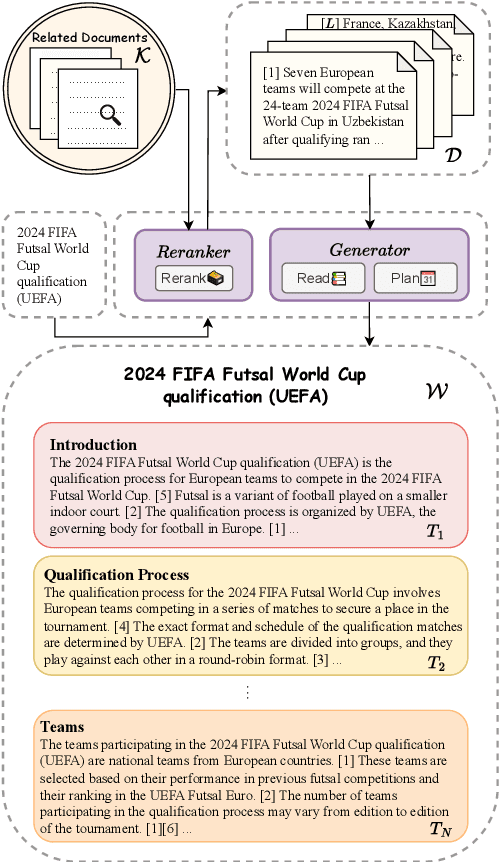
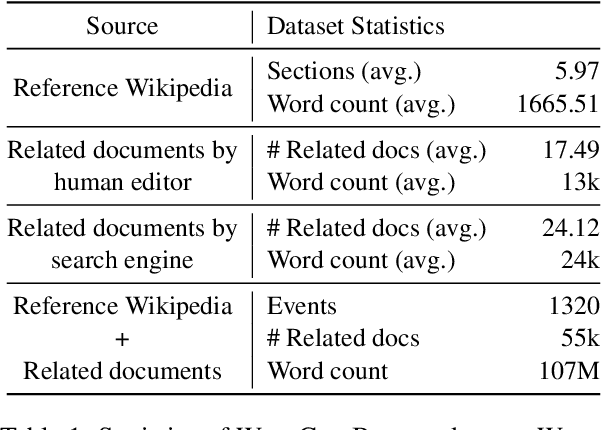
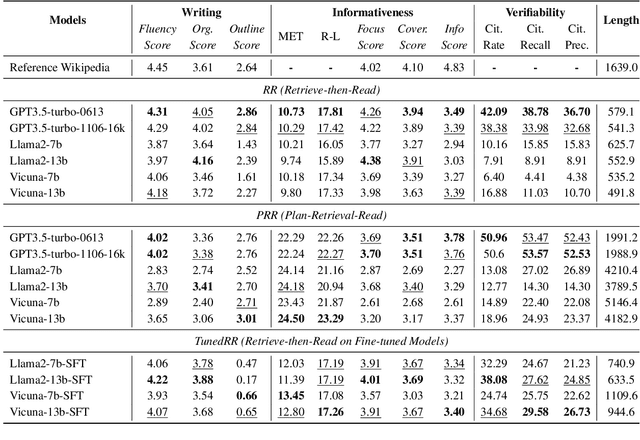
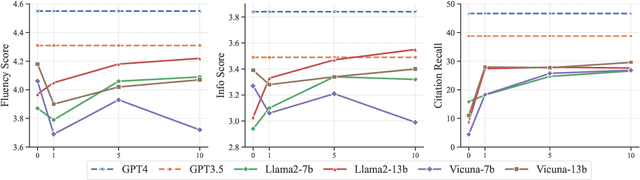
In today's fast-paced world, the growing demand to quickly generate comprehensive and accurate Wikipedia documents for emerging events is both crucial and challenging. However, previous efforts in Wikipedia generation have often fallen short of meeting real-world requirements. Some approaches focus solely on generating segments of a complete Wikipedia document, while others overlook the importance of faithfulness in generation or fail to consider the influence of the pre-training corpus. In this paper, we simulate a real-world scenario where structured full-length Wikipedia documents are generated for emergent events using input retrieved from web sources. To ensure that Large Language Models (LLMs) are not trained on corpora related to recently occurred events, we select events that have taken place recently and introduce a new benchmark Wiki-GenBen, which consists of 309 events paired with their corresponding retrieved web pages for generating evidence. Additionally, we design a comprehensive set of systematic evaluation metrics and baseline methods, to evaluate the capability of LLMs in generating factual full-length Wikipedia documents. The data and code are open-sourced at WikiGenBench.