 Add to Chrome
 Add to Firefox
 Add to Edge
Auteur: Language-Driven Cinematographic Framing for Human-Centric Video Generation
Jun 01, 2026
Generative video models have achieved remarkable visual fidelity and temporal coherence, yet intentional camera control remains elusive. Existing frameworks treat camera motion as a byproduct of pixel synthesis, producing trajectories that are stochastic, spatially inconsistent, and indifferent to the human subject driving the scene. In this work, we present Auteur, a method for language-driven, human-centric camera framing in generative video. Our core insight is that professional filmmakers conceive shots not as world-space trajectories but as framings defined relative to the actor, encoding shot size, angle, and composition as functions of human pose and motion. We formalize this intuition as a human-centric camera parameterization and introduce a Domain-Specific Language (DSL) that is convertible to standard 6-DoF camera parameters. A fine-tuned multimodal large language model then acts as a virtual director, mapping natural language descriptions and coarse human motion to sparse DSL keyframes that are deterministically interpolated into continuous camera trajectories, which are then provided as input to video generators. We train and evaluate Auteur on a new dataset of 34K aligned text, human motion, and DSL-annotated camera trajectories drawn from procedural synthesis and real-world movie footage from the CondensedMovies dataset. Auteur enables cinematographic framing of human-centered scenes, a capability largely absent in prior generative models. To assess this behavior, we propose new framing-focused metrics, and our experiments show that Auteur consistently outperforms existing methods

HyperGAN-CLIP: A Unified Framework for Domain Adaptation, Image Synthesis and Manipulation
Nov 19, 2024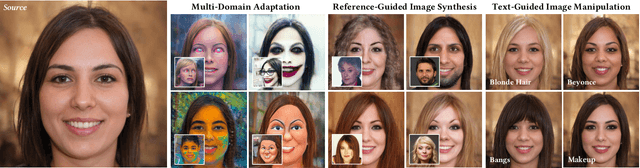
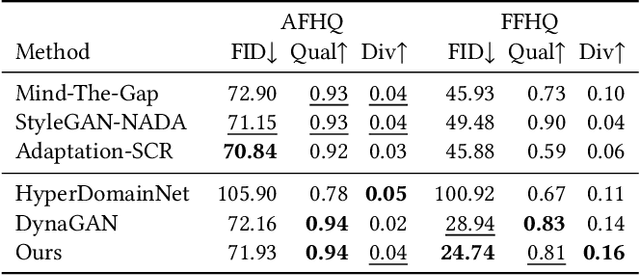
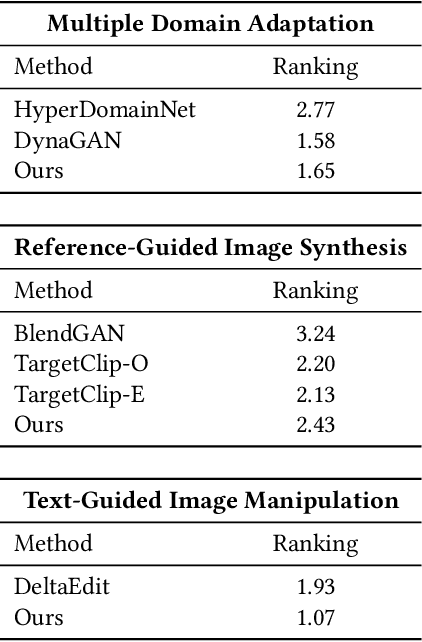
Generative Adversarial Networks (GANs), particularly StyleGAN and its variants, have demonstrated remarkable capabilities in generating highly realistic images. Despite their success, adapting these models to diverse tasks such as domain adaptation, reference-guided synthesis, and text-guided manipulation with limited training data remains challenging. Towards this end, in this study, we present a novel framework that significantly extends the capabilities of a pre-trained StyleGAN by integrating CLIP space via hypernetworks. This integration allows dynamic adaptation of StyleGAN to new domains defined by reference images or textual descriptions. Additionally, we introduce a CLIP-guided discriminator that enhances the alignment between generated images and target domains, ensuring superior image quality. Our approach demonstrates unprecedented flexibility, enabling text-guided image manipulation without the need for text-specific training data and facilitating seamless style transfer. Comprehensive qualitative and quantitative evaluations confirm the robustness and superior performance of our framework compared to existing methods.