 Add to Chrome
 Add to Firefox
 Add to Edge
To Lie or Not to Lie? Investigating The Biased Spread of Global Lies by LLMs
Apr 08, 2026
Misinformation is on the rise, and the strong writing capabilities of LLMs lower the barrier for malicious actors to produce and disseminate false information. We study how LLMs behave when prompted to spread misinformation across languages and target countries, and introduce GlobalLies, a multilingual parallel dataset of 440 misinformation generation prompt templates and 6,867 entities, spanning 8 languages and 195 countries. Using both human annotations and large-scale LLM-as-a-judge evaluations across hundreds of thousands of generations from state-of-the-art models, we show that misinformation generation varies systematically based on the country being discussed. Propagation of lies by LLMs is substantially higher in many lower-resource languages and for countries with a lower Human Development Index (HDI). We find that existing mitigation strategies provide uneven protection: input safety classifiers exhibit cross-lingual gaps, and retrieval-augmented fact-checking remains inconsistent across regions due to unequal information availability. We release GlobalLies for research purposes, aiming to support the development of mitigation strategies to reduce the spread of global misinformation: https://github.com/zohaib-khan5040/globallies

FewMMBench: A Benchmark for Multimodal Few-Shot Learning
Feb 25, 2026As multimodal large language models (MLLMs) advance in handling interleaved image-text data, assessing their few-shot learning capabilities remains an open challenge. In this paper, we introduce FewMMBench, a comprehensive benchmark designed to evaluate MLLMs under few-shot conditions, with a focus on In-Context Learning (ICL) and Chain-of-Thought (CoT) prompting. Covering a diverse suite of multimodal understanding tasks, from attribute recognition to temporal reasoning, FewMMBench enables systematic analysis across task types, model families, and prompting strategies. We evaluate 26 open-weight MLLMs from six model families across zero-shot, few-shot, and CoT-augmented few-shot settings. Our findings reveal that instruction-tuned models exhibit strong zero-shot performance but benefit minimally, or even regress, with additional demonstrations or CoT reasoning. Retrieval-based demonstrations and increased context size also yield limited gains. These results highlight FewMMBench as a rigorous testbed for diagnosing and advancing few-shot capabilities in multimodal LLMs. The data is available at: https://huggingface.co/datasets/mustafaa/FewMMBench
Evaluating Linguistic Capabilities of Multimodal LLMs in the Lens of Few-Shot Learning
Jul 17, 2024The linguistic capabilities of Multimodal Large Language Models (MLLMs) are critical for their effective application across diverse tasks. This study aims to evaluate the performance of MLLMs on the VALSE benchmark, focusing on the efficacy of few-shot In-Context Learning (ICL), and Chain-of-Thought (CoT) prompting. We conducted a comprehensive assessment of state-of-the-art MLLMs, varying in model size and pretraining datasets. The experimental results reveal that ICL and CoT prompting significantly boost model performance, particularly in tasks requiring complex reasoning and contextual understanding. Models pretrained on captioning datasets show superior zero-shot performance, while those trained on interleaved image-text data benefit from few-shot learning. Our findings provide valuable insights into optimizing MLLMs for better grounding of language in visual contexts, highlighting the importance of the composition of pretraining data and the potential of few-shot learning strategies to improve the reasoning abilities of MLLMs.
ViLMA: A Zero-Shot Benchmark for Linguistic and Temporal Grounding in Video-Language Models
Nov 13, 2023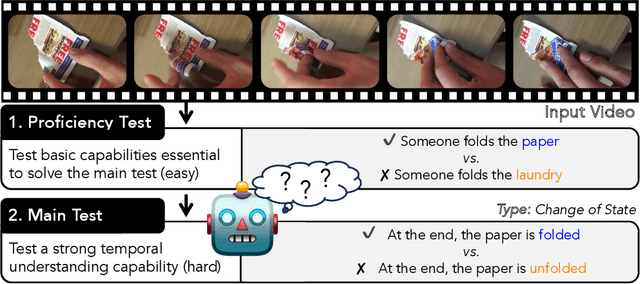
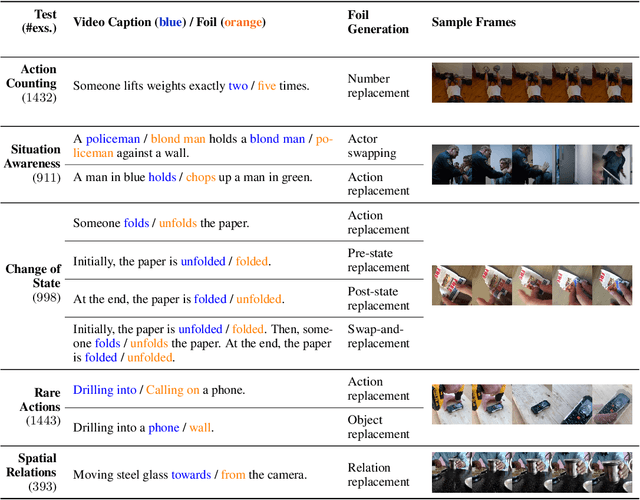
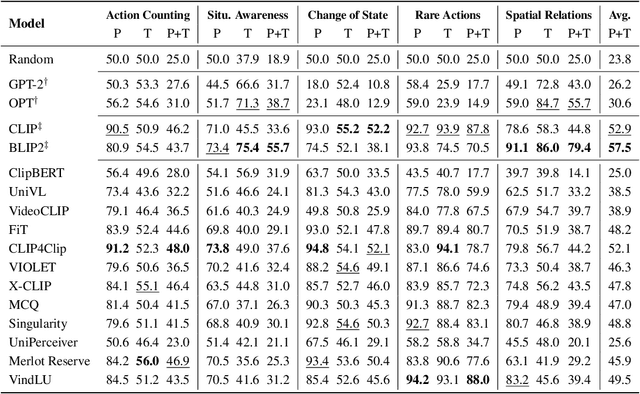
With the ever-increasing popularity of pretrained Video-Language Models (VidLMs), there is a pressing need to develop robust evaluation methodologies that delve deeper into their visio-linguistic capabilities. To address this challenge, we present ViLMA (Video Language Model Assessment), a task-agnostic benchmark that places the assessment of fine-grained capabilities of these models on a firm footing. Task-based evaluations, while valuable, fail to capture the complexities and specific temporal aspects of moving images that VidLMs need to process. Through carefully curated counterfactuals, ViLMA offers a controlled evaluation suite that sheds light on the true potential of these models, as well as their performance gaps compared to human-level understanding. ViLMA also includes proficiency tests, which assess basic capabilities deemed essential to solving the main counterfactual tests. We show that current VidLMs' grounding abilities are no better than those of vision-language models which use static images. This is especially striking once the performance on proficiency tests is factored in. Our benchmark serves as a catalyst for future research on VidLMs, helping to highlight areas that still need to be explored.