 Add to Chrome
 Add to Firefox
 Add to Edge
BeyondMasks: Evaluating Causal and Physical Consistency in Video Object Removal
Aug 20, 2026
Recent advances in generative video models have significantly improved visual realism in video object removal, yet evaluation protocols still focus on masked region fidelity, treating removal as local inpainting. In real scenes, object removal is a causal intervention: eliminating an object also requires removing its induced physical effects, such as shadows, reflections, illumination changes, translucency, and dynamic traces. Existing benchmarks lack aligned clean references or remain limited to simplified synthetic settings, preventing systematic evaluation of causal consistency. We introduce BeyondMasks, a paired benchmark for causally consistent video object removal, consisting of temporally aligned synthetic and real world video pairs with clean background references. The dataset spans diverse photometric, geometric, volumetric, and dynamic interactions, and supports both mask based and instruction driven editing. We further propose CORE, a structured vision language model based evaluation protocol that jointly measures object disappearance and after effect consistency, aligning more closely with human judgments than existing metrics. Benchmarking state of the art methods reveals systematic failures in removing secondary physical effects despite high masked region fidelity, exposing a gap between visual plausibility and causal correctness. BeyondMasks reframes video object removal as causal scene consistency rather than local reconstruction and provides a unified framework for its evaluation.

The Unreasonable Effectiveness of Text Embedding Interpolation for Continuous Image Steering
Mar 18, 2026We present a training-free framework for continuous and controllable image editing at test time for text-conditioned generative models. In contrast to prior approaches that rely on additional training or manual user intervention, we find that a simple steering in the text-embedding space is sufficient to produce smooth edit control. Given a target concept (e.g., enhancing photorealism or changing facial expression), we use a large language model to automatically construct a small set of debiased contrastive prompt pairs, from which we compute a steering vector in the generator's text-encoder space. We then add this vector directly to the input prompt representation to control generation along the desired semantic axis. To obtain a continuous control, we propose an elastic range search procedure that automatically identifies an effective interval of steering magnitudes, avoiding both under-steering (no-edit) and over-steering (changing other attributes). Adding the scaled versions of the same vector within this interval yields smooth and continuous edits. Since our method modifies only textual representations, it naturally generalizes across text-conditioned modalities, including image and video generation. To quantify the steering continuity, we introduce a new evaluation metric that measures the uniformity of semantic change across edit strengths. We compare the continuous editing behavior across methods and find that, despite its simplicity and lightweight design, our approach is comparable to training-based alternatives, outperforming other training-free methods.
RoPECraft: Training-Free Motion Transfer with Trajectory-Guided RoPE Optimization on Diffusion Transformers
May 19, 2025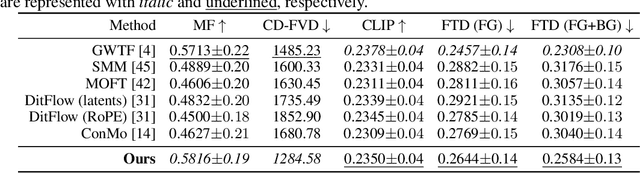
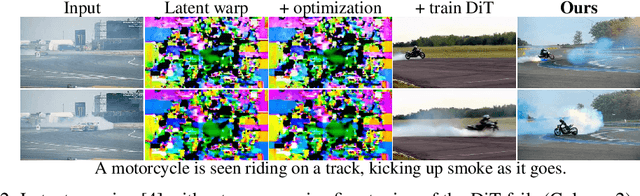
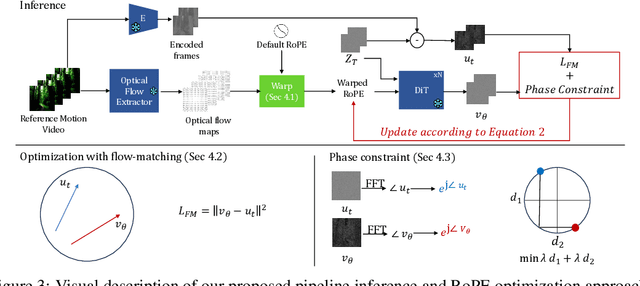
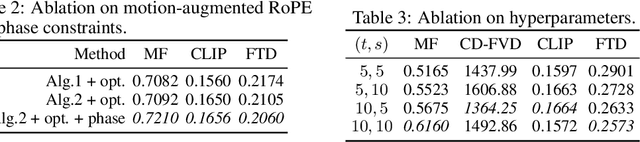
We propose RoPECraft, a training-free video motion transfer method for diffusion transformers that operates solely by modifying their rotary positional embeddings (RoPE). We first extract dense optical flow from a reference video, and utilize the resulting motion offsets to warp the complex-exponential tensors of RoPE, effectively encoding motion into the generation process. These embeddings are then further optimized during denoising time steps via trajectory alignment between the predicted and target velocities using a flow-matching objective. To keep the output faithful to the text prompt and prevent duplicate generations, we incorporate a regularization term based on the phase components of the reference video's Fourier transform, projecting the phase angles onto a smooth manifold to suppress high-frequency artifacts. Experiments on benchmarks reveal that RoPECraft outperforms all recently published methods, both qualitatively and quantitatively.
CLIPAway: Harmonizing Focused Embeddings for Removing Objects via Diffusion Models
Jun 13, 2024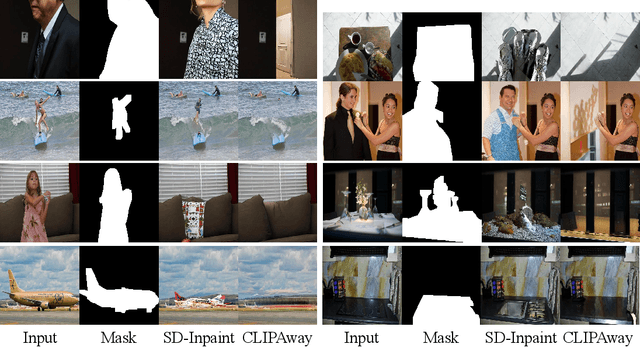
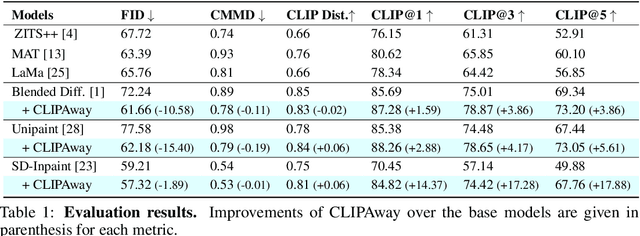
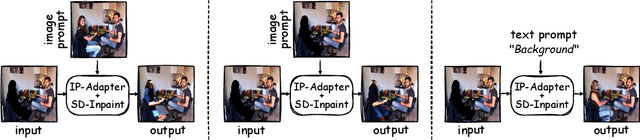
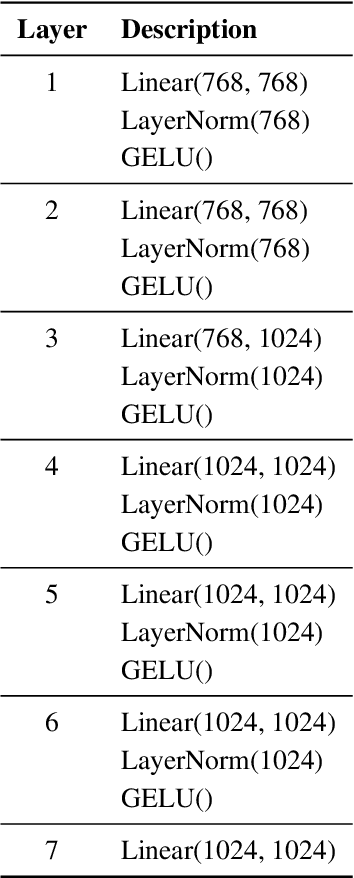
Advanced image editing techniques, particularly inpainting, are essential for seamlessly removing unwanted elements while preserving visual integrity. Traditional GAN-based methods have achieved notable success, but recent advancements in diffusion models have produced superior results due to their training on large-scale datasets, enabling the generation of remarkably realistic inpainted images. Despite their strengths, diffusion models often struggle with object removal tasks without explicit guidance, leading to unintended hallucinations of the removed object. To address this issue, we introduce CLIPAway, a novel approach leveraging CLIP embeddings to focus on background regions while excluding foreground elements. CLIPAway enhances inpainting accuracy and quality by identifying embeddings that prioritize the background, thus achieving seamless object removal. Unlike other methods that rely on specialized training datasets or costly manual annotations, CLIPAway provides a flexible, plug-and-play solution compatible with various diffusion-based inpainting techniques.