 Add to Chrome
 Add to Firefox
 Add to Edge
FullCircle: Effortless 3D Reconstruction from Casual 360$^\circ$ Captures
Mar 23, 2026
Radiance fields have emerged as powerful tools for 3D scene reconstruction. However, casual capture remains challenging due to the narrow field of view of perspective cameras, which limits viewpoint coverage and feature correspondences necessary for reliable camera calibration and reconstruction. While commercially available 360$^\circ$ cameras offer significantly broader coverage than perspective cameras for the same capture effort, existing 360$^\circ$ reconstruction methods require special capture protocols and pre-processing steps that undermine the promise of radiance fields: effortless workflows to capture and reconstruct 3D scenes. We propose a practical pipeline for reconstructing 3D scenes directly from raw 360$^\circ$ camera captures. We require no special capture protocols or pre-processing, and exhibit robustness to a prevalent source of reconstruction errors: the human operator that is visible in all 360$^\circ$ imagery. To facilitate evaluation, we introduce a multi-tiered dataset of scenes captured as raw dual-fisheye images, establishing a benchmark for robust casual 360$^\circ$ reconstruction. Our method significantly outperforms not only vanilla 3DGS for 360$^\circ$ cameras but also robust perspective baselines when perspective cameras are simulated from the same capture, demonstrating the advantages of 360$^\circ$ capture for casual reconstruction. Additional results are available at: https://theialab.github.io/fullcircle

GeoFusionLRM: Geometry-Aware Self-Correction for Consistent 3D Reconstruction
Feb 15, 2026Single-image 3D reconstruction with large reconstruction models (LRMs) has advanced rapidly, yet reconstructions often exhibit geometric inconsistencies and misaligned details that limit fidelity. We introduce GeoFusionLRM, a geometry-aware self-correction framework that leverages the model's own normal and depth predictions to refine structural accuracy. Unlike prior approaches that rely solely on features extracted from the input image, GeoFusionLRM feeds back geometric cues through a dedicated transformer and fusion module, enabling the model to correct errors and enforce consistency with the conditioning image. This design improves the alignment between the reconstructed mesh and the input views without additional supervision or external signals. Extensive experiments demonstrate that GeoFusionLRM achieves sharper geometry, more consistent normals, and higher fidelity than state-of-the-art LRM baselines.
RoPECraft: Training-Free Motion Transfer with Trajectory-Guided RoPE Optimization on Diffusion Transformers
May 19, 2025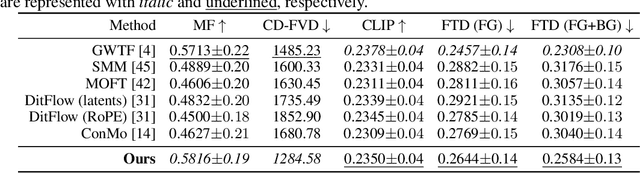
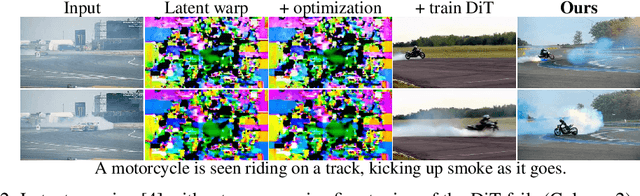
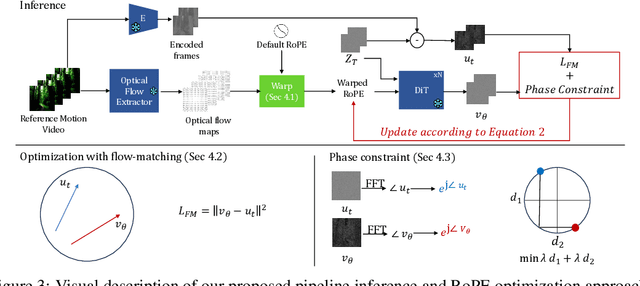
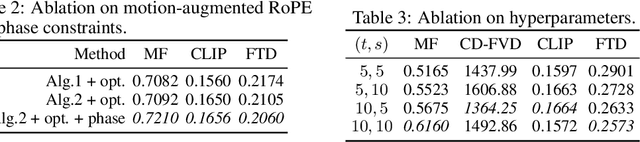
We propose RoPECraft, a training-free video motion transfer method for diffusion transformers that operates solely by modifying their rotary positional embeddings (RoPE). We first extract dense optical flow from a reference video, and utilize the resulting motion offsets to warp the complex-exponential tensors of RoPE, effectively encoding motion into the generation process. These embeddings are then further optimized during denoising time steps via trajectory alignment between the predicted and target velocities using a flow-matching objective. To keep the output faithful to the text prompt and prevent duplicate generations, we incorporate a regularization term based on the phase components of the reference video's Fourier transform, projecting the phase angles onto a smooth manifold to suppress high-frequency artifacts. Experiments on benchmarks reveal that RoPECraft outperforms all recently published methods, both qualitatively and quantitatively.
3D Stylization via Large Reconstruction Model
Apr 30, 2025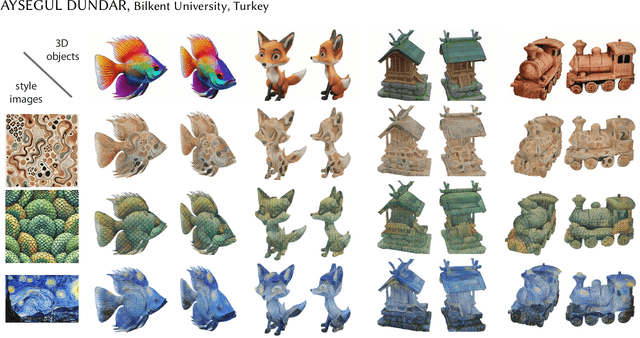

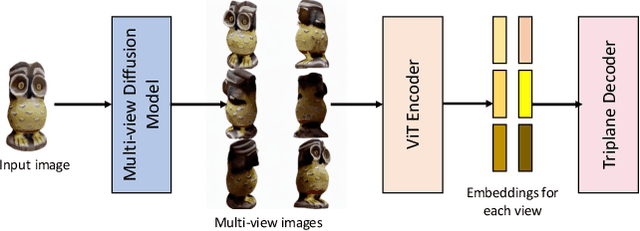
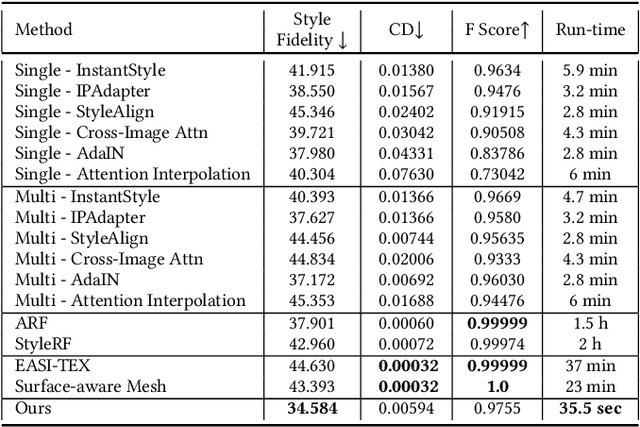
With the growing success of text or image guided 3D generators, users demand more control over the generation process, appearance stylization being one of them. Given a reference image, this requires adapting the appearance of a generated 3D asset to reflect the visual style of the reference while maintaining visual consistency from multiple viewpoints. To tackle this problem, we draw inspiration from the success of 2D stylization methods that leverage the attention mechanisms in large image generation models to capture and transfer visual style. In particular, we probe if large reconstruction models, commonly used in the context of 3D generation, has a similar capability. We discover that the certain attention blocks in these models capture the appearance specific features. By injecting features from a visual style image to such blocks, we develop a simple yet effective 3D appearance stylization method. Our method does not require training or test time optimization. Through both quantitative and qualitative evaluations, we demonstrate that our approach achieves superior results in terms of 3D appearance stylization, significantly improving efficiency while maintaining high-quality visual outcomes.
MD-ProjTex: Texturing 3D Shapes with Multi-Diffusion Projection
Apr 03, 2025We introduce MD-ProjTex, a method for fast and consistent text-guided texture generation for 3D shapes using pretrained text-to-image diffusion models. At the core of our approach is a multi-view consistency mechanism in UV space, which ensures coherent textures across different viewpoints. Specifically, MD-ProjTex fuses noise predictions from multiple views at each diffusion step and jointly updates the per-view denoising directions to maintain 3D consistency. In contrast to existing state-of-the-art methods that rely on optimization or sequential view synthesis, MD-ProjTex is computationally more efficient and achieves better quantitative and qualitative results.
Identity Preserving 3D Head Stylization with Multiview Score Distillation
Nov 20, 2024



3D head stylization transforms realistic facial features into artistic representations, enhancing user engagement across gaming and virtual reality applications. While 3D-aware generators have made significant advancements, many 3D stylization methods primarily provide near-frontal views and struggle to preserve the unique identities of original subjects, often resulting in outputs that lack diversity and individuality. This paper addresses these challenges by leveraging the PanoHead model, synthesizing images from a comprehensive 360-degree perspective. We propose a novel framework that employs negative log-likelihood distillation (LD) to enhance identity preservation and improve stylization quality. By integrating multi-view grid score and mirror gradients within the 3D GAN architecture and introducing a score rank weighing technique, our approach achieves substantial qualitative and quantitative improvements. Our findings not only advance the state of 3D head stylization but also provide valuable insights into effective distillation processes between diffusion models and GANs, focusing on the critical issue of identity preservation. Please visit the https://three-bee.github.io/head_stylization for more visuals.
Dual Encoder GAN Inversion for High-Fidelity 3D Head Reconstruction from Single Images
Sep 30, 2024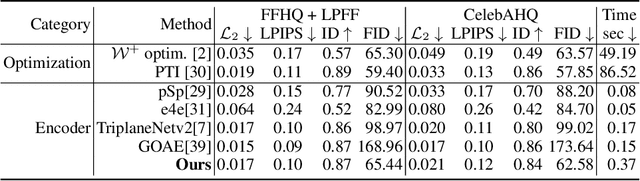
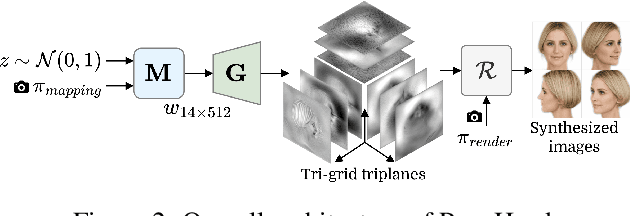
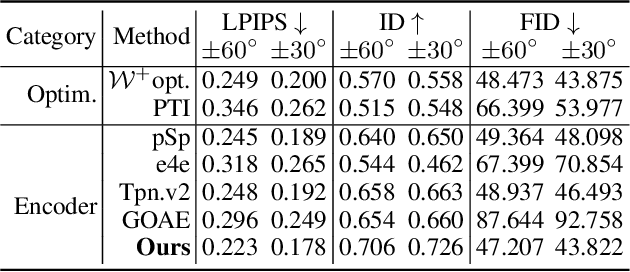
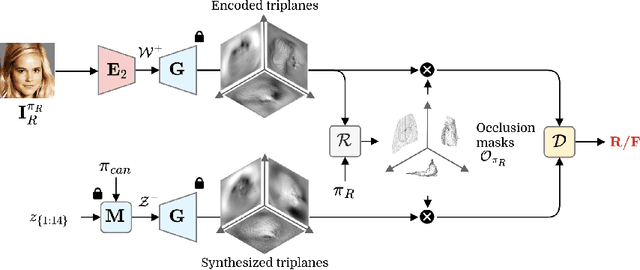
3D GAN inversion aims to project a single image into the latent space of a 3D Generative Adversarial Network (GAN), thereby achieving 3D geometry reconstruction. While there exist encoders that achieve good results in 3D GAN inversion, they are predominantly built on EG3D, which specializes in synthesizing near-frontal views and is limiting in synthesizing comprehensive 3D scenes from diverse viewpoints. In contrast to existing approaches, we propose a novel framework built on PanoHead, which excels in synthesizing images from a 360-degree perspective. To achieve realistic 3D modeling of the input image, we introduce a dual encoder system tailored for high-fidelity reconstruction and realistic generation from different viewpoints. Accompanying this, we propose a stitching framework on the triplane domain to get the best predictions from both. To achieve seamless stitching, both encoders must output consistent results despite being specialized for different tasks. For this reason, we carefully train these encoders using specialized losses, including an adversarial loss based on our novel occlusion-aware triplane discriminator. Experiments reveal that our approach surpasses the existing encoder training methods qualitatively and quantitatively. Please visit the project page: https://berkegokmen1.github.io/dual-enc-3d-gan-inv.
CLIPAway: Harmonizing Focused Embeddings for Removing Objects via Diffusion Models
Jun 13, 2024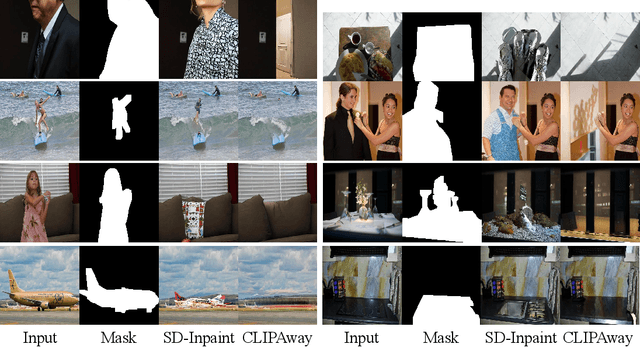
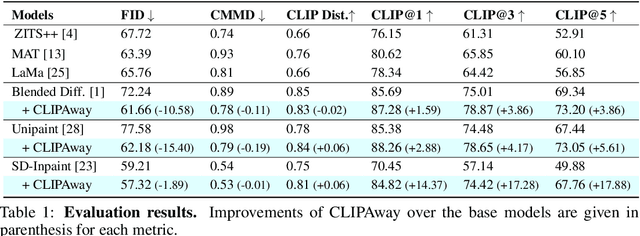
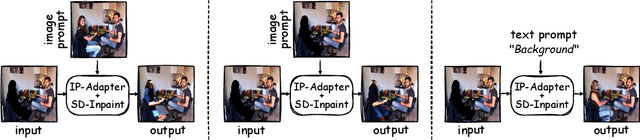
Advanced image editing techniques, particularly inpainting, are essential for seamlessly removing unwanted elements while preserving visual integrity. Traditional GAN-based methods have achieved notable success, but recent advancements in diffusion models have produced superior results due to their training on large-scale datasets, enabling the generation of remarkably realistic inpainted images. Despite their strengths, diffusion models often struggle with object removal tasks without explicit guidance, leading to unintended hallucinations of the removed object. To address this issue, we introduce CLIPAway, a novel approach leveraging CLIP embeddings to focus on background regions while excluding foreground elements. CLIPAway enhances inpainting accuracy and quality by identifying embeddings that prioritize the background, thus achieving seamless object removal. Unlike other methods that rely on specialized training datasets or costly manual annotations, CLIPAway provides a flexible, plug-and-play solution compatible with various diffusion-based inpainting techniques.
Reference-Based 3D-Aware Image Editing with Triplane
Apr 04, 2024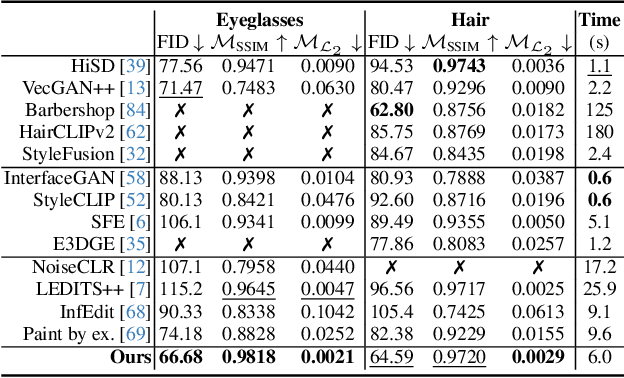
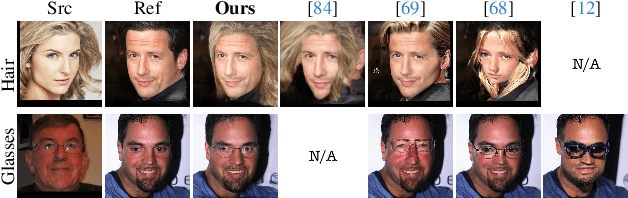
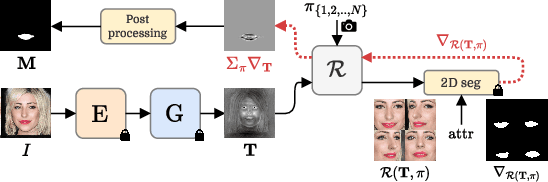
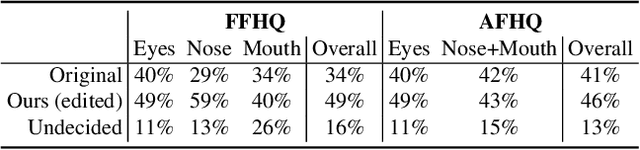
Generative Adversarial Networks (GANs) have emerged as powerful tools not only for high-quality image generation but also for real image editing through manipulation of their interpretable latent spaces. Recent advancements in GANs include the development of 3D-aware models such as EG3D, characterized by efficient triplane-based architectures enabling the reconstruction of 3D geometry from single images. However, scant attention has been devoted to providing an integrated framework for high-quality reference-based 3D-aware image editing within this domain. This study addresses this gap by exploring and demonstrating the effectiveness of EG3D's triplane space for achieving advanced reference-based edits, presenting a unique perspective on 3D-aware image editing through our novel pipeline. Our approach integrates the encoding of triplane features, spatial disentanglement and automatic localization of features in the triplane domain, and fusion learning for desired image editing. Moreover, our framework demonstrates versatility across domains, extending its effectiveness to animal face edits and partial stylization of cartoon portraits. The method shows significant improvements over relevant 3D-aware latent editing and 2D reference-based editing methods, both qualitatively and quantitatively. Project page: https://three-bee.github.io/triplane_edit
Warping the Residuals for Image Editing with StyleGAN
Dec 18, 2023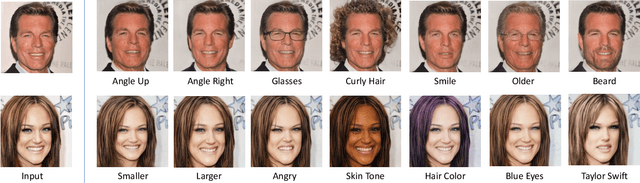
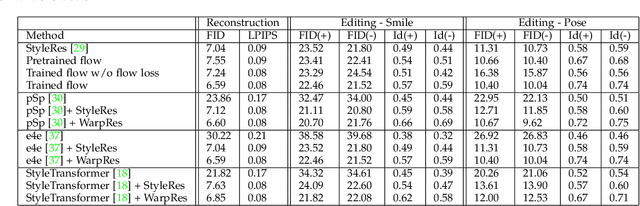
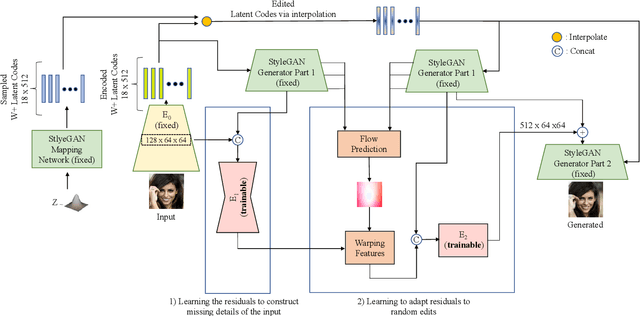
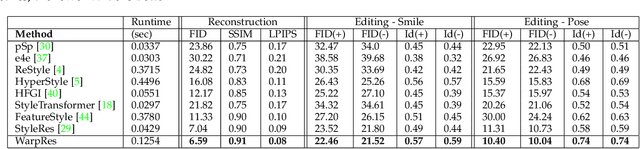
StyleGAN models show editing capabilities via their semantically interpretable latent organizations which require successful GAN inversion methods to edit real images. Many works have been proposed for inverting images into StyleGAN's latent space. However, their results either suffer from low fidelity to the input image or poor editing qualities, especially for edits that require large transformations. That is because low-rate latent spaces lose many image details due to the information bottleneck even though it provides an editable space. On the other hand, higher-rate latent spaces can pass all the image details to StyleGAN for perfect reconstruction of images but suffer from low editing qualities. In this work, we present a novel image inversion architecture that extracts high-rate latent features and includes a flow estimation module to warp these features to adapt them to edits. The flows are estimated from StyleGAN features of edited and unedited latent codes. By estimating the high-rate features and warping them for edits, we achieve both high-fidelity to the input image and high-quality edits. We run extensive experiments and compare our method with state-of-the-art inversion methods. Qualitative metrics and visual comparisons show significant improvements.