 Add to Chrome
 Add to Firefox
 Add to Edge
Leveraging Image Editing Foundation Models for Data-Efficient CT Metal Artifact Reduction
Apr 07, 2026
Metal artifacts from high-attenuation implants severely degrade CT image quality, obscuring critical anatomical structures and posing a challenge for standard deep learning methods that require extensive paired training data. We propose a paradigm shift: reframing artifact reduction as an in-context reasoning task by adapting a general-purpose vision-language diffusion foundation model via parameter-efficient Low-Rank Adaptation (LoRA). By leveraging rich visual priors, our approach achieves effective artifact suppression with only 16 to 128 paired training examples reducing data requirements by two orders of magnitude. Crucially, we demonstrate that domain adaptation is essential for hallucination mitigation; without it, foundation models interpret streak artifacts as erroneous natural objects (e.g., waffles or petri dishes). To ground the restoration, we propose a multi-reference conditioning strategy where clean anatomical exemplars from unrelated subjects are provided alongside the corrupted input, enabling the model to exploit category-specific context to infer uncorrupted anatomy. Extensive evaluation on the AAPM CT-MAR benchmark demonstrates that our method achieves state-of-the-art performance on perceptual and radiological-feature metrics . This work establishes that foundation models, when appropriately adapted, offer a scalable alternative for interpretable, data-efficient medical image reconstruction. Code is available at https://github.com/ahmetemirdagi/CT-EditMAR.

Edit2Interp: Adapting Image Foundation Models from Spatial Editing to Video Frame Interpolation with Few-Shot Learning
Mar 16, 2026Pre-trained image editing models exhibit strong spatial reasoning and object-aware transformation capabilities acquired from billions of image-text pairs, yet they possess no explicit temporal modeling. This paper demonstrates that these spatial priors can be repurposed to unlock temporal synthesis capabilities through minimal adaptation - without introducing any video-specific architecture or motion estimation modules. We show that a large image editing model (Qwen-Image-Edit), originally designed solely for static instruction-based edits, can be adapted for Video Frame Interpolation (VFI) using only 64-256 training samples via Low-Rank Adaptation (LoRA). Our core contribution is revealing that the model's inherent understanding of "how objects transform" in static scenes contains latent temporal reasoning that can be activated through few-shot fine-tuning. While the baseline model completely fails at producing coherent intermediate frames, our parameter-efficient adaptation successfully unlocks its interpolation capability. Rather than competing with task-specific VFI methods trained from scratch on massive datasets, our work establishes that foundation image editing models possess untapped potential for temporal tasks, offering a data-efficient pathway for video synthesis in resource-constrained scenarios. This bridges the gap between image manipulation and video understanding, suggesting that spatial and temporal reasoning may be more intertwined in foundation models than previously recognized
Edit2Restore:Few-Shot Image Restoration via Parameter-Efficient Adaptation of Pre-trained Editing Models
Jan 06, 2026Image restoration has traditionally required training specialized models on thousands of paired examples per degradation type. We challenge this paradigm by demonstrating that powerful pre-trained text-conditioned image editing models can be efficiently adapted for multiple restoration tasks through parameter-efficient fine-tuning with remarkably few examples. Our approach fine-tunes LoRA adapters on FLUX.1 Kontext, a state-of-the-art 12B parameter flow matching model for image-to-image translation, using only 16-128 paired images per task, guided by simple text prompts that specify the restoration operation. Unlike existing methods that train specialized restoration networks from scratch with thousands of samples, we leverage the rich visual priors already encoded in large-scale pre-trained editing models, dramatically reducing data requirements while maintaining high perceptual quality. A single unified LoRA adapter, conditioned on task-specific text prompts, effectively handles multiple degradations including denoising, deraining, and dehazing. Through comprehensive ablation studies, we analyze: (i) the impact of training set size on restoration quality, (ii) trade-offs between task-specific versus unified multi-task adapters, (iii) the role of text encoder fine-tuning, and (iv) zero-shot baseline performance. While our method prioritizes perceptual quality over pixel-perfect reconstruction metrics like PSNR/SSIM, our results demonstrate that pre-trained image editing models, when properly adapted, offer a compelling and data-efficient alternative to traditional image restoration approaches, opening new avenues for few-shot, prompt-guided image enhancement. The code to reproduce our results are available at: https://github.com/makinyilmaz/Edit2Restore
SonicDiffusion: Audio-Driven Image Generation and Editing with Pretrained Diffusion Models
May 01, 2024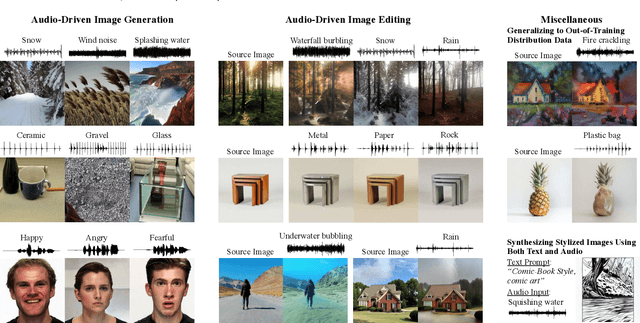
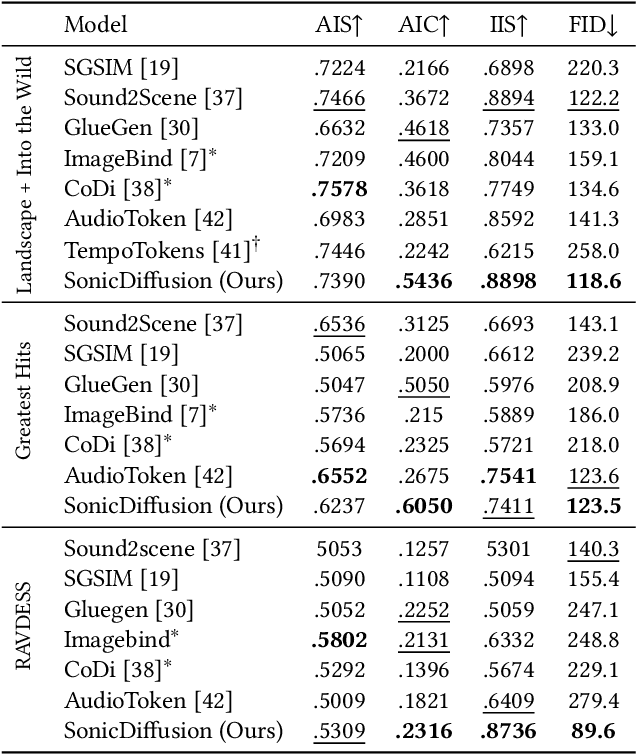
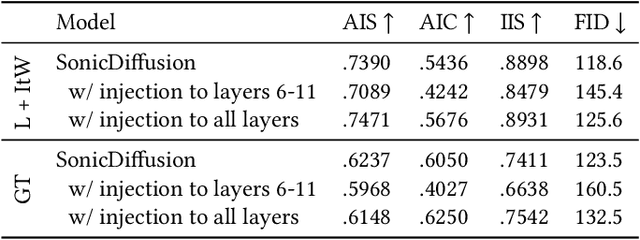
We are witnessing a revolution in conditional image synthesis with the recent success of large scale text-to-image generation methods. This success also opens up new opportunities in controlling the generation and editing process using multi-modal input. While spatial control using cues such as depth, sketch, and other images has attracted a lot of research, we argue that another equally effective modality is audio since sound and sight are two main components of human perception. Hence, we propose a method to enable audio-conditioning in large scale image diffusion models. Our method first maps features obtained from audio clips to tokens that can be injected into the diffusion model in a fashion similar to text tokens. We introduce additional audio-image cross attention layers which we finetune while freezing the weights of the original layers of the diffusion model. In addition to audio conditioned image generation, our method can also be utilized in conjuction with diffusion based editing methods to enable audio conditioned image editing. We demonstrate our method on a wide range of audio and image datasets. We perform extensive comparisons with recent methods and show favorable performance.