 Add to Chrome
 Add to Firefox
 Add to Edge
Hybrid Quantum-inspired Kolmogorov-Arnold Networks for Privacy-Aware Federated Biosignal Learning
Aug 14, 2026
Electrocardiogram (ECG) recordings are sensitive biomedical data, limiting the ability of hospitals and wearable devices to share raw signals for centralized model training. Federated learning addresses this practical privacy constraint by enabling collaborative model training while keeping raw biosignal data at their respective sources. However, federated ECG classification remains challenging due to limited client-side samples, imbalanced arrhythmia labels, and non-independent and identically distributed (non-IID) data across clients. These constraints require classifiers that are both communication-efficient and robust to cross-client distribution shifts. In this work, we evaluate a hybrid quantum-inspired Kolmogorov-Arnold network (HQKAN) against a multilayer perceptron (MLP) for five-class arrhythmia classification on the MIT-BIH dataset and three-class classification on the INCART dataset under federated averaging (FedAvg). Across multiple client configurations, HQKAN improves most aggregate and minority-class metrics while using 37.35% fewer trainable parameters and reducing communication cost by 24.89% on MIT-BIH; on INCART, it achieves corresponding reductions of 44.81% and 36.41%. These results indicate that HQKAN offers a compact, communication-efficient and robust alternative to the MLP baseline for privacy-aware federated learning on biosignal data.

Complementary Matrix-Gated QKAN Fast-Weight Programmers for Quantum Dynamics Forecasting
Jul 30, 2026Sequence models must decide what to write into memory and what to retain. In quantum and quantum-inspired sequence learning, nonlinear recurrent updates often require repeated circuit evaluations and sequential backpropagation through time, making long contexts costly. Gated fast-weight programmers (FWPs) based on quantum-inspired Kolmogorov-Arnold networks (QKANs) alleviate this bottleneck by storing context in time-varying fast parameters. However, their scalar gate applies one retention-write balance to every fast-state coordinate, forcing all parameters to share a memory timescale. We introduce Self-Modulating QKAN-based FWPs, which replace this broadcast gate with low-rank-generated element-wise modulation of the new-proposal branch, a bounded old-state branch, or both. We further propose Complementary Matrix Gating (CMG), which uses one sigmoid matrix gate to retain the old state and its complement to write the new proposal. CMG provides coordinate-wise memory control while preserving the bounded convex update and affine prefix-scan structure of scalar gating, at the modulation-head cost of a single-branch rule. We compare four self-modulating rules with scalar gating across four FWP architectures combining classical and QKAN-based slow and fast programmers. Across seven single-step forecasting benchmarks and five sequence lengths, CMG gives the most consistent improvements for architectures whose fast programmer incorporates a QKAN-based module. In direct multi-step forecasting of Jaynes-Cummings and transmon-resonator dynamics simulated with CUDA-Q Dynamics, CMG models maintain mean-squared errors on the order of 0.001 or lower across forecasting horizons of 4, 8, and 16 steps, while improving on their scalar-gated counterparts by at least 91.2%. These results establish coordinate-wise complementary modulation as a stable and effective update for QKAN-based FWPs.
Rethinking Quantum Continual Learning with Quantum Fisher Information
Jul 17, 2026Quantum continual learning aims to train quantum models on sequential tasks without losing previously learned knowledge. However, variational quantum classifiers (VQCs) are prone to catastrophic forgetting under nonstationary task distributions. We propose quantum elastic weight consolidation (QEWC), a quantum Fisher information (QFI)-informed regularization method for mitigating forgetting. Unlike conventional elastic weight consolidation based on classical Fisher information (CFI), which measures parameter importance through measurement-dependent output statistics, QEWC uses QFI to quantify the intrinsic sensitivity of the parameterized quantum state. This gives an information-geometric view in which important parameters are identified by the local response of the quantum state manifold. We evaluate QEWC on VQCs trained on sequential binary classification tasks, including classical image-classification and quantum phase-classification tasks. Simulations show that sequential training without regularization causes severe forgetting, while both CFI-based EWC and QFI-based QEWC improve retention of previous tasks. Mechanistic analyses further show that the two methods impose different regularization geometries: CFI acts selectively on measurement-sensitive directions, whereas QFI imposes a denser state-geometric constraint over parameter space. Under depolarizing noise, CFI values are strongly suppressed by degraded measurement statistics, while QFI preserves a more stable sensitivity structure of the noisy parameterized quantum state. These results establish QEWC as a physically motivated approach for studying and mitigating forgetting in quantum continual learning through quantum-state geometry.
Do Quantum Transformers Help? A Systematic VQC Architecture Comparison on Tabular Benchmarks
Apr 27, 2026Variational quantum circuits (VQCs) are a leading approach to quantum machine learning on near-term devices, yet it remains unclear which circuit architecture yields the best accuracy-parameter trade-off on classical tabular data. We present a systematic empirical comparison of four VQC families -- multi-layer fully-connected (FC-VQC), residual (ResNet-VQC), hybrid quantum-classical transformer (QT), and fully quantum transformer (FQT) -- across five regression and classification benchmarks. Our key findings are: \textbf{(i)}~FC-VQCs achieve 90-96\% of the $R^2$ of attention-based VQCs while using 40-50\% fewer parameters, and consistently outperform equal-capacity MLPs (mean $R^2{=}0.829$ vs.\ MLP$_{720}$'s $0.753$ on Boston Housing, 3-seed average); \textbf{(ii)}~FC-VQC's Type~4 inter-block connectivity provides partial cross-token mixing that approximates the role of attention -- explicit quantum self-attention yields only marginal gains on most datasets while significantly increasing parameter count; \textbf{(iii)}~expressibility saturates at circuit depth~${\approx}\,3$, explaining why shallow VQCs already cover the Hilbert space effectively; \textbf{(iv)}~LayerNorm on the fully quantum transformer improves classification accuracy, suggesting normalization is important when all operations are quantum; \textbf{(v)}~in our noise study on Boston Housing, FQT degrades gracefully under depolarizing noise while QT collapses. All results are validated across three random seeds. These findings provide practical architectural guidance for deploying VQCs on near-term quantum hardware.
FreqLens: Interpretable Frequency Attribution for Time Series Forecasting
Feb 09, 2026Time series forecasting models often lack interpretability, limiting their adoption in domains requiring explainable predictions. We propose \textsc{FreqLens}, an interpretable forecasting framework that discovers and attributes predictions to learnable frequency components. \textsc{FreqLens} introduces two key innovations: (1) \emph{learnable frequency discovery} -- frequency bases are parameterized via sigmoid mapping and learned from data with diversity regularization, enabling automatic discovery of dominant periodic patterns without domain knowledge; and (2) \emph{axiomatic frequency attribution} -- a theoretically grounded framework that provably satisfies Completeness, Faithfulness, Null-Frequency, and Symmetry axioms, with per-frequency attributions equivalent to Shapley values. On Traffic and Weather datasets, \textsc{FreqLens} achieves competitive or superior performance while discovering physically meaningful frequencies: all 5 independent runs discover the 24-hour daily cycle ($24.6 \pm 0.1$h, 2.5\% error) and 12-hour half-daily cycle ($11.8 \pm 0.1$h, 1.6\% error) on Traffic, and weekly cycles ($10\times$ longer than the input window) on Weather. These results demonstrate genuine frequency-level knowledge discovery with formal theoretical guarantees on attribution quality.
A Unified SPD Token Transformer Framework for EEG Classification: Systematic Comparison of Geometric Embeddings
Jan 29, 2026Spatial covariance matrices of EEG signals are Symmetric Positive Definite (SPD) and lie on a Riemannian manifold, yet the theoretical connection between embedding geometry and optimization dynamics remains unexplored. We provide a formal analysis linking embedding choice to gradient conditioning and numerical stability for SPD manifolds, establishing three theoretical results: (1) BWSPD's $\sqrtκ$ gradient conditioning (vs $κ$ for Log-Euclidean) via Daleckii-Kreĭn matrices provides better gradient conditioning on high-dimensional inputs ($d \geq 22$), with this advantage reducing on low-dimensional inputs ($d \leq 8$) where eigendecomposition overhead dominates; (2) Embedding-Space Batch Normalization (BN-Embed) approximates Riemannian normalization up to $O(\varepsilon^2)$ error, yielding $+26\%$ accuracy on 56-channel ERP data but negligible effect on 8-channel SSVEP data, matching the channel-count-dependent prediction; (3) bi-Lipschitz bounds prove BWSPD tokens preserve manifold distances with distortion governed solely by the condition ratio $κ$. We validate these predictions via a unified Transformer framework comparing BWSPD, Log-Euclidean, and Euclidean embeddings within identical architecture across 1,500+ runs on three EEG paradigms (motor imagery, ERP, SSVEP; 36 subjects). Our Log-Euclidean Transformer achieves state-of-the-art performance on all datasets, substantially outperforming classical Riemannian classifiers and recent SPD baselines, while BWSPD offers competitive accuracy with similar training time.
Quantum Reinforcement Learning-Guided Diffusion Model for Image Synthesis via Hybrid Quantum-Classical Generative Model Architectures
Sep 17, 2025Diffusion models typically employ static or heuristic classifier-free guidance (CFG) schedules, which often fail to adapt across timesteps and noise conditions. In this work, we introduce a quantum reinforcement learning (QRL) controller that dynamically adjusts CFG at each denoising step. The controller adopts a hybrid quantum--classical actor--critic architecture: a shallow variational quantum circuit (VQC) with ring entanglement generates policy features, which are mapped by a compact multilayer perceptron (MLP) into Gaussian actions over $\Delta$CFG, while a classical critic estimates value functions. The policy is optimized using Proximal Policy Optimization (PPO) with Generalized Advantage Estimation (GAE), guided by a reward that balances classification confidence, perceptual improvement, and action regularization. Experiments on CIFAR-10 demonstrate that our QRL policy improves perceptual quality (LPIPS, PSNR, SSIM) while reducing parameter count compared to classical RL actors and fixed schedules. Ablation studies on qubit number and circuit depth reveal trade-offs between accuracy and efficiency, and extended evaluations confirm robust generation under long diffusion schedules.
Unraveling Quantum Environments: Transformer-Assisted Learning in Lindblad Dynamics
May 11, 2025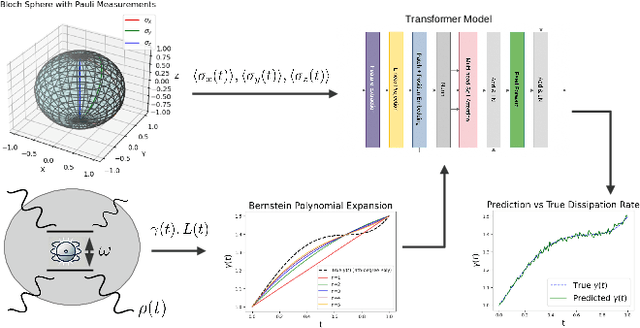
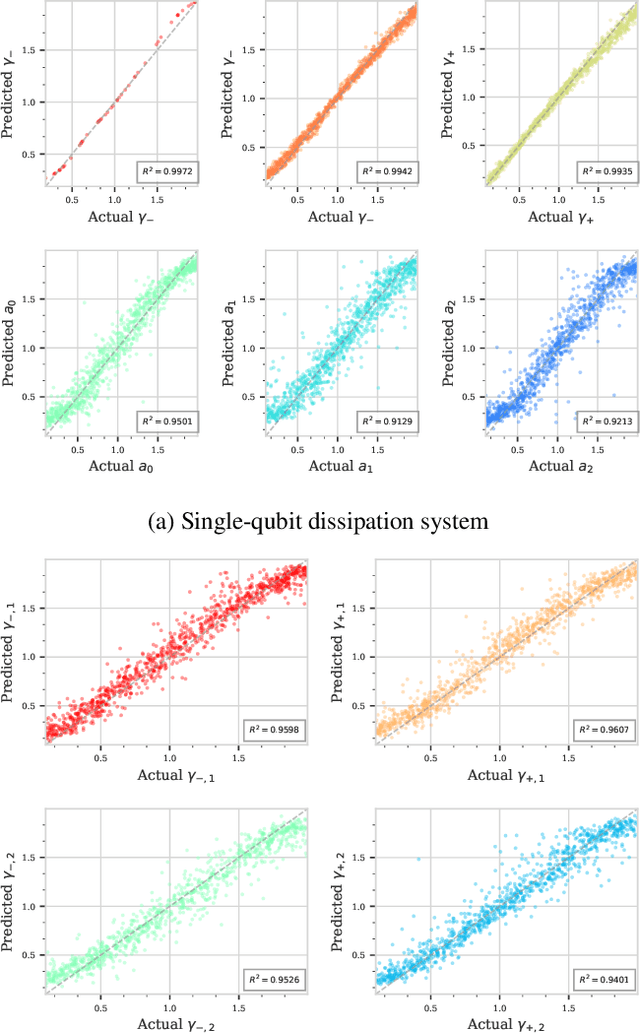
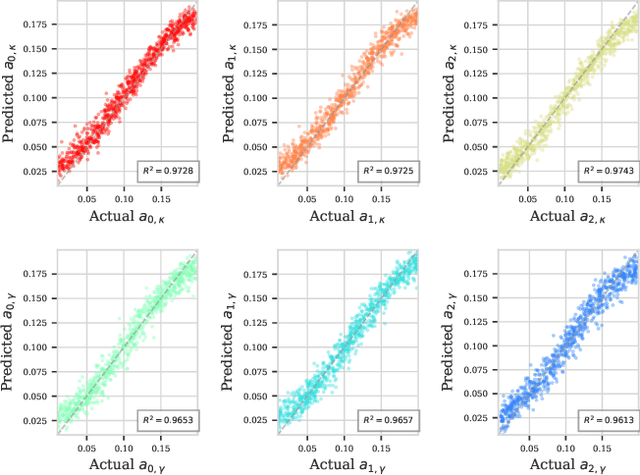
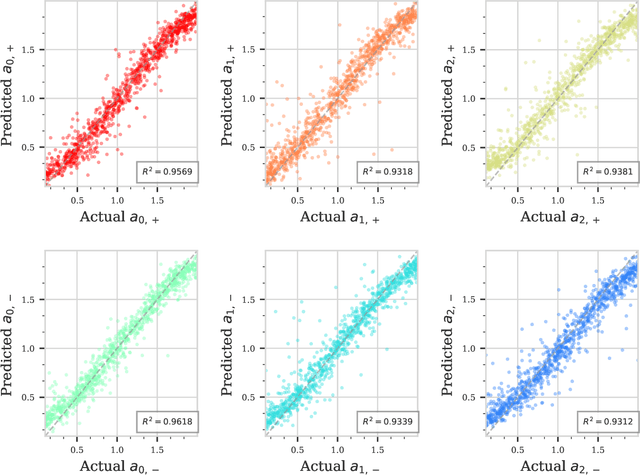
Understanding dissipation in open quantum systems is crucial for the development of robust quantum technologies. In this work, we introduce a Transformer-based machine learning framework to infer time-dependent dissipation rates in quantum systems governed by the Lindblad master equation. Our approach uses time series of observable quantities, such as expectation values of single Pauli operators, as input to learn dissipation profiles without requiring knowledge of the initial quantum state or even the system Hamiltonian. We demonstrate the effectiveness of our approach on a hierarchy of open quantum models of increasing complexity, including single-qubit systems with time-independent or time-dependent jump rates, two-qubit interacting systems (e.g., Heisenberg and transverse Ising models), and the Jaynes--Cummings model involving light--matter interaction and cavity loss with time-dependent decay rates. Our method accurately reconstructs both fixed and time-dependent decay rates from observable time series. To support this, we prove that under reasonable assumptions, the jump rates in all these models are uniquely determined by a finite set of observables, such as qubit and photon measurements. In practice, we combine Transformer-based architectures with lightweight feature extraction techniques to efficiently learn these dynamics. Our results suggest that modern machine learning tools can serve as scalable and data-driven alternatives for identifying unknown environments in open quantum systems.
Quantum Adaptive Self-Attention for Quantum Transformer Models
Apr 05, 2025Transformer models have revolutionized sequential learning across various domains, yet their self-attention mechanism incurs quadratic computational cost, posing limitations for real-time and resource-constrained tasks. To address this, we propose Quantum Adaptive Self-Attention (QASA), a novel hybrid architecture that enhances classical Transformer models with a quantum attention mechanism. QASA replaces dot-product attention with a parameterized quantum circuit (PQC) that adaptively captures inter-token relationships in the quantum Hilbert space. Additionally, a residual quantum projection module is introduced before the feedforward network to further refine temporal features. Our design retains classical efficiency in earlier layers while injecting quantum expressiveness in the final encoder block, ensuring compatibility with current NISQ hardware. Experiments on synthetic time-series tasks demonstrate that QASA achieves faster convergence and superior generalization compared to both standard Transformers and reduced classical variants. Preliminary complexity analysis suggests potential quantum advantages in gradient computation, opening new avenues for efficient quantum deep learning models.
Computational Limits of Low-Rank Adaptation (LoRA) for Transformer-Based Models
Jun 05, 2024We study the computational limits of Low-Rank Adaptation (LoRA) update for finetuning transformer-based models using fine-grained complexity theory. Our key observation is that the existence of low-rank decompositions within the gradient computation of LoRA adaptation leads to possible algorithmic speedup. This allows us to (i) identify a phase transition behavior and (ii) prove the existence of nearly linear algorithms by controlling the LoRA update computation term by term, assuming the Strong Exponential Time Hypothesis (SETH). For the former, we identify a sharp transition in the efficiency of all possible rank-$r$ LoRA update algorithms for transformers, based on specific norms resulting from the multiplications of the input sequence $\mathbf{X}$, pretrained weights $\mathbf{W^\star}$, and adapter matrices $\alpha \mathbf{B} \mathbf{A} / r$. Specifically, we derive a shared upper bound threshold for such norms and show that efficient (sub-quadratic) approximation algorithms of LoRA exist only below this threshold. For the latter, we prove the existence of nearly linear approximation algorithms for LoRA adaptation by utilizing the hierarchical low-rank structures of LoRA gradients and approximating the gradients with a series of chained low-rank approximations. To showcase our theory, we consider two practical scenarios: partial (e.g., only $\mathbf{W}_V$ and $\mathbf{W}_Q$) and full adaptations (e.g., $\mathbf{W}_Q$, $\mathbf{W}_V$, and $\mathbf{W}_K$) of weights in attention heads.