 Add to Chrome
 Add to Firefox
 Add to Edge
Hybrid Quantum-inspired Kolmogorov-Arnold Networks for Privacy-Aware Federated Biosignal Learning
Aug 14, 2026
Electrocardiogram (ECG) recordings are sensitive biomedical data, limiting the ability of hospitals and wearable devices to share raw signals for centralized model training. Federated learning addresses this practical privacy constraint by enabling collaborative model training while keeping raw biosignal data at their respective sources. However, federated ECG classification remains challenging due to limited client-side samples, imbalanced arrhythmia labels, and non-independent and identically distributed (non-IID) data across clients. These constraints require classifiers that are both communication-efficient and robust to cross-client distribution shifts. In this work, we evaluate a hybrid quantum-inspired Kolmogorov-Arnold network (HQKAN) against a multilayer perceptron (MLP) for five-class arrhythmia classification on the MIT-BIH dataset and three-class classification on the INCART dataset under federated averaging (FedAvg). Across multiple client configurations, HQKAN improves most aggregate and minority-class metrics while using 37.35% fewer trainable parameters and reducing communication cost by 24.89% on MIT-BIH; on INCART, it achieves corresponding reductions of 44.81% and 36.41%. These results indicate that HQKAN offers a compact, communication-efficient and robust alternative to the MLP baseline for privacy-aware federated learning on biosignal data.

Complementary Matrix-Gated QKAN Fast-Weight Programmers for Quantum Dynamics Forecasting
Jul 30, 2026Sequence models must decide what to write into memory and what to retain. In quantum and quantum-inspired sequence learning, nonlinear recurrent updates often require repeated circuit evaluations and sequential backpropagation through time, making long contexts costly. Gated fast-weight programmers (FWPs) based on quantum-inspired Kolmogorov-Arnold networks (QKANs) alleviate this bottleneck by storing context in time-varying fast parameters. However, their scalar gate applies one retention-write balance to every fast-state coordinate, forcing all parameters to share a memory timescale. We introduce Self-Modulating QKAN-based FWPs, which replace this broadcast gate with low-rank-generated element-wise modulation of the new-proposal branch, a bounded old-state branch, or both. We further propose Complementary Matrix Gating (CMG), which uses one sigmoid matrix gate to retain the old state and its complement to write the new proposal. CMG provides coordinate-wise memory control while preserving the bounded convex update and affine prefix-scan structure of scalar gating, at the modulation-head cost of a single-branch rule. We compare four self-modulating rules with scalar gating across four FWP architectures combining classical and QKAN-based slow and fast programmers. Across seven single-step forecasting benchmarks and five sequence lengths, CMG gives the most consistent improvements for architectures whose fast programmer incorporates a QKAN-based module. In direct multi-step forecasting of Jaynes-Cummings and transmon-resonator dynamics simulated with CUDA-Q Dynamics, CMG models maintain mean-squared errors on the order of 0.001 or lower across forecasting horizons of 4, 8, and 16 steps, while improving on their scalar-gated counterparts by at least 91.2%. These results establish coordinate-wise complementary modulation as a stable and effective update for QKAN-based FWPs.
Rethinking Quantum Continual Learning with Quantum Fisher Information
Jul 17, 2026Quantum continual learning aims to train quantum models on sequential tasks without losing previously learned knowledge. However, variational quantum classifiers (VQCs) are prone to catastrophic forgetting under nonstationary task distributions. We propose quantum elastic weight consolidation (QEWC), a quantum Fisher information (QFI)-informed regularization method for mitigating forgetting. Unlike conventional elastic weight consolidation based on classical Fisher information (CFI), which measures parameter importance through measurement-dependent output statistics, QEWC uses QFI to quantify the intrinsic sensitivity of the parameterized quantum state. This gives an information-geometric view in which important parameters are identified by the local response of the quantum state manifold. We evaluate QEWC on VQCs trained on sequential binary classification tasks, including classical image-classification and quantum phase-classification tasks. Simulations show that sequential training without regularization causes severe forgetting, while both CFI-based EWC and QFI-based QEWC improve retention of previous tasks. Mechanistic analyses further show that the two methods impose different regularization geometries: CFI acts selectively on measurement-sensitive directions, whereas QFI imposes a denser state-geometric constraint over parameter space. Under depolarizing noise, CFI values are strongly suppressed by degraded measurement statistics, while QFI preserves a more stable sensitivity structure of the noisy parameterized quantum state. These results establish QEWC as a physically motivated approach for studying and mitigating forgetting in quantum continual learning through quantum-state geometry.
Parameter-Efficient Quantum-Inspired Fast Weight Programmers for Traffic-Matrix Forecasting
Jun 26, 2026Traffic matrices (TMs) capture network-wide origin-destination demand and are central to traffic engineering, yet accurate whole-matrix forecasting remains challenging when prediction must be performed under the memory, update, and training-budget constraints of online network control. This paper investigates whether compact quantum-inspired recurrent models can provide effective TM forecasts without relying on dedicated graph, transformer, or diffusion modules. We adapt gated quantum-inspired Kolmogorov-Arnold network fast-weight programmers (QKAN-FWPs) to direct multi-step Abilene TM forecasting, where each model predicts the next 20 five-minute frames of a 144-channel origin-destination (OD) matrix from a two-hour history. We benchmark three QKAN placement variants against a matched-size long short-term memory (LSTM) network, a larger LSTM, and a classical gated fast-weight programmer under a shared fixed-budget training protocol. Among the evaluated recurrent models, G-QKANFWP achieves the best pooled root-mean-square error (RMSE), while using only 22.4% of the larger LSTM. It also outperforms both the matched-size LSTM and the classical G-FWP baseline, indicating that the gain is not due to gated fast-weight framework alone. Convergence and channel-wise analyses further show that the quantum-inspired variants obtain lower validation-loss area under the learning curve (AULC) than matched-size recurrent baselines, while G-QKANFWP and GQKAN-FWP achieve substantially more OD-channel wins. These results identify a classical slow programmer with a quantum-inspired fast programmer as a promising accuracy-efficiency design for resource-conscious network traffic-matrix forecasting.
Generative Quantum-inspired Kolmogorov-Arnold Eigensolver
May 06, 2026High-performance computing (HPC) is increasingly important for scalable quantum chemistry workflows that couple classical generative models, quantum circuit simulation, and selected configuration interaction postprocessing. We present the generative quantum-inspired Kolmogorov-Arnold eigensolver (GQKAE), a parameter-efficient extension of the generative quantum eigensolver (GQE) for quantum chemistry. GQKAE replaces the parameter-heavy feed-forward network components in GPT-style generative eigensolvers with hybrid quantum-inspired Kolmogorov-Arnold network modules, forming a compact HQKANsformer backbone. The method preserves autoregressive operator selection and the quantum-selected configuration interaction evaluation pipeline, while using single-qubit DatA Re-Uploading ActivatioN modules to provide expressive nonlinear mappings. Numerical benchmarks on H4, N2, LiH, C2H6, H2O, and the H2O dimer show that GQKAE achieves chemical accuracy comparable to the GPT-based GQE architecture, while reducing trainable parameters and memory by approximately 66% and improving wall-time performance. For strongly correlated systems such as N2 and LiH, GQKAE also improves convergence behavior and final energy errors. These results indicate that quantum-inspired Kolmogorov-Arnold networks can reduce classical-side overhead while preserving circuit-generation quality, offering a scalable route for HPC-quantum co-design on near-term quantum platforms.
Quantum Pointwise Convolution: A Flexible and Scalable Approach for Neural Network Enhancement
Dec 02, 2024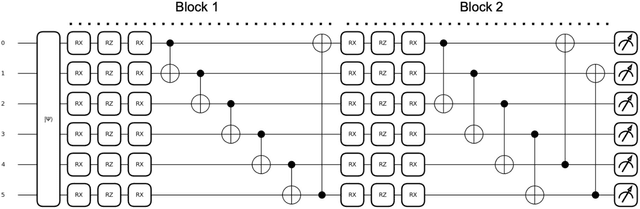
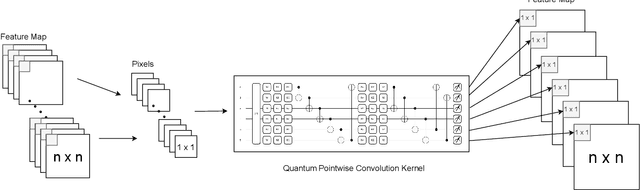
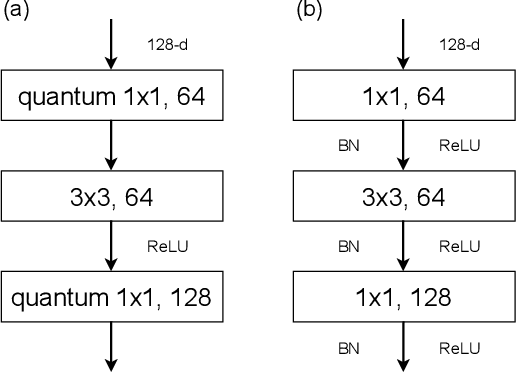
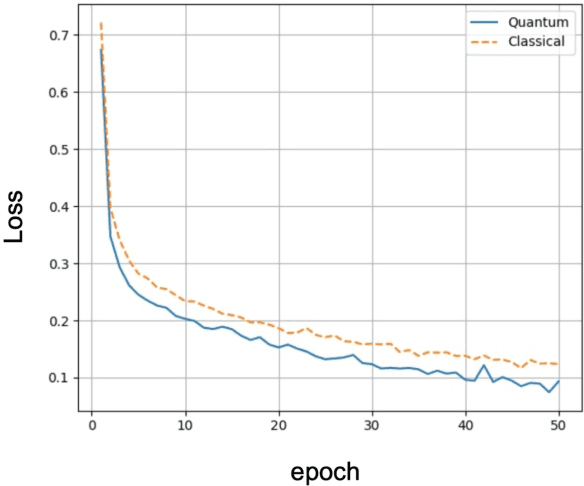
In this study, we propose a novel architecture, the Quantum Pointwise Convolution, which incorporates pointwise convolution within a quantum neural network framework. Our approach leverages the strengths of pointwise convolution to efficiently integrate information across feature channels while adjusting channel outputs. By using quantum circuits, we map data to a higher-dimensional space, capturing more complex feature relationships. To address the current limitations of quantum machine learning in the Noisy Intermediate-Scale Quantum (NISQ) era, we implement several design optimizations. These include amplitude encoding for data embedding, allowing more information to be processed with fewer qubits, and a weight-sharing mechanism that accelerates quantum pointwise convolution operations, reducing the need to retrain for each input pixels. In our experiments, we applied the quantum pointwise convolution layer to classification tasks on the FashionMNIST and CIFAR10 datasets, where our model demonstrated competitive performance compared to its classical counterpart. Furthermore, these optimizations not only improve the efficiency of the quantum pointwise convolutional layer but also make it more readily deployable in various CNN-based or deep learning models, broadening its potential applications across different architectures.
CIMulator: A Comprehensive Simulation Platform for Computing-In-Memory Circuit Macros with Low Bit-Width and Real Memory Materials
Jun 26, 2023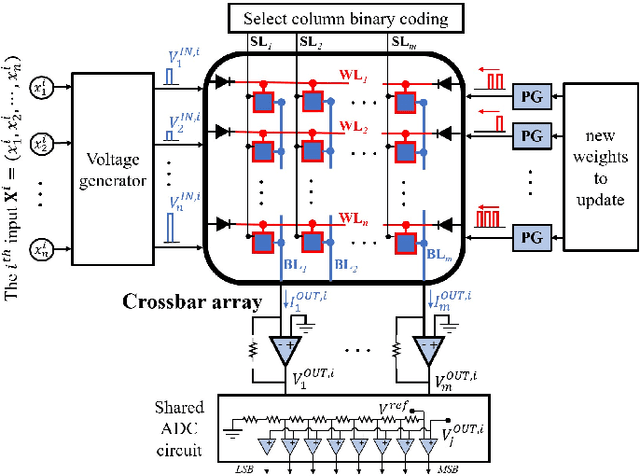
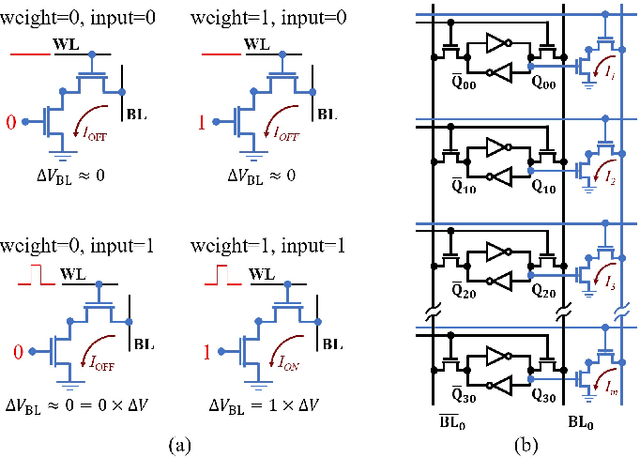
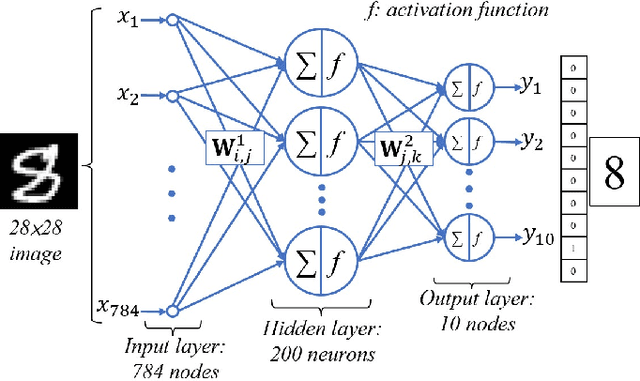
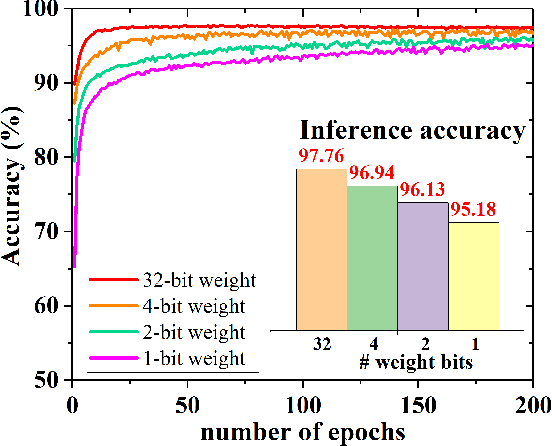
This paper presents a simulation platform, namely CIMulator, for quantifying the efficacy of various synaptic devices in neuromorphic accelerators for different neural network architectures. Nonvolatile memory devices, such as resistive random-access memory, ferroelectric field-effect transistor, and volatile static random-access memory devices, can be selected as synaptic devices. A multilayer perceptron and convolutional neural networks (CNNs), such as LeNet-5, VGG-16, and a custom CNN named C4W-1, are simulated to evaluate the effects of these synaptic devices on the training and inference outcomes. The dataset used in the simulations are MNIST, CIFAR-10, and a white blood cell dataset. By applying batch normalization and appropriate optimizers in the training phase, neuromorphic systems with very low-bit-width or binary weights could achieve high pattern recognition rates that approach software-based CNN accuracy. We also introduce spiking neural networks with RRAM-based synaptic devices for the recognition of MNIST handwritten digits.