 Add to Chrome
 Add to Firefox
 Add to Edge
Stable Self-Modulating Quantum Fast-Weight Programmers with Bounded Memory Gates
Jul 02, 2026
Quantum Fast-Weight Programmers (QFWPs) store temporal information in dynamically programmed variational-circuit parameters rather than in nonlinear recurrent hidden states, offering a practical route to quantum sequence modeling. Self-Modulating QFWP improves this framework by using input-dependent gates for both new fast-weight updates and the accumulated fast-weight state, but its unbounded old-state multiplier can diverge in long-sequence regimes. We propose a bounded old-state modulation rule that applies a sign-preserving tanh gate only to the recurrent memory branch while leaving the additive update and new-update modulation unchanged. We evaluate standard QFWP, full Self-Modulating QFWP, Only-New, and Only-Old variants on two CUDA-Q quantum-dynamics forecasting tasks and on Milan SMS telecommunication activity prediction. The quantum-dynamics results show that old-state modulation is the most consistent source of improvement over Standard QFWP, and that bounding the old-state gate removes long-sequence divergence while improving aggregate robustness. On Milan SMS forecasting, the original unbounded Self-Modulating QFWP converges across the tested grid and shows its clearest gains at longer input windows, with behavior close to the Only-Old ablation. These findings identify accumulated-memory modulation as the key mechanism of Self-Modulating QFWP and bounded old-state gating as a targeted stabilization strategy.

Parameter-Efficient Quantum-Inspired Fast Weight Programmers for Traffic-Matrix Forecasting
Jun 26, 2026Traffic matrices (TMs) capture network-wide origin-destination demand and are central to traffic engineering, yet accurate whole-matrix forecasting remains challenging when prediction must be performed under the memory, update, and training-budget constraints of online network control. This paper investigates whether compact quantum-inspired recurrent models can provide effective TM forecasts without relying on dedicated graph, transformer, or diffusion modules. We adapt gated quantum-inspired Kolmogorov-Arnold network fast-weight programmers (QKAN-FWPs) to direct multi-step Abilene TM forecasting, where each model predicts the next 20 five-minute frames of a 144-channel origin-destination (OD) matrix from a two-hour history. We benchmark three QKAN placement variants against a matched-size long short-term memory (LSTM) network, a larger LSTM, and a classical gated fast-weight programmer under a shared fixed-budget training protocol. Among the evaluated recurrent models, G-QKANFWP achieves the best pooled root-mean-square error (RMSE), while using only 22.4% of the larger LSTM. It also outperforms both the matched-size LSTM and the classical G-FWP baseline, indicating that the gain is not due to gated fast-weight framework alone. Convergence and channel-wise analyses further show that the quantum-inspired variants obtain lower validation-loss area under the learning curve (AULC) than matched-size recurrent baselines, while G-QKANFWP and GQKAN-FWP achieve substantially more OD-channel wins. These results identify a classical slow programmer with a quantum-inspired fast programmer as a promising accuracy-efficiency design for resource-conscious network traffic-matrix forecasting.
Self-Modulating Quantum Fast-Weight Programmers for Efficient Adaptive Sequential Learning
Jun 22, 2026Recent advances in quantum machine learning have motivated efficient models for sequential data processing. In this paper, we propose Self-Modulating Quantum Fast Weight Programmers, or Self-Modulating QFWP, which extends Quantum Fast Weight Programmers by introducing adaptive modulation over both newly generated fast-weight updates and historical fast-weight memory. Numerical results show that the proposed mechanism improves convergence stability and prediction performance across varying model settings, including different numbers of qubits and input sequence lengths. We further provide theoretical arguments explaining how self-modulation balances new information injection with memory retention, thereby enhancing temporal information propagation. These results suggest that Self-Modulating QFWP is a compact and effective framework for quantum machine learning on time-series data.
Recursive QLSTM with Dynamic Variational Quantum Circuit Adaptation
Jun 22, 2026Recent advances in quantum computing and machine learning have motivated the development of quantum models for sequential data processing. In this paper, we propose a Recursive Quantum Long Short-Term Memory model, or Recursive QLSTM, which extends QLSTM through metacore-based recursive constructions. We numerically test the model under different input sequence lengths, metacore designs, and recursive rules, and identify the best-performing architecture among these variants. For this selected model, we further provide theoretical arguments explaining why its recursive structure improves temporal information propagation and enhances learning performance. Our results suggest that Recursive QLSTM offers a flexible and effective framework for quantum recurrent learning over input time series of various lengths.
Generative Quantum-inspired Kolmogorov-Arnold Eigensolver
May 06, 2026High-performance computing (HPC) is increasingly important for scalable quantum chemistry workflows that couple classical generative models, quantum circuit simulation, and selected configuration interaction postprocessing. We present the generative quantum-inspired Kolmogorov-Arnold eigensolver (GQKAE), a parameter-efficient extension of the generative quantum eigensolver (GQE) for quantum chemistry. GQKAE replaces the parameter-heavy feed-forward network components in GPT-style generative eigensolvers with hybrid quantum-inspired Kolmogorov-Arnold network modules, forming a compact HQKANsformer backbone. The method preserves autoregressive operator selection and the quantum-selected configuration interaction evaluation pipeline, while using single-qubit DatA Re-Uploading ActivatioN modules to provide expressive nonlinear mappings. Numerical benchmarks on H4, N2, LiH, C2H6, H2O, and the H2O dimer show that GQKAE achieves chemical accuracy comparable to the GPT-based GQE architecture, while reducing trainable parameters and memory by approximately 66% and improving wall-time performance. For strongly correlated systems such as N2 and LiH, GQKAE also improves convergence behavior and final energy errors. These results indicate that quantum-inspired Kolmogorov-Arnold networks can reduce classical-side overhead while preserving circuit-generation quality, offering a scalable route for HPC-quantum co-design on near-term quantum platforms.
Quantum Variational Activation Functions Empower Kolmogorov-Arnold Networks
Sep 17, 2025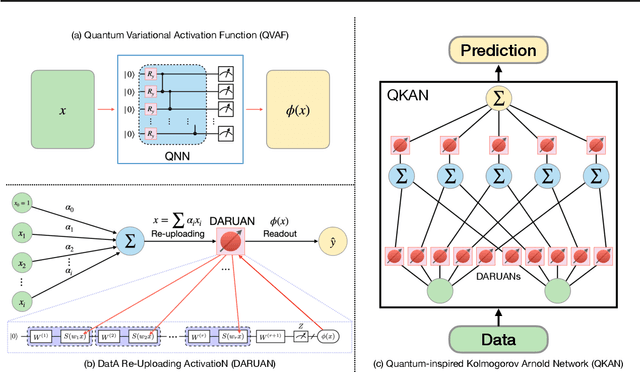
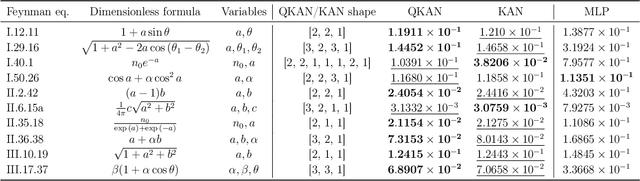
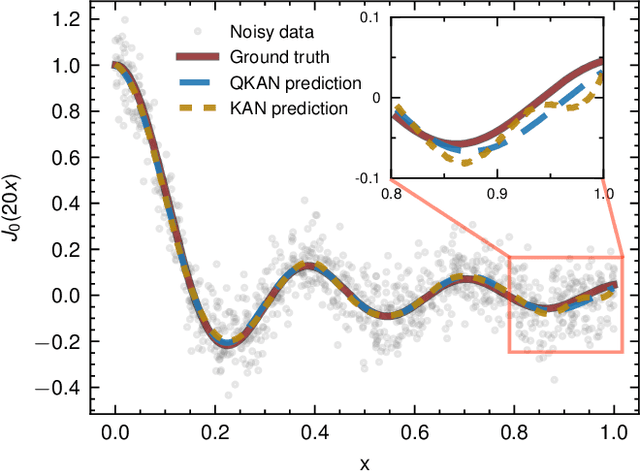
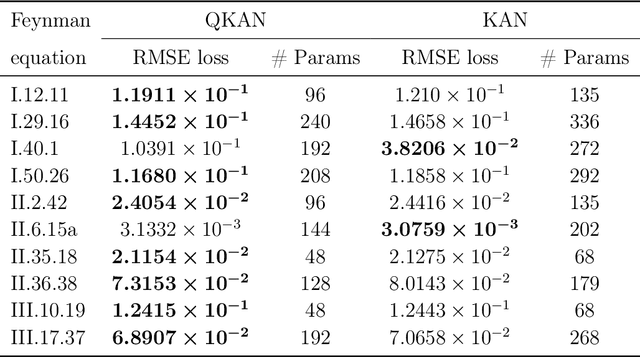
Variational quantum circuits (VQCs) are central to quantum machine learning, while recent progress in Kolmogorov-Arnold networks (KANs) highlights the power of learnable activation functions. We unify these directions by introducing quantum variational activation functions (QVAFs), realized through single-qubit data re-uploading circuits called DatA Re-Uploading ActivatioNs (DARUANs). We show that DARUAN with trainable weights in data pre-processing possesses an exponentially growing frequency spectrum with data repetitions, enabling an exponential reduction in parameter size compared with Fourier-based activations without loss of expressivity. Embedding DARUAN into KANs yields quantum-inspired KANs (QKANs), which retain the interpretability of KANs while improving their parameter efficiency, expressivity, and generalization. We further introduce two novel techniques to enhance scalability, feasibility and computational efficiency, such as layer extension and hybrid QKANs (HQKANs) as drop-in replacements of multi-layer perceptrons (MLPs) for feed-forward networks in large-scale models. We provide theoretical analysis and extensive experiments on function regression, image classification, and autoregressive generative language modeling, demonstrating the efficiency and scalability of QKANs. DARUANs and QKANs offer a promising direction for advancing quantum machine learning on both noisy intermediate-scale quantum (NISQ) hardware and classical quantum simulators.