 Add to Chrome
 Add to Firefox
 Add to Edge
World-Task Factorization for Robot Learning
Jun 01, 2026
Robot learning must produce policies that generalize to new combinations of constraints, teammates, and environments. To achieve this, we must structurally factor the policy, which is a choice that dictates what generalizes, what requires retraining, and what remains entangled. Existing methods span a wide spectrum, from expecting structure to emerge from data scaling, to hand-designing it via hierarchies, skill libraries or learned specializations. In this paper, we study what we argue is the most fundamental factorization in robotics: separating the world from the task. We investigate the conditions under which this factorization is principled. World factors are properties of the embodied system and the environment; they exist independently of intent. Task factors are defined by the task's logic over what the world admits. We formalize this asymmetry through Bayesian model evidence: it aligns with the data-generating process, maintains high likelihood through an analytical world model, and reduces the Occam razor's penalty on task parameters. We instantiate this factorization by pairing AICON, a differentiable graph of recursive estimators and interconnections that is compositional, operates without task-specific data, and propagates cost gradients to actuators, with a compact, learned policy that modulates gradient paths. Gradients serve as the interface between the two factors: they carry world structure through the graph and task structure through costs, enabling low-dimensional learning while preserving structural generalization. We test the world/task factorization across three problems that encompass heterogeneous robots, environments, task logic and sensorimotor modalities. Our framework outperforms end-to-end baselines and analytical heuristics in all settings, generalizes zero-shot to out-of-distribution configurations, and transfers to real hardware without retraining.

Events as Triggers for Behavioral Diversity in Multi-Agent Reinforcement Learning
May 13, 2026Effective multi-agent cooperation requires agents to adopt diverse behaviors as task conditions evolve-and to do so at the right moment. Yet, current Multi-Agent Reinforcement Learning (MARL) frameworks that facilitate this diversity are still limited by the fact that they bind fixed behaviors to fixed agent identities. Consequently, they are ill-equipped for tasks where agents need to take on different roles at very specific moments in time. We argue that, to define these behavioral transitions, the missing ingredient is $\textbf{events}$. Events are changes in the state of the system that induce qualitative changes in the task. Based on this view, we introduce a framework that decouples agent identity from behavior, capturing a continuous manifold from which agents instantiate their behaviors in response to events. This framework is based on two elements. First, to build an expressive behavior manifold, we introduce Neural Manifold Diversity (NMD), a formal distance metric that remains well-defined when behaviors are transient and agent-agnostic. Second, we use an event-based hypernetwork that generates Low-Rank Adaptation (LoRA) modules over a shared team policy, enabling on-the-fly agent-policy reconfiguration in response to events. We prove that this construction ensures that diversity does not interfere with reward maximization by design. Empirical results demonstrate that our framework outperforms established baselines across benchmarks while exhibiting zero-shot generalization, and being the only method that solves tasks requiring sequential behavior reassignment.
Wake Up to the Past: Using Memory to Model Fluid Wake Effects on Robots
Mar 23, 2026Autonomous aerial and aquatic robots that attain mobility by perturbing their medium, such as multicopters and torpedoes, produce wake effects that act as disturbances for adjacent robots. Wake effects are hard to model and predict due to the chaotic spatio-temporal dynamics of the fluid, entangled with the physical geometry of the robots and their complex motion patterns. Data-driven approaches using neural networks typically learn a memory-less function that maps the current states of the two robots to a force observed by the "sufferer" robot. Such models often perform poorly in agile scenarios: since the wake effect has a finite propagation time, the disturbance observed by a sufferer robot is some function of relative states in the past. In this work, we present an empirical study of the properties a wake-effect predictor must satisfy to accurately model the interactions between two robots mediated by a fluid. We explore seven data-driven models designed to capture the spatio-temporal evolution of fluid wake effects in four different media. This allows us to introspect the models and analyze the reasons why certain features enable improved accuracy in prediction across predictors and fluids. As experimental validation, we develop a planar rectilinear gantry for two spinning monocopters to test in real-world data with feedback control. The conclusion is that support of history of previous states as input and transport delay prediction substantially helps to learn an accurate wake-effect predictor.
From Vision to Decision: Neuromorphic Control for Autonomous Navigation and Tracking
Feb 05, 2026Robotic navigation has historically struggled to reconcile reactive, sensor-based control with the decisive capabilities of model-based planners. This duality becomes critical when the absence of a predominant option among goals leads to indecision, challenging reactive systems to break symmetries without computationally-intense planners. We propose a parsimonious neuromorphic control framework that bridges this gap for vision-guided navigation and tracking. Image pixels from an onboard camera are encoded as inputs to dynamic neuronal populations that directly transform visual target excitation into egocentric motion commands. A dynamic bifurcation mechanism resolves indecision by delaying commitment until a critical point induced by the environmental geometry. Inspired by recently proposed mechanistic models of animal cognition and opinion dynamics, the neuromorphic controller provides real-time autonomy with a minimal computational burden, a small number of interpretable parameters, and can be seamlessly integrated with application-specific image processing pipelines. We validate our approach in simulation environments as well as on an experimental quadrotor platform.
LATMOS: Latent Automaton Task Model from Observation Sequences
Mar 11, 2025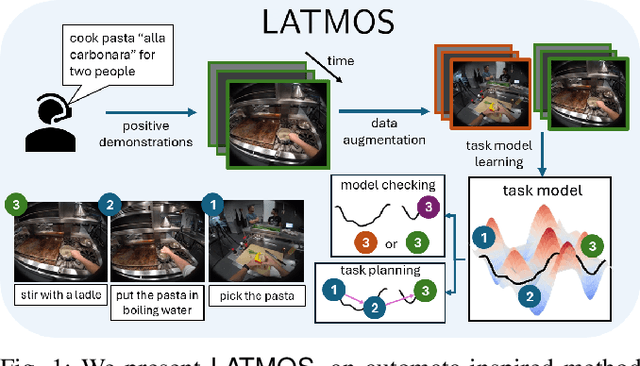
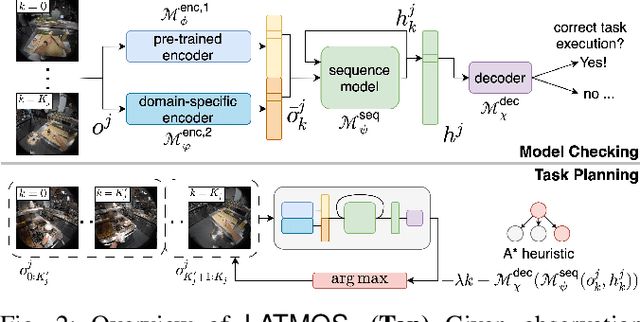
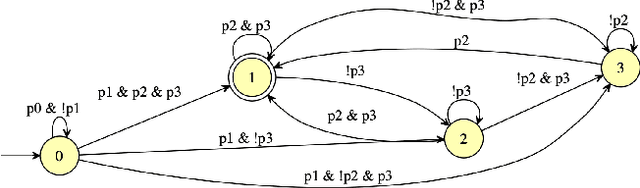
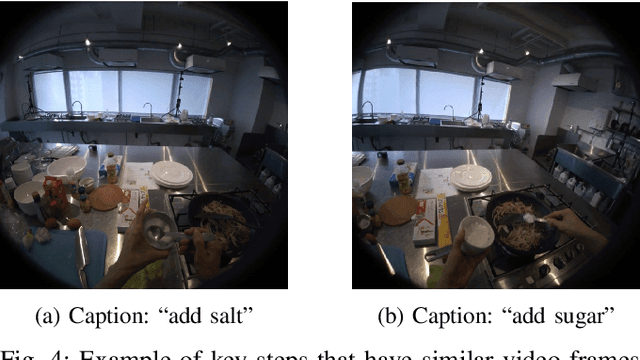
Robot task planning from high-level instructions is an important step towards deploying fully autonomous robot systems in the service sector. Three key aspects of robot task planning present challenges yet to be resolved simultaneously, namely, (i) factorization of complex tasks specifications into simpler executable subtasks, (ii) understanding of the current task state from raw observations, and (iii) planning and verification of task executions. To address these challenges, we propose LATMOS, an automata-inspired task model that, given observations from correct task executions, is able to factorize the task, while supporting verification and planning operations. LATMOS combines an observation encoder to extract the features from potentially high-dimensional observations with automata theory to learn a sequential model that encapsulates an automaton with symbols in the latent feature space. We conduct extensive evaluations in three task model learning setups: (i) abstract tasks described by logical formulas, (ii) real-world human tasks described by videos and natural language prompts and (iii) a robot task described by image and state observations. The results demonstrate the improved plan generation and verification capabilities of LATMOS across observation modalities and tasks.
AVOCADO: Adaptive Optimal Collision Avoidance driven by Opinion
Jun 29, 2024


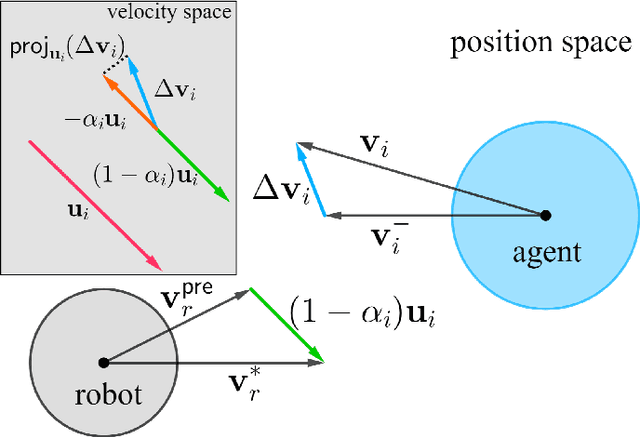
We present AVOCADO (AdaptiVe Optimal Collision Avoidance Driven by Opinion), a novel navigation approach to address holonomic robot collision avoidance when the degree of cooperation of the other agents in the environment is unknown. AVOCADO departs from a Velocity Obstacle's formulation akin to the Optimal Reciprocal Collision Avoidance method. However, instead of assuming reciprocity, AVOCADO poses an adaptive control problem that aims at adapting in real-time to the cooperation degree of other robots and agents. Adaptation is achieved through a novel nonlinear opinion dynamics design that relies solely on sensor observations. As a by-product, based on the nonlinear opinion dynamics, we propose a novel method to avoid the deadlocks under geometrical symmetries among robots and agents. Extensive numerical simulations show that AVOCADO surpasses existing geometrical, learning and planning-based approaches in mixed cooperative/non-cooperative navigation environments in terms of success rate, time to goal and computational time. In addition, we conduct multiple real experiments that verify that AVOCADO is able to avoid collisions in environments crowded with other robots and humans.