 Add to Chrome
 Add to Firefox
 Add to Edge
Distillation Traps and Guards: A Calibration Knob for LLM Distillability
Apr 21, 2026
Knowledge distillation (KD) transfers capabilities from large language models (LLMs) to smaller students, yet it can fail unpredictably and also underpins model leakage risks. Our analysis revealed several distillation traps: tail noise, off-policy instability, and, most fundamentally, the teacher-student gap, that distort training signals. These traps manifest as overconfident hallucinations, self-correction collapse, and local decoding degradation, causing distillation to fail. Motivated by these findings, we propose a post-hoc calibration method that, to the best of our knowledge, for the first time enables control over a teacher's distillability via reinforcement fine-tuning (RFT). Our objective combines task utility, KL anchor, and across-tokenizer calibration reward. This makes distillability a practical safety lever for foundation models, connecting robust teacher-student transfer with deployment-aware model protection. Experiments across math, knowledge QA, and instruction-following tasks show that students distilled from distillable calibrated teachers outperform SFT and KD baselines, while undistillable calibrated teachers retain their task performance but cause distilled students to collapse, offering a practical knob for both better KD and model IP protection.

LATMOS: Latent Automaton Task Model from Observation Sequences
Mar 11, 2025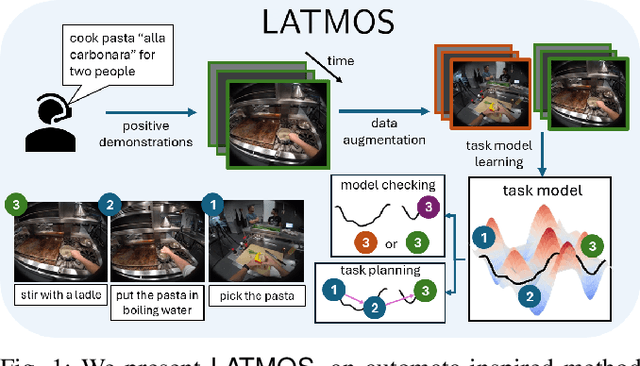
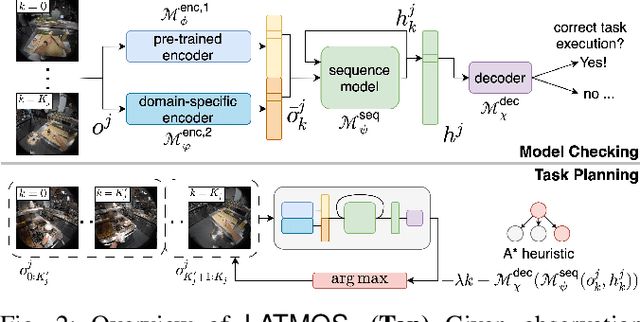
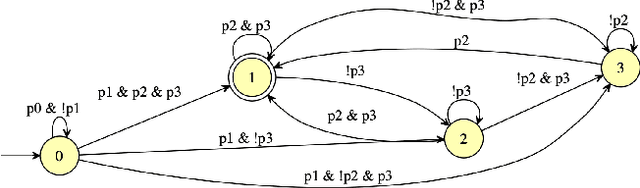
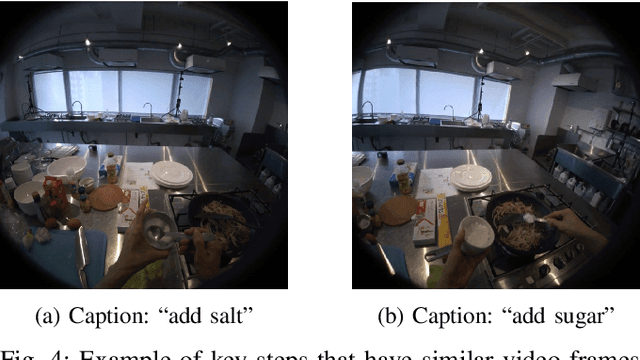
Robot task planning from high-level instructions is an important step towards deploying fully autonomous robot systems in the service sector. Three key aspects of robot task planning present challenges yet to be resolved simultaneously, namely, (i) factorization of complex tasks specifications into simpler executable subtasks, (ii) understanding of the current task state from raw observations, and (iii) planning and verification of task executions. To address these challenges, we propose LATMOS, an automata-inspired task model that, given observations from correct task executions, is able to factorize the task, while supporting verification and planning operations. LATMOS combines an observation encoder to extract the features from potentially high-dimensional observations with automata theory to learn a sequential model that encapsulates an automaton with symbols in the latent feature space. We conduct extensive evaluations in three task model learning setups: (i) abstract tasks described by logical formulas, (ii) real-world human tasks described by videos and natural language prompts and (iii) a robot task described by image and state observations. The results demonstrate the improved plan generation and verification capabilities of LATMOS across observation modalities and tasks.