 Add to Chrome
 Add to Firefox
 Add to Edge
World-Task Factorization for Robot Learning
Jun 01, 2026
Robot learning must produce policies that generalize to new combinations of constraints, teammates, and environments. To achieve this, we must structurally factor the policy, which is a choice that dictates what generalizes, what requires retraining, and what remains entangled. Existing methods span a wide spectrum, from expecting structure to emerge from data scaling, to hand-designing it via hierarchies, skill libraries or learned specializations. In this paper, we study what we argue is the most fundamental factorization in robotics: separating the world from the task. We investigate the conditions under which this factorization is principled. World factors are properties of the embodied system and the environment; they exist independently of intent. Task factors are defined by the task's logic over what the world admits. We formalize this asymmetry through Bayesian model evidence: it aligns with the data-generating process, maintains high likelihood through an analytical world model, and reduces the Occam razor's penalty on task parameters. We instantiate this factorization by pairing AICON, a differentiable graph of recursive estimators and interconnections that is compositional, operates without task-specific data, and propagates cost gradients to actuators, with a compact, learned policy that modulates gradient paths. Gradients serve as the interface between the two factors: they carry world structure through the graph and task structure through costs, enabling low-dimensional learning while preserving structural generalization. We test the world/task factorization across three problems that encompass heterogeneous robots, environments, task logic and sensorimotor modalities. Our framework outperforms end-to-end baselines and analytical heuristics in all settings, generalizes zero-shot to out-of-distribution configurations, and transfers to real hardware without retraining.

Building Generalization Into Behavior Generation Via Adaptive Compositions of Regularities
May 29, 2026Generalization in robotics requires prior knowledge about how the world is structured, yet this structure changes from one situation to the next. This paper investigates the proposition that generalization arises from adaptively composing regularities -- predictable relationships within the robot-environment system -- into situation-appropriate structures for behavior generation. We examine this proposition by analyzing the mechanism in AICON (Active InterCONnect), a framework representing regularities as interacting processes in a differentiable network, where sensory feedback realizes composition and gradient descent generates behavior. To isolate adaptive composition as the key mechanism, we study a simple simulated problem in which all relevant regularities can be identified. We expose the resulting model to a wide range of novel conditions not considered during design, and we find that it generates context-appropriate behavior in all but one case, where encoded regularities are provably insufficient. Ablations reveal that the network automatically modulates which regularities influence behavior based on their informativeness. These results suggest that adaptive composition of regularities constitutes a powerful inductive bias for building generalization into behavior generation.
Riding the Shifting Potential: When Reactive Control Suffices for Multi-Goal Behavior
May 26, 2026Reactive control is often considered insufficient for multi-objective tasks because conflicting objectives give rise to local minima. We argue this limitation is not inherent but arises from static encodings that fail to reflect how objectives currently interact. We exploit the interaction structure encoded in a graph-based world model by extending it with nullspace projections: conflicts are resolved where they arise by projecting lower-priority gradients into the nullspace of higher-priority ones, with priorities determined continuously from the current state. We demonstrate this in two domains where conflicts between objectives are central: navigation around non-convex obstacles, where static potential fields fundamentally fail, and planar pushing of non-convex objects, where our method achieves $100\%$ success across one-hundred configurations versus $0\%$ for the steepest-descent baseline and ${\sim}55\%$ for diffusion policy, without demonstrations or retraining. The same formulation transfers directly to a real robot with additional perceptual and kinematic constraints, accommodating them through the same mechanism.
Coupled Particle Filters for Robust Affordance Estimation
Mar 16, 2026Robotic affordance estimation is challenging due to visual, geometric, and semantic ambiguities in sensory input. We propose a method that disambiguates these signals using two coupled recursive estimators for sub-aspects of affordances: graspable and movable regions. Each estimator encodes property-specific regularities to reduce uncertainty, while their coupling enables bidirectional information exchange that focuses attention on regions where both agree, i.e., affordances. Evaluated on a real-world dataset, our method outperforms three recent affordance estimators (Where2Act, Hands-as-Probes, and HRP) by 308%, 245%, and 257% in precision, and remains robust under challenging conditions such as low light or cluttered environments. Furthermore, our method achieves a 70% success rate in our real-world evaluation. These results demonstrate that coupling complementary estimators yields precise, robust, and embodiment-appropriate affordance predictions.
A Helping (Human) Hand in Kinematic Structure Estimation
Mar 07, 2025Visual uncertainties such as occlusions, lack of texture, and noise present significant challenges in obtaining accurate kinematic models for safe robotic manipulation. We introduce a probabilistic real-time approach that leverages the human hand as a prior to mitigate these uncertainties. By tracking the constrained motion of the human hand during manipulation and explicitly modeling uncertainties in visual observations, our method reliably estimates an object's kinematic model online. We validate our approach on a novel dataset featuring challenging objects that are occluded during manipulation and offer limited articulations for perception. The results demonstrate that by incorporating an appropriate prior and explicitly accounting for uncertainties, our method produces accurate estimates, outperforming two recent baselines by 195% and 140%, respectively. Furthermore, we demonstrate that our approach's estimates are precise enough to allow a robot to manipulate even small objects safely.
No Plan but Everything Under Control: Robustly Solving Sequential Tasks with Dynamically Composed Gradient Descent
Mar 03, 2025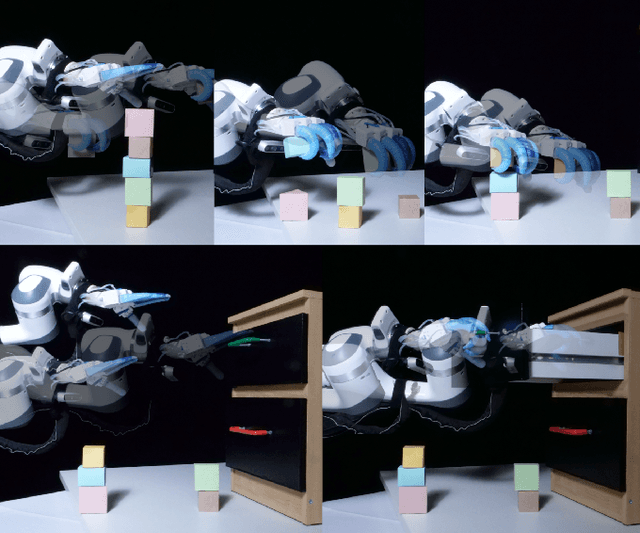
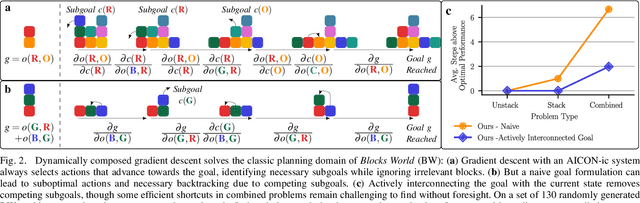
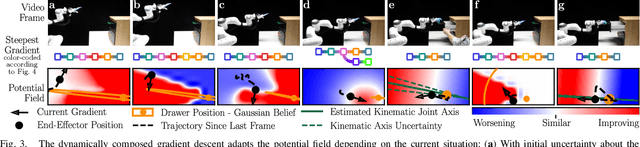
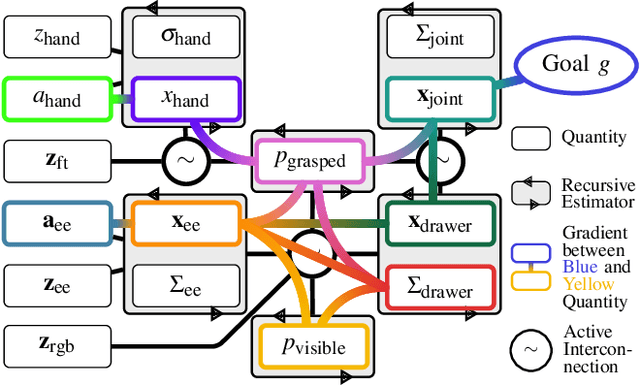
We introduce a novel gradient-based approach for solving sequential tasks by dynamically adjusting the underlying myopic potential field in response to feedback and the world's regularities. This adjustment implicitly considers subgoals encoded in these regularities, enabling the solution of long sequential tasks, as demonstrated by solving the traditional planning domain of Blocks World - without any planning. Unlike conventional planning methods, our feedback-driven approach adapts to uncertain and dynamic environments, as demonstrated by one hundred real-world trials involving drawer manipulation. These experiments highlight the robustness of our method compared to planning and show how interactive perception and error recovery naturally emerge from gradient descent without explicitly implementing them. This offers a computationally efficient alternative to planning for a variety of sequential tasks, while aligning with observations on biological problem-solving strategies.
A Robotics-Inspired Scanpath Model Reveals the Importance of Uncertainty and Semantic Object Cues for Gaze Guidance in Dynamic Scenes
Aug 02, 2024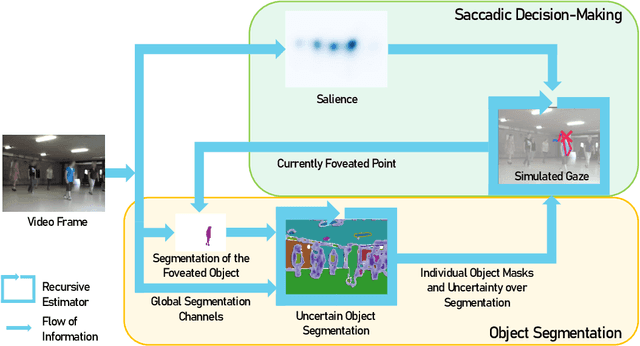
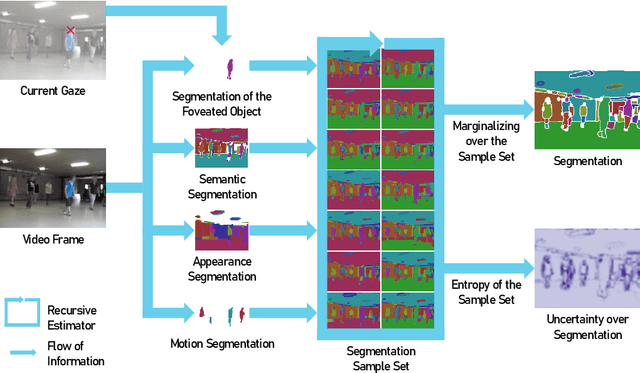
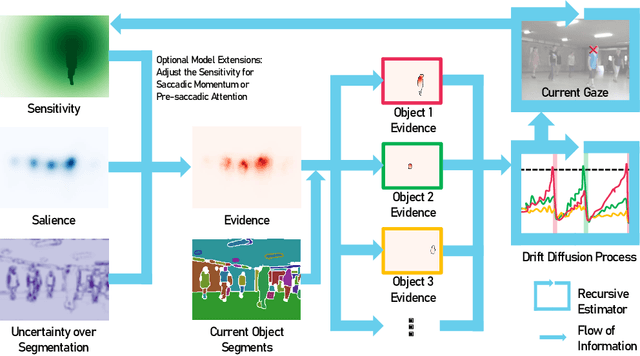
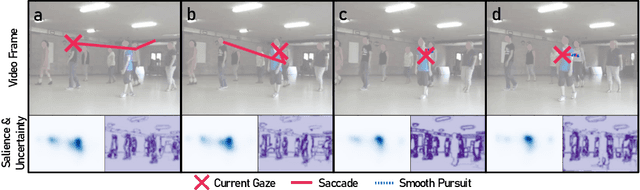
How we perceive objects around us depends on what we actively attend to, yet our eye movements depend on the perceived objects. Still, object segmentation and gaze behavior are typically treated as two independent processes. Drawing on an information processing pattern from robotics, we present a mechanistic model that simulates these processes for dynamic real-world scenes. Our image-computable model uses the current scene segmentation for object-based saccadic decision-making while using the foveated object to refine its scene segmentation recursively. To model this refinement, we use a Bayesian filter, which also provides an uncertainty estimate for the segmentation that we use to guide active scene exploration. We demonstrate that this model closely resembles observers' free viewing behavior, measured by scanpath statistics, including foveation duration and saccade amplitude distributions used for parameter fitting and higher-level statistics not used for fitting. These include how object detections, inspections, and returns are balanced and a delay of returning saccades without an explicit implementation of such temporal inhibition of return. Extensive simulations and ablation studies show that uncertainty promotes balanced exploration and that semantic object cues are crucial to form the perceptual units used in object-based attention. Moreover, we show how our model's modular design allows for extensions, such as incorporating saccadic momentum or pre-saccadic attention, to further align its output with human scanpaths.