 Add to Chrome
 Add to Firefox
 Add to Edge
Fourier Weak SINDy: Spectral Test Function Selection for Robust Model Identification
Apr 22, 2026
We introduce Fourier Weak SINDy, a minimal noise-robust and interpretable derivative-free equation learning method that combines weak-form sparse equation learning with spectral density estimation for data-driven test function selection. By using orthogonal sinusoidal test functions inspired by their prevalence in Modulating Function-based system identification, the weak-form sparse regression problem reduces to a regression over Fourier coefficients. Dominant frequencies are then selected via multitaper estimation of the frequency spectrum of the data. This formulation unifies weak-form learning and spectral estimation within a compact and flexible framework. We illustrate the effectiveness of this approach in numerical experiments across multiple chaotic and hyperchaotic ODE benchmarks.

On Dominant Manifolds in Reservoir Computing Networks
Apr 07, 2026Understanding how training shapes the geometry of recurrent network dynamics is a central problem in time-series modeling. We study the emergence of low-dimensional dominant manifolds in the training of Reservoir Computing (RC) networks for temporal forecasting tasks. For a simplified linear and continuous-time reservoir model, we link the dimensionality and structure of the dominant modes directly to the intrinsic dimensionality and information content of the training data. In particular, for training data generated by an autonomous dynamical system, we relate the dominant modes of the trained reservoir to approximations of the Koopman eigenfunctions of the original system, illuminating an explicit connection between reservoir computing and the Dynamic Mode Decomposition algorithm. We illustrate the eigenvalue motion that generates the dominant manifolds during training in simulation, and discuss generalization to nonlinear RC via tangent dynamics and differential p-dominance.
From Vision to Decision: Neuromorphic Control for Autonomous Navigation and Tracking
Feb 05, 2026Robotic navigation has historically struggled to reconcile reactive, sensor-based control with the decisive capabilities of model-based planners. This duality becomes critical when the absence of a predominant option among goals leads to indecision, challenging reactive systems to break symmetries without computationally-intense planners. We propose a parsimonious neuromorphic control framework that bridges this gap for vision-guided navigation and tracking. Image pixels from an onboard camera are encoded as inputs to dynamic neuronal populations that directly transform visual target excitation into egocentric motion commands. A dynamic bifurcation mechanism resolves indecision by delaying commitment until a critical point induced by the environmental geometry. Inspired by recently proposed mechanistic models of animal cognition and opinion dynamics, the neuromorphic controller provides real-time autonomy with a minimal computational burden, a small number of interpretable parameters, and can be seamlessly integrated with application-specific image processing pipelines. We validate our approach in simulation environments as well as on an experimental quadrotor platform.
Adaptive bias for dissensus in nonlinear opinion dynamics with application to evolutionary division of labor games
Sep 21, 2024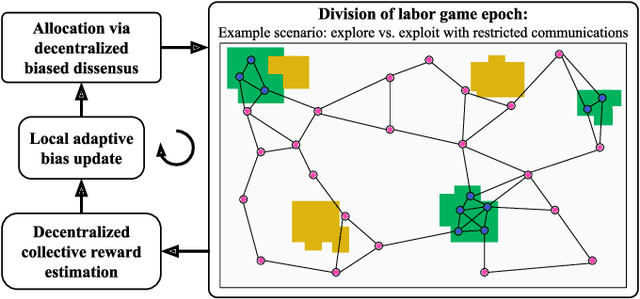
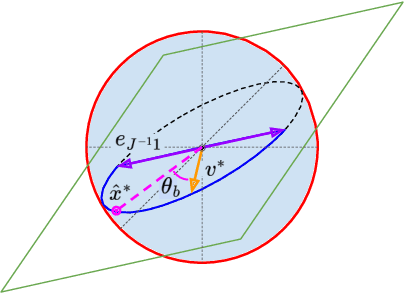
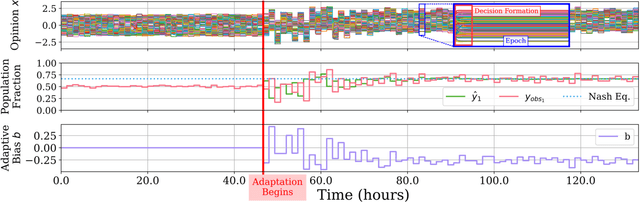
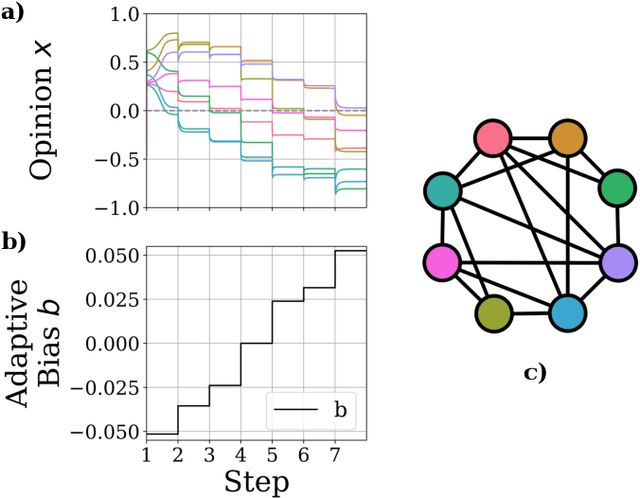
This paper addresses the problem of adaptively controlling the bias parameter in nonlinear opinion dynamics (NOD) to allocate agents into groups of arbitrary sizes for the purpose of maximizing collective rewards. In previous work, an algorithm based on the coupling of NOD with an multi-objective behavior optimization was successfully deployed as part of a multi-robot system in an autonomous task allocation field experiment. Motivated by the field results, in this paper we propose and analyze a new task allocation model that synthesizes NOD with an evolutionary game framework. We prove sufficient conditions under which it is possible to control the opinion state in the group to a desired allocation of agents between two tasks through an adaptive bias using decentralized feedback. We then verify the theoretical results with a simulation study of a collaborative evolutionary division of labor game.