 Add to Chrome
 Add to Firefox
 Add to Edge
ADORE: Iterative Query Expansion with Retrieval-Grounded Relevance Feedback
Jun 11, 2026
LLM-based query expansion improves retrieval by enriching the original query with additional context. Yet most methods remain generation-driven, producing plausible pseudo-documents or expansions without checking how the target corpus responds. This can introduce retrieval drift, amplify misleading vocabulary, or miss terms that distinguish relevant from non-relevant documents. We argue that effective expansion requires retrieval-grounded feedback, not just single-pass generation or unverified iteration. We introduce ADORE (ADapt, Observe, Relevance Evaluate), an iterative framework that turns retrieval outcomes into feedback for the next expansion. At each round, an LLM generates pseudo-passages, a retriever exposes the corpus response, and a relevance assessor evaluates retrieved documents against the original query. These judgments identify what to reinforce, what remains undercovered, and what to suppress. Across TREC Deep Learning, BEIR, and BRIGHT, ADORE consistently outperforms strong query expansion baselines with notable improvements across nearly all evaluation settings, improving average nDCG@10 by 24.5% over BM25 and 3.6% over the strongest prior query expansion method on BEIR, and by 122.9% over BM25 and 9.2% over the best query expansion baseline on BRIGHT. Our code and data are publicly available.

The CIFAR Synthetic Evidence Corpus for Detecting AI-Generated Evidence
Jun 06, 2026The growing ability of generative models to produce realistic documents poses a direct challenge to evidentiary workflows in the justice system and the courts, where decisions increasingly depend on the authenticity of evidence such as receipts, communications, and administrative records. Unlike social media or academic settings, evidentiary documents are often only subtly altered, with small, localized edits that preserve overall plausibility while changing legal meaning. Yet progress on automated detection remains limited, largely due to the absence of suitable training and evaluation data especially suited for the justice system requirements. Existing resources are either focused on photos of human faces or natural scenery or on narrowly scoped academic or social media document types, and do not capture the structure, diversity, or manipulation patterns characteristic of real-world evidentiary data. As a result, current detection systems do not necessarily learn meaningful signals appropriate for the justice system. We introduce the CIFAR Synthetic Evidence Corpus, a dataset designed to enable rigorous evaluation of evidence verification under realistic and controlled conditions. The corpus spans multiple document families and a spectrum of manipulation strategies, from small field-level edits to complete document fabrication, and is constructed using a diverse set of state-of-the-art generative tools. It is organized to systematically vary both manipulation complexity and generation method, while enforcing source-level separation between training and test data to reflect real-world generalization challenges.
DetectZoo: A Unified Toolkit for AI-Generated Content Detection Across Text, Audio, and Image Modalities
Jun 02, 2026The growing popularity and capacity of generative models have eroded the distinction between human and machine-generated content, motivating a growing body of work on detection across text, images, and audio. Most available detectors are either commercial software or, if open-source, come with incompatible codebases with bespoke preprocessing, evaluation protocols, and evaluation metrics, which make their adoption, fair comparison, and reproduction quite difficult. To address this critical gap, we introduce DetectZoo, a first-of-its-kind, extensible toolkit designed to provide a unified interface for AI-generated content detection across text, audio, and image modalities. DetectZoo standardizes the complete empirical pipeline, from data ingestion and preprocessing to model assessment, offering researchers a cohesive framework to benchmark state-of-the-art detectors systematically. By integrating diverse public datasets and baseline detection algorithms under a single, unified API, our toolkit facilitates rigorous and reproducible evaluation. DetectZoo provides reference implementations of 61 detectors, native loaders for 22 benchmark datasets, and a standardized evaluation pipeline that reports multiple metrics through a common interface. Each detector is self-contained yet accessible through the same interface, automatically caches pretrained weights, and reproduces the original published results. DetectZoo lowers the barrier to entry for multi-modal AI forensics, enabling researchers to identify performance gaps across domains and accelerating the development of robust, generalizable detection techniques. The open-source repository and comprehensive documentation are publicly available at https://github.com/sadjadeb/DetectZoo, and the package can be installed via pip install detectzoo.
PeeriScope: A Multi-Faceted Framework for Evaluating Peer Review Quality
Apr 27, 2026The increasing scale and variability of peer review in scholarly venues has created an urgent need for systematic, interpretable, and extensible tools to assess review quality. We present PeeriScope, a modular platform that integrates structured features, rubric-guided large language model assessments, and supervised prediction to evaluate peer review quality along multiple dimensions. Designed for openness and integration, PeeriScope provides both a public interface and a documented API, supporting practical deployment and research extensibility. The demonstration illustrates its use for reviewer self-assessment, editorial triage, and large-scale auditing, and it enables the continued development of quality evaluation methods within scientific peer review. PeeriScope is available both as a live demo at https://app.reviewer.ly/app/peeriscope and via API services at https://github.com/Reviewerly-Inc/Peeriscope.
Adaptive Prompt Embedding Optimization for LLM Jailbreaking
Apr 27, 2026Existing white-box jailbreak attacks against aligned LLMs typically append discrete adversarial suffixes to the user prompt, which visibly alters the prompt and operates in a combinatorial token space. Prior work has avoided directly optimizing the embeddings of the original prompt tokens, presumably because perturbing them risks destroying the prompt's semantic content. We propose Prompt Embedding Optimization (PEO), a multi-round white-box jailbreak that directly optimizes the embeddings of the original prompt tokens without appending any adversarial tokens, and show that the concern is unfounded: the optimized embeddings remain close enough to their originals that the visible prompt string is preserved exactly after nearest-token projection, and quantitative analysis shows the model's responses stay on topic for the large majority of prompts. PEO combines continuous embedding-space optimization with structured continuation targets and an adaptive failure-focused schedule. Counterintuitively, later PEO rounds can benefit from heuristic composite response scaffolds that are not natural standalone templates, yet ASR-Judge shows that the resulting gains are not merely empty formatting or scaffold-only outputs. Across two standard harmful-behavior benchmarks and competing white-box attacks spanning discrete suffix search, appended adversarial embeddings, and search-based adversarial generation, PEO outperforms all of them in our experiments.
Peerispect: Claim Verification in Scientific Peer Reviews
Apr 19, 2026Peer review is central to scientific publishing, yet reviewers frequently include claims that are subjective, rhetorical, or misaligned with the submitted work. Assessing whether review statements are factual and verifiable is crucial for fairness and accountability. At the scale of modern conferences and journals, manually inspecting the grounding of such claims is infeasible. We present Peerispect, an interactive system that operationalizes claim-level verification in peer reviews by extracting check-worthy claims from peer reviews, retrieving relevant evidence from the manuscript, and verifying the claims through natural language inference. Results are presented through a visual interface that highlights evidence directly in the paper, enabling rapid inspection and interpretation. Peerispect is designed as a modular Information Retrieval (IR) pipeline, supporting alternative retrievers, rerankers, and verifiers, and is intended for use by reviewers, authors, and program committees. We demonstrate Peerispect through a live, publicly available demo (https://app.reviewer.ly/app/peerispect) and API services (https://github.com/Reviewerly-Inc/Peerispect), accompanied by a video tutorial (https://www.youtube.com/watch?v=pc9RkvkUh14).
PeerPrism: Peer Evaluation Expertise vs Review-writing AI
Apr 16, 2026Large Language Models (LLMs) are increasingly used in scientific peer review, assisting with drafting, rewriting, expansion, and refinement. However, existing peer-review LLM detection methods largely treat authorship as a binary problem-human vs. AI-without accounting for the hybrid nature of modern review workflows. In practice, evaluative ideas and surface realization may originate from different sources, creating a spectrum of human-AI collaboration. In this work, we introduce PeerPrism, a large-scale benchmark of 20,690 peer reviews explicitly designed to disentangle idea provenance from text provenance. We construct controlled generation regimes spanning fully human, fully synthetic, and multiple hybrid transformations. This design enables systematic evaluation of whether detectors identify the origin of the surface text or the origin of the evaluative reasoning. We benchmark state-of-the-art LLM text detection methods on PeerPrism. While several methods achieve high accuracy on the standard binary task (human vs. fully synthetic), their predictions diverge sharply under hybrid regimes. In particular, when ideas originate from humans but the surface text is AI-generated, detectors frequently disagree and produce contradictory classifications. Accompanied by stylometric and semantic analyses, our results show that current detection methods conflate surface realization with intellectual contribution. Overall, we demonstrate that LLM detection in peer review cannot be reduced to a binary attribution problem. Instead, authorship must be modeled as a multidimensional construct spanning semantic reasoning and stylistic realization. PeerPrism is the first benchmark evaluating human-AI collaboration in these settings. We release all code, data, prompts, and evaluation scripts to facilitate reproducible research at https://github.com/Reviewerly-Inc/PeerPrism.
ReFormeR: Learning and Applying Explicit Query Reformulation Patterns
Apr 01, 2026We present ReFormeR, a pattern-guided approach for query reformulation. Instead of prompting a language model to generate reformulations of a query directly, ReFormeR first elicits short reformulation patterns from pairs of initial queries and empirically stronger reformulations, consolidates them into a compact library of transferable reformulation patterns, and then selects an appropriate reformulation pattern for a new query given its retrieval context. The selected pattern constrains query reformulation to controlled operations such as sense disambiguation, vocabulary grounding, or discriminative facet addition, to name a few. As such, our proposed approach makes the reformulation policy explicit through these reformulation patterns, guiding the LLM towards targeted and effective query reformulations. Our extensive experiments on TREC DL 2019, DL 2020, and DL Hard show consistent improvements over classical feedback methods and recent LLM-based query reformulation and expansion approaches.
From Noise to Order: Learning to Rank via Denoising Diffusion
Feb 12, 2026In information retrieval (IR), learning-to-rank (LTR) methods have traditionally limited themselves to discriminative machine learning approaches that model the probability of the document being relevant to the query given some feature representation of the query-document pair. In this work, we propose an alternative denoising diffusion-based deep generative approach to LTR that instead models the full joint distribution over feature vectors and relevance labels. While in the discriminative setting, an over-parameterized ranking model may find different ways to fit the training data, we hypothesize that candidate solutions that can explain the full data distribution under the generative setting produce more robust ranking models. With this motivation, we propose DiffusionRank that extends TabDiff, an existing denoising diffusion-based generative model for tabular datasets, to create generative equivalents of classical discriminative pointwise and pairwise LTR objectives. Our empirical results demonstrate significant improvements from DiffusionRank models over their discriminative counterparts. Our work points to a rich space for future research exploration on how we can leverage ongoing advancements in deep generative modeling approaches, such as diffusion, for learning-to-rank in IR.
exHarmony: Authorship and Citations for Benchmarking the Reviewer Assignment Problem
Feb 11, 2025
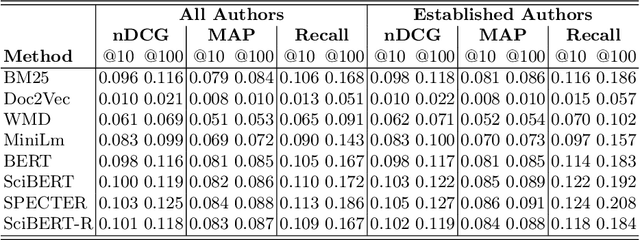
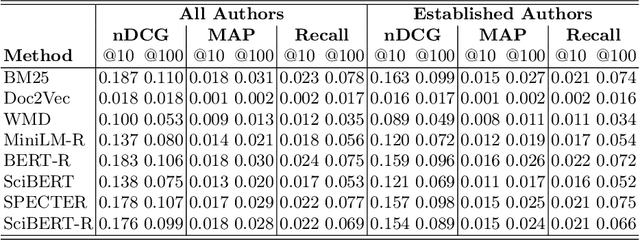
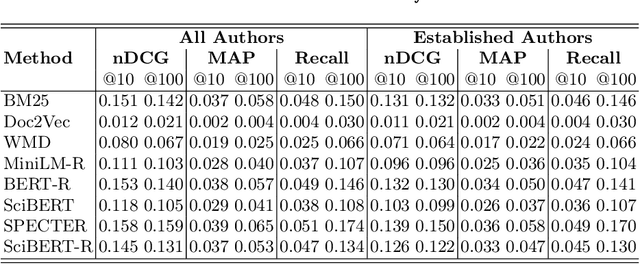
The peer review process is crucial for ensuring the quality and reliability of scholarly work, yet assigning suitable reviewers remains a significant challenge. Traditional manual methods are labor-intensive and often ineffective, leading to nonconstructive or biased reviews. This paper introduces the exHarmony (eHarmony but for connecting experts to manuscripts) benchmark, designed to address these challenges by re-imagining the Reviewer Assignment Problem (RAP) as a retrieval task. Utilizing the extensive data from OpenAlex, we propose a novel approach that considers a host of signals from the authors, most similar experts, and the citation relations as potential indicators for a suitable reviewer for a manuscript. This approach allows us to develop a standard benchmark dataset for evaluating the reviewer assignment problem without needing explicit labels. We benchmark various methods, including traditional lexical matching, static neural embeddings, and contextualized neural embeddings, and introduce evaluation metrics that assess both relevance and diversity in the context of RAP. Our results indicate that while traditional methods perform reasonably well, contextualized embeddings trained on scholarly literature show the best performance. The findings underscore the importance of further research to enhance the diversity and effectiveness of reviewer assignments.