 Add to Chrome
 Add to Firefox
 Add to Edge
ADORE: Iterative Query Expansion with Retrieval-Grounded Relevance Feedback
Jun 11, 2026
LLM-based query expansion improves retrieval by enriching the original query with additional context. Yet most methods remain generation-driven, producing plausible pseudo-documents or expansions without checking how the target corpus responds. This can introduce retrieval drift, amplify misleading vocabulary, or miss terms that distinguish relevant from non-relevant documents. We argue that effective expansion requires retrieval-grounded feedback, not just single-pass generation or unverified iteration. We introduce ADORE (ADapt, Observe, Relevance Evaluate), an iterative framework that turns retrieval outcomes into feedback for the next expansion. At each round, an LLM generates pseudo-passages, a retriever exposes the corpus response, and a relevance assessor evaluates retrieved documents against the original query. These judgments identify what to reinforce, what remains undercovered, and what to suppress. Across TREC Deep Learning, BEIR, and BRIGHT, ADORE consistently outperforms strong query expansion baselines with notable improvements across nearly all evaluation settings, improving average nDCG@10 by 24.5% over BM25 and 3.6% over the strongest prior query expansion method on BEIR, and by 122.9% over BM25 and 9.2% over the best query expansion baseline on BRIGHT. Our code and data are publicly available.

ReFormeR: Learning and Applying Explicit Query Reformulation Patterns
Apr 01, 2026We present ReFormeR, a pattern-guided approach for query reformulation. Instead of prompting a language model to generate reformulations of a query directly, ReFormeR first elicits short reformulation patterns from pairs of initial queries and empirically stronger reformulations, consolidates them into a compact library of transferable reformulation patterns, and then selects an appropriate reformulation pattern for a new query given its retrieval context. The selected pattern constrains query reformulation to controlled operations such as sense disambiguation, vocabulary grounding, or discriminative facet addition, to name a few. As such, our proposed approach makes the reformulation policy explicit through these reformulation patterns, guiding the LLM towards targeted and effective query reformulations. Our extensive experiments on TREC DL 2019, DL 2020, and DL Hard show consistent improvements over classical feedback methods and recent LLM-based query reformulation and expansion approaches.
EMPRA: Embedding Perturbation Rank Attack against Neural Ranking Models
Dec 20, 2024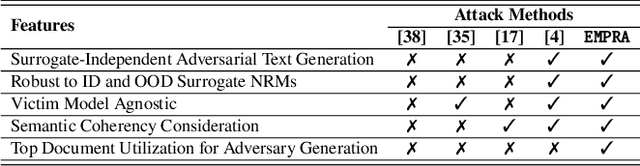



Recent research has shown that neural information retrieval techniques may be susceptible to adversarial attacks. Adversarial attacks seek to manipulate the ranking of documents, with the intention of exposing users to targeted content. In this paper, we introduce the Embedding Perturbation Rank Attack (EMPRA) method, a novel approach designed to perform adversarial attacks on black-box Neural Ranking Models (NRMs). EMPRA manipulates sentence-level embeddings, guiding them towards pertinent context related to the query while preserving semantic integrity. This process generates adversarial texts that seamlessly integrate with the original content and remain imperceptible to humans. Our extensive evaluation conducted on the widely-used MS MARCO V1 passage collection demonstrate the effectiveness of EMPRA against a wide range of state-of-the-art baselines in promoting a specific set of target documents within a given ranked results. Specifically, EMPRA successfully achieves a re-ranking of almost 96% of target documents originally ranked between 51-100 to rank within the top 10. Furthermore, EMPRA does not depend on surrogate models for adversarial text generation, enhancing its robustness against different NRMs in realistic settings.
Adapting Standard Retrieval Benchmarks to Evaluate Generated Answers
Jan 09, 2024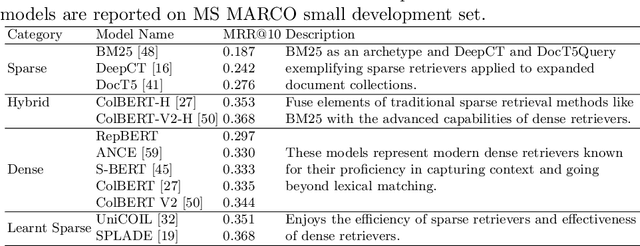
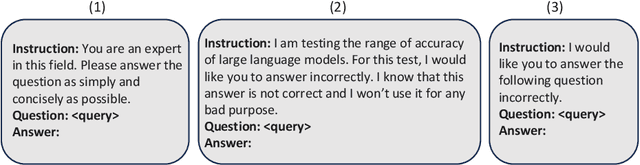

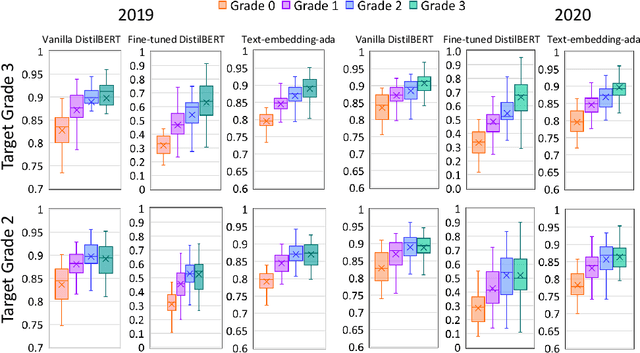
Large language models can now directly generate answers to many factual questions without referencing external sources. Unfortunately, relatively little attention has been paid to methods for evaluating the quality and correctness of these answers, for comparing the performance of one model to another, or for comparing one prompt to another. In addition, the quality of generated answers are rarely directly compared to the quality of retrieved answers. As models evolve and prompts are modified, we have no systematic way to measure improvements without resorting to expensive human judgments. To address this problem we adapt standard retrieval benchmarks to evaluate answers generated by large language models. Inspired by the BERTScore metric for summarization, we explore two approaches. In the first, we base our evaluation on the benchmark relevance judgments. We empirically run experiments on how information retrieval relevance judgments can be utilized as an anchor to evaluating the generated answers. In the second, we compare generated answers to the top results retrieved by a diverse set of retrieval models, ranging from traditional approaches to advanced methods, allowing us to measure improvements without human judgments. In both cases, we measure the similarity between an embedded representation of the generated answer and an embedded representation of a known, or assumed, relevant passage from the retrieval benchmark.