 Add to Chrome
 Add to Firefox
 Add to Edge
PeeriScope: A Multi-Faceted Framework for Evaluating Peer Review Quality
Apr 27, 2026
The increasing scale and variability of peer review in scholarly venues has created an urgent need for systematic, interpretable, and extensible tools to assess review quality. We present PeeriScope, a modular platform that integrates structured features, rubric-guided large language model assessments, and supervised prediction to evaluate peer review quality along multiple dimensions. Designed for openness and integration, PeeriScope provides both a public interface and a documented API, supporting practical deployment and research extensibility. The demonstration illustrates its use for reviewer self-assessment, editorial triage, and large-scale auditing, and it enables the continued development of quality evaluation methods within scientific peer review. PeeriScope is available both as a live demo at https://app.reviewer.ly/app/peeriscope and via API services at https://github.com/Reviewerly-Inc/Peeriscope.

exHarmony: Authorship and Citations for Benchmarking the Reviewer Assignment Problem
Feb 11, 2025
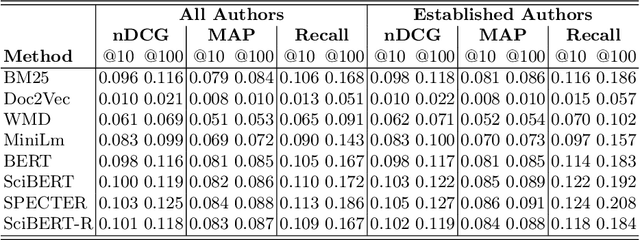
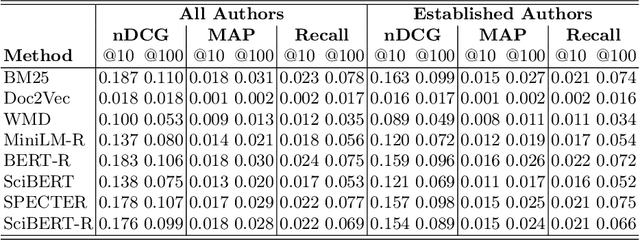
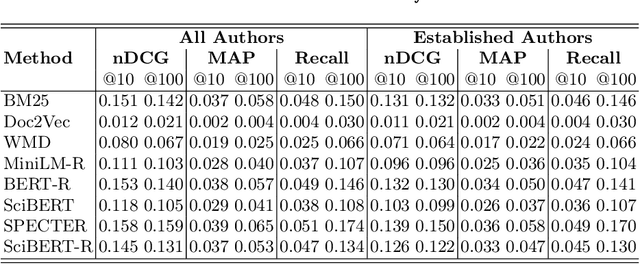
The peer review process is crucial for ensuring the quality and reliability of scholarly work, yet assigning suitable reviewers remains a significant challenge. Traditional manual methods are labor-intensive and often ineffective, leading to nonconstructive or biased reviews. This paper introduces the exHarmony (eHarmony but for connecting experts to manuscripts) benchmark, designed to address these challenges by re-imagining the Reviewer Assignment Problem (RAP) as a retrieval task. Utilizing the extensive data from OpenAlex, we propose a novel approach that considers a host of signals from the authors, most similar experts, and the citation relations as potential indicators for a suitable reviewer for a manuscript. This approach allows us to develop a standard benchmark dataset for evaluating the reviewer assignment problem without needing explicit labels. We benchmark various methods, including traditional lexical matching, static neural embeddings, and contextualized neural embeddings, and introduce evaluation metrics that assess both relevance and diversity in the context of RAP. Our results indicate that while traditional methods perform reasonably well, contextualized embeddings trained on scholarly literature show the best performance. The findings underscore the importance of further research to enhance the diversity and effectiveness of reviewer assignments.