 Add to Chrome
 Add to Firefox
 Add to Edge
Uncertainty-Guided Dual-Domain Learning for Reliable Skin Lesion Segmentation
May 10, 2026
Accurate skin lesion segmentation is vital for dermoscopic Computer-Aided Diagnosis. However, visual ambiguity and morphological irregularity often defeat spatial modeling, necessitating multi-domain architectures. Existing paradigms frequently overlook the active use of prediction uncertainty, leading to deterministic frameworks that suffer from blind cross-domain fusion and overfit to label noise. To address these issues, we propose the Uncertainty-Guided Dual-Domain Network (UGDD-Net). UGDD-Net introduces a novel "Glance-and-Gaze" mechanism to transform uncertainty into an active guiding signal. Specifically, the Uncertainty-Guided Bi-directional Feature Fusion (UGBFF) module uses pixel-level uncertainty to modulate spatial-spectral interactions. The Uncertainty-Guided Graph Refinement (UGGR) module constructs a topology-aware graph to propagate reliable semantic consensus and refine uncertain nodes. Finally, the Uncertainty-Guided Margin-Adaptive Loss (UGML) enforces strict constraints on confident pixels while relaxing penalties on uncertain ones to improve statistical calibration. Extensive experiments on ISIC2017, ISIC2018, PH2, and HAM10000 datasets demonstrate that UGDD-Net achieves state-of-the-art performance, especially on "Hard Samples". Our uncertainty maps align with expert inter-observer variability, providing robust interpretability for human-machine collaborative diagnosis.

PaAgent: Portrait-Aware Image Restoration Agent via Subjective-Objective Reinforcement Learning
Mar 17, 2026Image Restoration (IR) agents, leveraging multimodal large language models to perceive degradation and invoke restoration tools, have shown promise in automating IR tasks. However, existing IR agents typically lack an insight summarization mechanism for past interactions, which results in an exhaustive search for the optimal IR tool. To address this limitation, we propose a portrait-aware IR agent, dubbed PaAgent, which incorporates a self-evolving portrait bank for IR tools and Retrieval-Augmented Generation (RAG) to select a suitable IR tool for input. Specifically, to construct and evolve the portrait bank, the PaAgent continuously enriches it by summarizing the characteristics of various IR tools with restored images, selected IR tools, and degraded images. In addition, the RAG is employed to select the optimal IR tool for the input image by retrieving relevant insights from the portrait bank. Furthermore, to enhance PaAgent's ability to perceive degradation in complex scenes, we propose a subjective-objective reinforcement learning strategy that considers both image quality scores and semantic insights in reward generation, which accurately provides the degradation information even under partial and non-uniform degradation. Extensive experiments across 8 IR benchmarks, covering six single-degradation and eight mixed-degradation scenarios, validate PaAgent's superiority in addressing complex IR tasks. Our project page is \href{https://wyjgr.github.io/PaAgent.html}{PaAgent}.
NTIRE 2025 Challenge on Efficient Burst HDR and Restoration: Datasets, Methods, and Results
May 17, 2025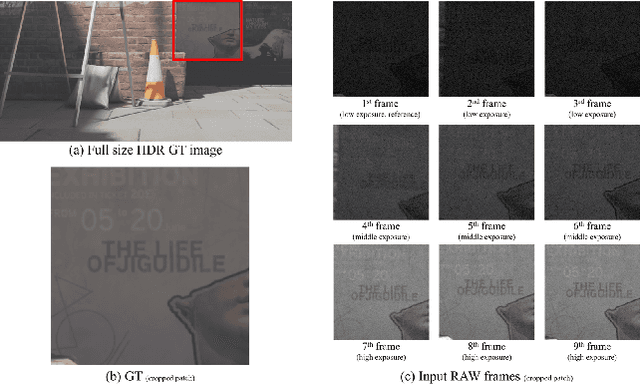
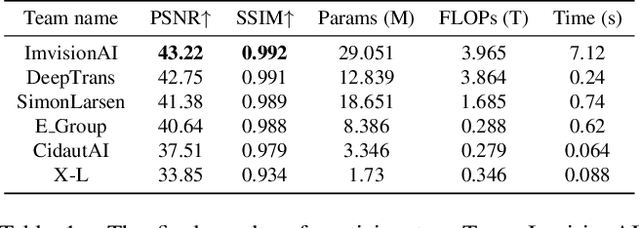
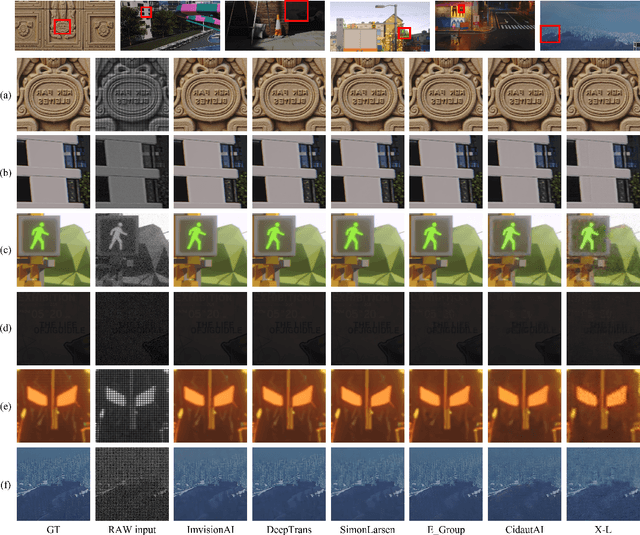
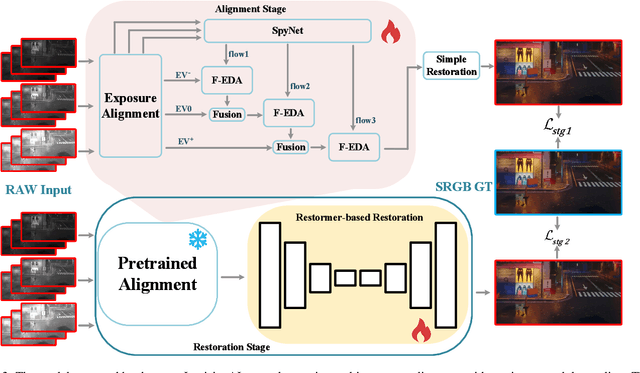
This paper reviews the NTIRE 2025 Efficient Burst HDR and Restoration Challenge, which aims to advance efficient multi-frame high dynamic range (HDR) and restoration techniques. The challenge is based on a novel RAW multi-frame fusion dataset, comprising nine noisy and misaligned RAW frames with various exposure levels per scene. Participants were tasked with developing solutions capable of effectively fusing these frames while adhering to strict efficiency constraints: fewer than 30 million model parameters and a computational budget under 4.0 trillion FLOPs. A total of 217 participants registered, with six teams finally submitting valid solutions. The top-performing approach achieved a PSNR of 43.22 dB, showcasing the potential of novel methods in this domain. This paper provides a comprehensive overview of the challenge, compares the proposed solutions, and serves as a valuable reference for researchers and practitioners in efficient burst HDR and restoration.