 Add to Chrome
 Add to Firefox
 Add to Edge
SM4RT: Learning Structured Motion Geometry for 4D Reconstruction
Jul 24, 2026
Geometry Foundation Models (GFMs) have substantially advanced monocular 3D reconstruction, yet extending this capability to 4D dynamic understanding remains a fundamental challenge. Most existing motion perception methods (e.g., sparse tracking, dense point-wise flow) treat motion as independent point-wise displacements, ignoring the structured nature of physical motion. However, real-world objects usually obey rigid-body kinematics, and points thus usually move collectively, not in isolation. Motion itself possesses geometric structure: physical objects undergo a set of rigid-body transformations governed by SE(3), rather than unstructured point-wise displacements. Building on this insight, we propose SM4RT, a Structured Motion 4D Reconstruction Transformer for end-to-end 3D reconstruction and structured motion perception. SM4RT introduces Structure-of-Motion to represent scene dynamics, where scene motion is decomposed into a compact set of motion bases, each represented as a temporal sequence of 6D twists in SE(3). Dense scene motion is then recovered by sparse, time-shared per-pixel assignment weights over these bases, ensuring points on the same object share a common rigid-body motion trajectory. SM4RT introduces a parallel motion geometry encoder and decoder that jointly infer 3D geometry, world-coordinate motion, and scene kinematic structure in a single forward pass from monocular RGB video. SM4RT achieves strong motion reconstruction performance while preserving the geometric structure of scene motion.

DriveTok: 3D Driving Scene Tokenization for Unified Multi-View Reconstruction and Understanding
Mar 19, 2026With the growing adoption of vision-language-action models and world models in autonomous driving systems, scalable image tokenization becomes crucial as the interface for the visual modality. However, most existing tokenizers are designed for monocular and 2D scenes, leading to inefficiency and inter-view inconsistency when applied to high-resolution multi-view driving scenes. To address this, we propose DriveTok, an efficient 3D driving scene tokenizer for unified multi-view reconstruction and understanding. DriveTok first obtains semantically rich visual features from vision foundation models and then transforms them into the scene tokens with 3D deformable cross-attention. For decoding, we employ a multi-view transformer to reconstruct multi-view features from the scene tokens and use multiple heads to obtain RGB, depth, and semantic reconstructions. We also add a 3D head directly on the scene tokens for 3D semantic occupancy prediction for better spatial awareness. With the multiple training objectives, DriveTok learns unified scene tokens that integrate semantic, geometric, and textural information for efficient multi-view tokenization. Extensive experiments on the widely used nuScenes dataset demonstrate that the scene tokens from DriveTok perform well on image reconstruction, semantic segmentation, depth prediction, and 3D occupancy prediction tasks.
Streaming 4D Visual Geometry Transformer
Jul 15, 2025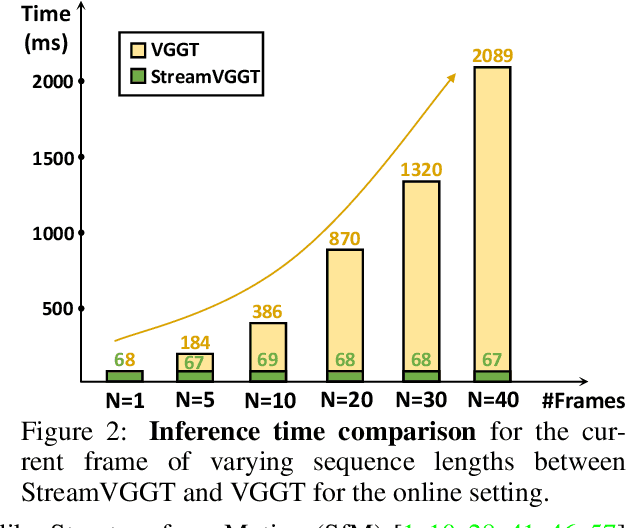
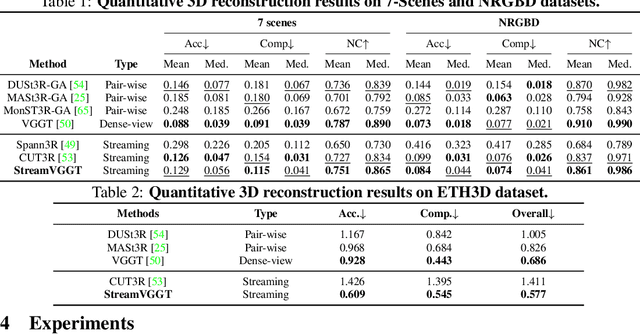
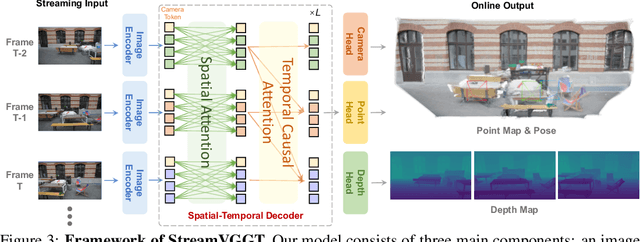
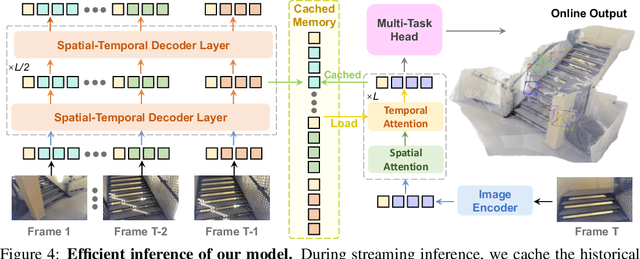
Perceiving and reconstructing 4D spatial-temporal geometry from videos is a fundamental yet challenging computer vision task. To facilitate interactive and real-time applications, we propose a streaming 4D visual geometry transformer that shares a similar philosophy with autoregressive large language models. We explore a simple and efficient design and employ a causal transformer architecture to process the input sequence in an online manner. We use temporal causal attention and cache the historical keys and values as implicit memory to enable efficient streaming long-term 4D reconstruction. This design can handle real-time 4D reconstruction by incrementally integrating historical information while maintaining high-quality spatial consistency. For efficient training, we propose to distill knowledge from the dense bidirectional visual geometry grounded transformer (VGGT) to our causal model. For inference, our model supports the migration of optimized efficient attention operator (e.g., FlashAttention) from the field of large language models. Extensive experiments on various 4D geometry perception benchmarks demonstrate that our model increases the inference speed in online scenarios while maintaining competitive performance, paving the way for scalable and interactive 4D vision systems. Code is available at: https://github.com/wzzheng/StreamVGGT.
DVLO: Deep Visual-LiDAR Odometry with Local-to-Global Feature Fusion and Bi-Directional Structure Alignment
Mar 27, 2024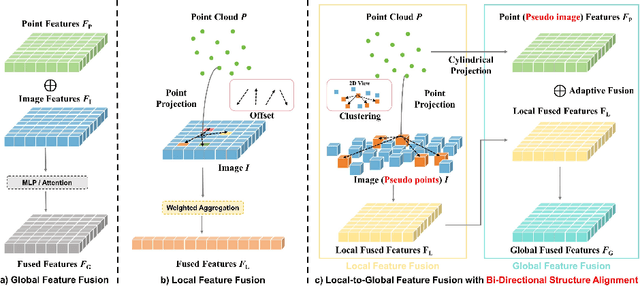
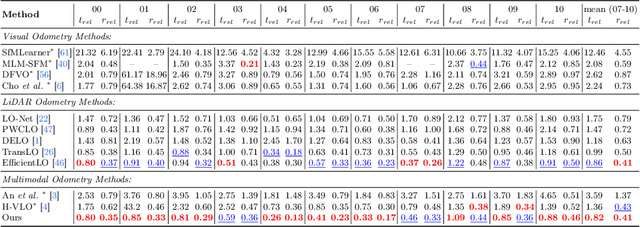
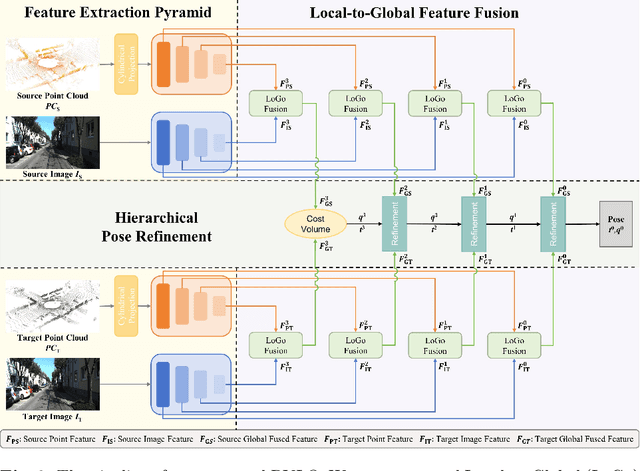

Information inside visual and LiDAR data is well complementary derived from the fine-grained texture of images and massive geometric information in point clouds. However, it remains challenging to explore effective visual-LiDAR fusion, mainly due to the intrinsic data structure inconsistency between two modalities: Images are regular and dense, but LiDAR points are unordered and sparse. To address the problem, we propose a local-to-global fusion network with bi-directional structure alignment. To obtain locally fused features, we project points onto image plane as cluster centers and cluster image pixels around each center. Image pixels are pre-organized as pseudo points for image-to-point structure alignment. Then, we convert points to pseudo images by cylindrical projection (point-to-image structure alignment) and perform adaptive global feature fusion between point features with local fused features. Our method achieves state-of-the-art performance on KITTI odometry and FlyingThings3D scene flow datasets compared to both single-modal and multi-modal methods. Codes will be released later.