 Add to Chrome
 Add to Firefox
 Add to Edge
Uncertainty-Aware Spatial Color Correlation for Low-Light Image Enhancement
Aug 06, 2025
Most existing low-light image enhancement approaches primarily focus on architectural innovations, while often overlooking the intrinsic uncertainty within feature representations particularly under extremely dark conditions where degraded gradient and noise dominance severely impair model reliability and causal reasoning. To address these issues, we propose U2CLLIE, a novel framework that integrates uncertainty-aware enhancement and spatial-color causal correlation modeling. From the perspective of entropy-based uncertainty, our framework introduces two key components: (1) An Uncertainty-Aware Dual-domain Denoise (UaD) Module, which leverages Gaussian-Guided Adaptive Frequency Domain Feature Enhancement (G2AF) to suppress frequency-domain noise and optimize entropy-driven representations. This module enhances spatial texture extraction and frequency-domain noise suppression/structure refinement, effectively mitigating gradient vanishing and noise dominance. (2) A hierarchical causality-aware framework, where a Luminance Enhancement Network (LEN) first performs coarse brightness enhancement on dark regions. Then, during the encoder-decoder phase, two asymmetric causal correlation modeling modules Neighborhood Correlation State Space (NeCo) and Adaptive Spatial-Color Calibration (AsC) collaboratively construct hierarchical causal constraints. These modules reconstruct and reinforce neighborhood structure and color consistency in the feature space. Extensive experiments demonstrate that U2CLLIE achieves state-of-the-art performance across multiple benchmark datasets, exhibiting robust performance and strong generalization across various scenes.

Stereo 3D Gaussian Splatting SLAM for Outdoor Urban Scenes
Jul 31, 20253D Gaussian Splatting (3DGS) has recently gained popularity in SLAM applications due to its fast rendering and high-fidelity representation. However, existing 3DGS-SLAM systems have predominantly focused on indoor environments and relied on active depth sensors, leaving a gap for large-scale outdoor applications. We present BGS-SLAM, the first binocular 3D Gaussian Splatting SLAM system designed for outdoor scenarios. Our approach uses only RGB stereo pairs without requiring LiDAR or active sensors. BGS-SLAM leverages depth estimates from pre-trained deep stereo networks to guide 3D Gaussian optimization with a multi-loss strategy enhancing both geometric consistency and visual quality. Experiments on multiple datasets demonstrate that BGS-SLAM achieves superior tracking accuracy and mapping performance compared to other 3DGS-based solutions in complex outdoor environments.
Dual form Complementary Masking for Domain-Adaptive Image Segmentation
Jul 16, 2025Recent works have correlated Masked Image Modeling (MIM) with consistency regularization in Unsupervised Domain Adaptation (UDA). However, they merely treat masking as a special form of deformation on the input images and neglect the theoretical analysis, which leads to a superficial understanding of masked reconstruction and insufficient exploitation of its potential in enhancing feature extraction and representation learning. In this paper, we reframe masked reconstruction as a sparse signal reconstruction problem and theoretically prove that the dual form of complementary masks possesses superior capabilities in extracting domain-agnostic image features. Based on this compelling insight, we propose MaskTwins, a simple yet effective UDA framework that integrates masked reconstruction directly into the main training pipeline. MaskTwins uncovers intrinsic structural patterns that persist across disparate domains by enforcing consistency between predictions of images masked in complementary ways, enabling domain generalization in an end-to-end manner. Extensive experiments verify the superiority of MaskTwins over baseline methods in natural and biological image segmentation. These results demonstrate the significant advantages of MaskTwins in extracting domain-invariant features without the need for separate pre-training, offering a new paradigm for domain-adaptive segmentation.
MK-Pose: Category-Level Object Pose Estimation via Multimodal-Based Keypoint Learning
Jul 09, 2025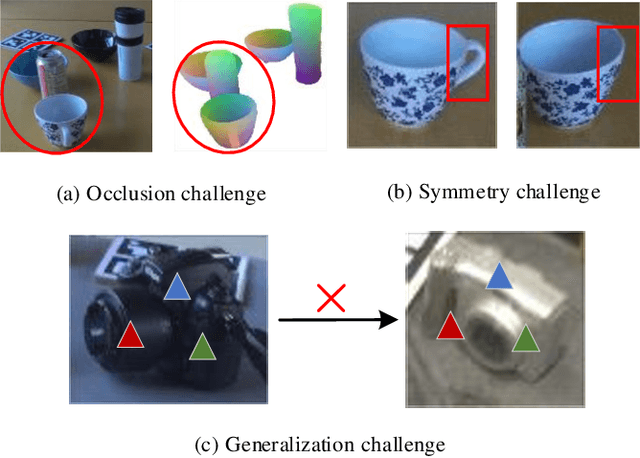
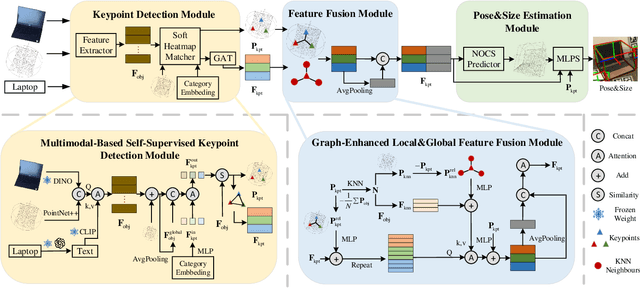
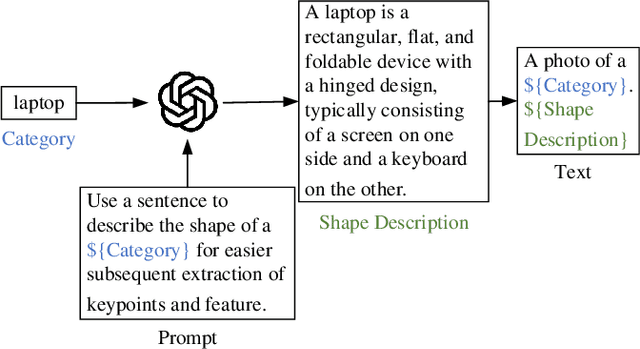
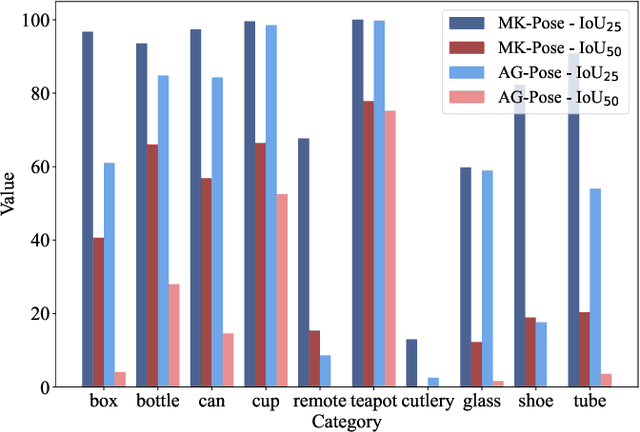
Category-level object pose estimation, which predicts the pose of objects within a known category without prior knowledge of individual instances, is essential in applications like warehouse automation and manufacturing. Existing methods relying on RGB images or point cloud data often struggle with object occlusion and generalization across different instances and categories. This paper proposes a multimodal-based keypoint learning framework (MK-Pose) that integrates RGB images, point clouds, and category-level textual descriptions. The model uses a self-supervised keypoint detection module enhanced with attention-based query generation, soft heatmap matching and graph-based relational modeling. Additionally, a graph-enhanced feature fusion module is designed to integrate local geometric information and global context. MK-Pose is evaluated on CAMERA25 and REAL275 dataset, and is further tested for cross-dataset capability on HouseCat6D dataset. The results demonstrate that MK-Pose outperforms existing state-of-the-art methods in both IoU and average precision without shape priors. Codes will be released at \href{https://github.com/yangyifanYYF/MK-Pose}{https://github.com/yangyifanYYF/MK-Pose}.
FastCache: Fast Caching for Diffusion Transformer Through Learnable Linear Approximation
May 26, 2025Diffusion Transformers (DiT) are powerful generative models but remain computationally intensive due to their iterative structure and deep transformer stacks. To alleviate this inefficiency, we propose FastCache, a hidden-state-level caching and compression framework that accelerates DiT inference by exploiting redundancy within the model's internal representations. FastCache introduces a dual strategy: (1) a spatial-aware token selection mechanism that adaptively filters redundant tokens based on hidden state saliency, and (2) a transformer-level cache that reuses latent activations across timesteps when changes are statistically insignificant. These modules work jointly to reduce unnecessary computation while preserving generation fidelity through learnable linear approximation. Theoretical analysis shows that FastCache maintains bounded approximation error under a hypothesis-testing-based decision rule. Empirical evaluations across multiple DiT variants demonstrate substantial reductions in latency and memory usage, with best generation output quality compared to other cache methods, as measured by FID and t-FID. Code implementation of FastCache is available on GitHub at https://github.com/NoakLiu/FastCache-xDiT.
Neural Video Compression with Context Modulation
May 20, 2025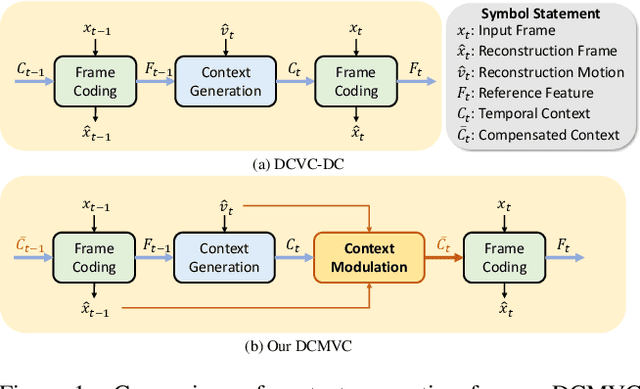
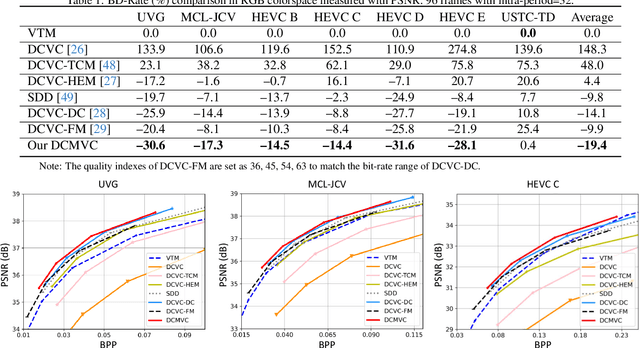
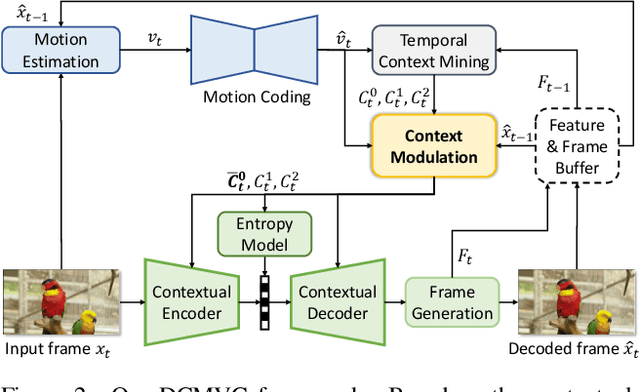
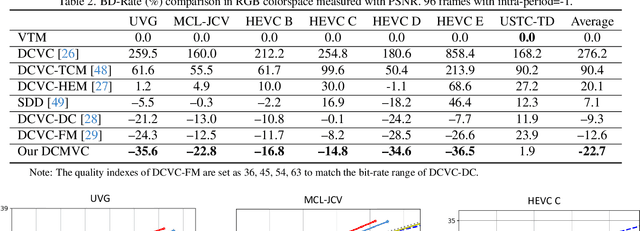
Efficient video coding is highly dependent on exploiting the temporal redundancy, which is usually achieved by extracting and leveraging the temporal context in the emerging conditional coding-based neural video codec (NVC). Although the latest NVC has achieved remarkable progress in improving the compression performance, the inherent temporal context propagation mechanism lacks the ability to sufficiently leverage the reference information, limiting further improvement. In this paper, we address the limitation by modulating the temporal context with the reference frame in two steps. Specifically, we first propose the flow orientation to mine the inter-correlation between the reference frame and prediction frame for generating the additional oriented temporal context. Moreover, we introduce the context compensation to leverage the oriented context to modulate the propagated temporal context generated from the propagated reference feature. Through the synergy mechanism and decoupling loss supervision, the irrelevant propagated information can be effectively eliminated to ensure better context modeling. Experimental results demonstrate that our codec achieves on average 22.7% bitrate reduction over the advanced traditional video codec H.266/VVC, and offers an average 10.1% bitrate saving over the previous state-of-the-art NVC DCVC-FM. The code is available at https://github.com/Austin4USTC/DCMVC.
CHRIS: Clothed Human Reconstruction with Side View Consistency
May 17, 2025Creating a realistic clothed human from a single-view RGB image is crucial for applications like mixed reality and filmmaking. Despite some progress in recent years, mainstream methods often fail to fully utilize side-view information, as the input single-view image contains front-view information only. This leads to globally unrealistic topology and local surface inconsistency in side views. To address these, we introduce Clothed Human Reconstruction with Side View Consistency, namely CHRIS, which consists of 1) A Side-View Normal Discriminator that enhances global visual reasonability by distinguishing the generated side-view normals from the ground truth ones; 2) A Multi-to-One Gradient Computation (M2O) that ensures local surface consistency. M2O calculates the gradient of a sampling point by integrating the gradients of the nearby points, effectively acting as a smooth operation. Experimental results demonstrate that CHRIS achieves state-of-the-art performance on public benchmarks and outperforms the prior work.
Augmented Deep Contexts for Spatially Embedded Video Coding
May 08, 2025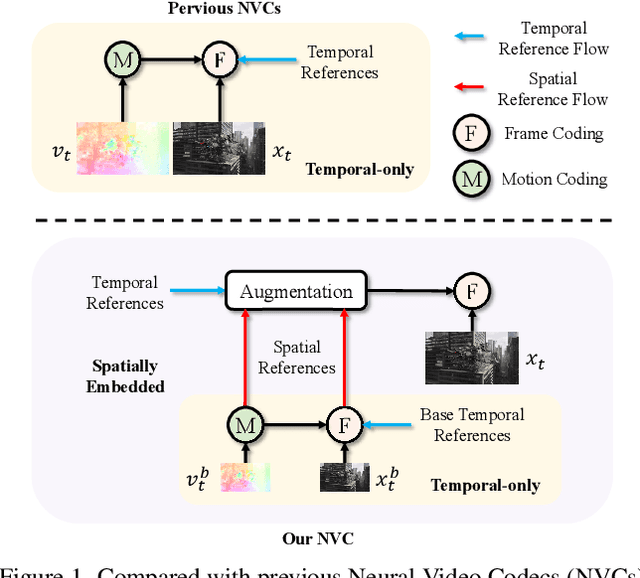
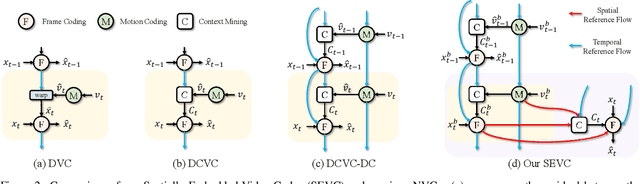
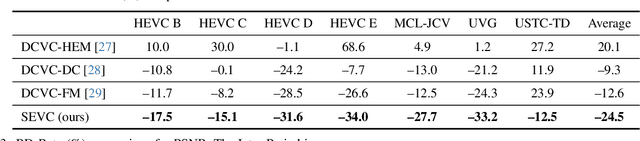
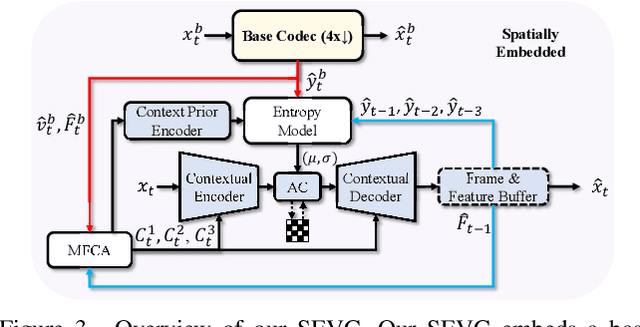
Most Neural Video Codecs (NVCs) only employ temporal references to generate temporal-only contexts and latent prior. These temporal-only NVCs fail to handle large motions or emerging objects due to limited contexts and misaligned latent prior. To relieve the limitations, we propose a Spatially Embedded Video Codec (SEVC), in which the low-resolution video is compressed for spatial references. Firstly, our SEVC leverages both spatial and temporal references to generate augmented motion vectors and hybrid spatial-temporal contexts. Secondly, to address the misalignment issue in latent prior and enrich the prior information, we introduce a spatial-guided latent prior augmented by multiple temporal latent representations. At last, we design a joint spatial-temporal optimization to learn quality-adaptive bit allocation for spatial references, further boosting rate-distortion performance. Experimental results show that our SEVC effectively alleviates the limitations in handling large motions or emerging objects, and also reduces 11.9% more bitrate than the previous state-of-the-art NVC while providing an additional low-resolution bitstream. Our code and model are available at https://github.com/EsakaK/SEVC.
Physics-Driven Neural Compensation For Electrical Impedance Tomography
Apr 28, 2025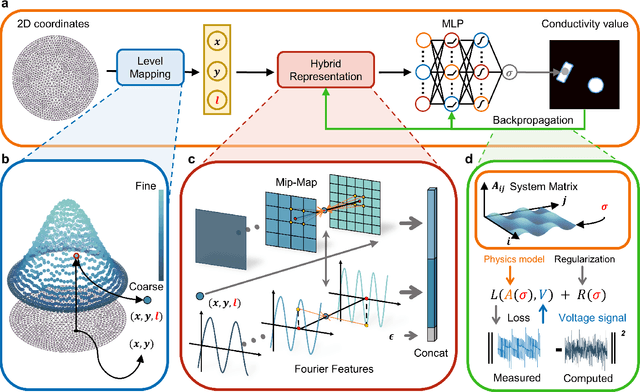

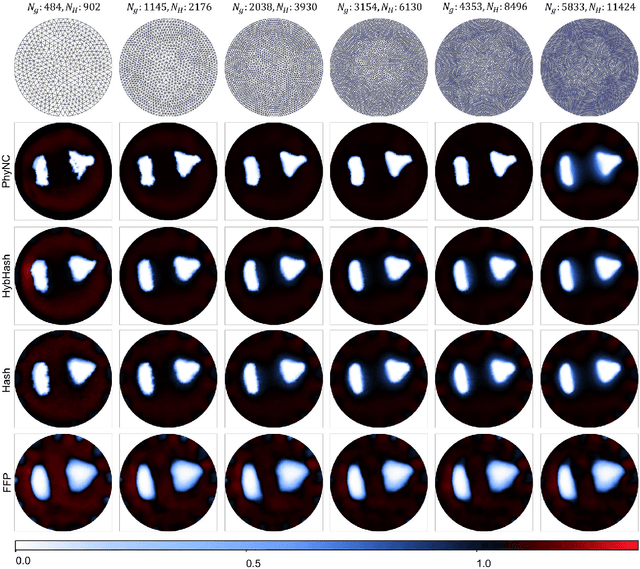

Electrical Impedance Tomography (EIT) provides a non-invasive, portable imaging modality with significant potential in medical and industrial applications. Despite its advantages, EIT encounters two primary challenges: the ill-posed nature of its inverse problem and the spatially variable, location-dependent sensitivity distribution. Traditional model-based methods mitigate ill-posedness through regularization but overlook sensitivity variability, while supervised deep learning approaches require extensive training data and lack generalization. Recent developments in neural fields have introduced implicit regularization techniques for image reconstruction, but these methods typically neglect the physical principles underlying EIT, thus limiting their effectiveness. In this study, we propose PhyNC (Physics-driven Neural Compensation), an unsupervised deep learning framework that incorporates the physical principles of EIT. PhyNC addresses both the ill-posed inverse problem and the sensitivity distribution by dynamically allocating neural representational capacity to regions with lower sensitivity, ensuring accurate and balanced conductivity reconstructions. Extensive evaluations on both simulated and experimental data demonstrate that PhyNC outperforms existing methods in terms of detail preservation and artifact resistance, particularly in low-sensitivity regions. Our approach enhances the robustness of EIT reconstructions and provides a flexible framework that can be adapted to other imaging modalities with similar challenges.
Partition Map-Based Fast Block Partitioning for VVC Inter Coding
Apr 25, 2025Among the new techniques of Versatile Video Coding (VVC), the quadtree with nested multi-type tree (QT+MTT) block structure yields significant coding gains by providing more flexible block partitioning patterns. However, the recursive partition search in the VVC encoder increases the encoder complexity substantially. To address this issue, we propose a partition map-based algorithm to pursue fast block partitioning in inter coding. Based on our previous work on partition map-based methods for intra coding, we analyze the characteristics of VVC inter coding, and thus improve the partition map by incorporating an MTT mask for early termination. Next, we develop a neural network that uses both spatial and temporal features to predict the partition map. It consists of several special designs including stacked top-down and bottom-up processing, quantization parameter modulation layers, and partitioning-adaptive warping. Furthermore, we present a dual-threshold decision scheme to achieve a fine-grained trade-off between complexity reduction and rate-distortion (RD) performance loss. The experimental results demonstrate that the proposed method achieves an average 51.30% encoding time saving with a 2.12% Bjontegaard Delta Bit Rate (BDBR) under the random access configuration.