 Add to Chrome
 Add to Firefox
 Add to Edge
Prosociality by Coupling, Not Mere Observation: Homeostatic Sharing in an Inspectable Recurrent Artificial Life Agent
Apr 12, 2026
Artificial agents can be made to "help" for many reasons, including explicit social reward, hard-coded prosocial bonuses, or direct access to another agent's internal state. Those possibilities make minimal prosocial behavior hard to interpret. Building on ReCoN-Ipsundrum, an inspectable recurrent controller with affect-coupled regulation, I add an explicit homeostat and a social coupling channel while keeping planning strictly self-directed: the agent scores only its own predicted internal state, and no partner-welfare reward term is introduced. I compare four matched conditions in two toy worlds. In a one-step FoodShareToy, an exact solver finds a sharp switch from EAT to PASS at $λ* \approx 0.91$ for the default state. In the experimental runs, the self-only and partner-observing conditions never help, whereas the affectively coupled conditions always do. In a multi-step SocialCorridorWorld, the same dissociation reappears: coupling flips help rate and partner recovery from 0 to 1 and cuts rescue latency from 18 to 9 steps, while raising mutual viability from 0.15 to 0.33. Sham lesions preserve helping, but coupling-off and shuffled-partner lesions abolish it in both tasks. A coupling sweep shows a load-dependent feasibility boundary: under low load, helping appears for $λ \geq 0.25$, whereas under medium and high loads no tested value rescues the partner within horizon. The result is a narrow claim for artificial life: in this minimal architecture, helping appears when another's need is routed into self-regulation.

ReCoN-Ipsundrum: An Inspectable Recurrent Persistence Loop Agent with Affect-Coupled Control and Mechanism-Linked Consciousness Indicator Assays
Feb 26, 2026Indicator-based approaches to machine consciousness recommend mechanism-linked evidence triangulated across tasks, supported by architectural inspection and causal intervention. Inspired by Humphrey's ipsundrum hypothesis, we implement ReCoN-Ipsundrum, an inspectable agent that extends a ReCoN state machine with a recurrent persistence loop over sensory salience Ns and an optional affect proxy reporting valence/arousal. Across fixed-parameter ablations (ReCoN, Ipsundrum, Ipsundrum+affect), we operationalize Humphrey's qualiaphilia (preference for sensory experience for its own sake) as a familiarity-controlled scenic-over-dull route choice. We find a novelty dissociation: non-affect variants are novelty-sensitive (Delta scenic-entry = 0.07). Affect coupling is stable (Delta scenic-entry = 0.01) even when scenic is less novel (median Delta novelty ~ -0.43). In reward-free exploratory play, the affect variant shows structured local investigation (scan events 31.4 vs. 0.9; cycle score 7.6). In a pain-tail probe, only the affect variant sustains prolonged planned caution (tail duration 90 vs. 5). Lesioning feedback+integration selectively reduces post-stimulus persistence in ipsundrum variants (AUC drop 27.62, 27.9%) while leaving ReCoN unchanged. These dissociations link recurrence -> persistence and affect-coupled control -> preference stability, scanning, and lingering caution, illustrating how indicator-like signatures can be engineered and why mechanistic and causal evidence should accompany behavioral markers.
Spark: A System for Scientifically Creative Idea Generation
Apr 25, 2025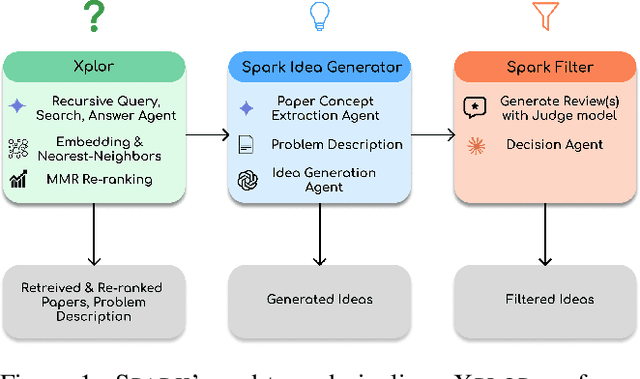
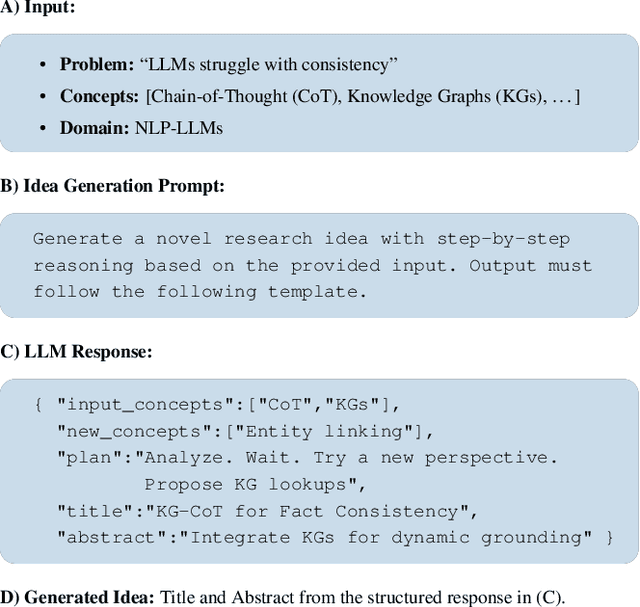
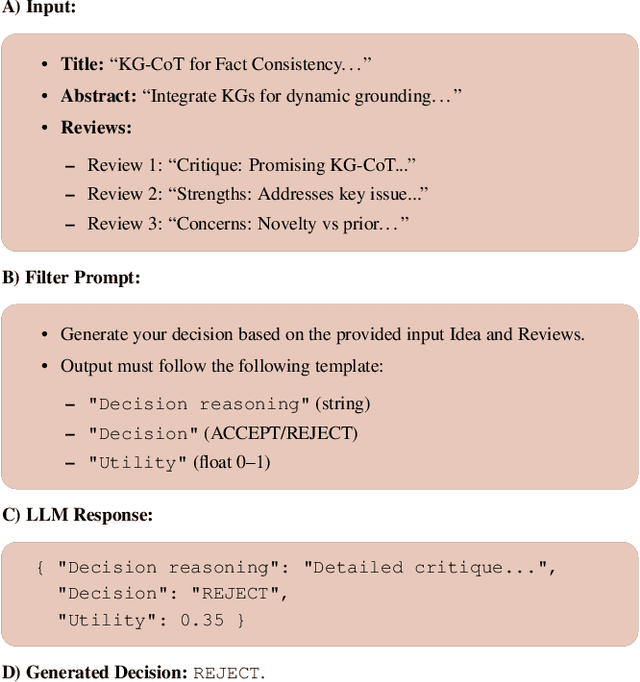
Recently, large language models (LLMs) have shown promising abilities to generate novel research ideas in science, a direction which coincides with many foundational principles in computational creativity (CC). In light of these developments, we present an idea generation system named Spark that couples retrieval-augmented idea generation using LLMs with a reviewer model named Judge trained on 600K scientific reviews from OpenReview. Our work is both a system demonstration and intended to inspire other CC researchers to explore grounding the generation and evaluation of scientific ideas within foundational CC principles. To this end, we release the annotated dataset used to train Judge, inviting other researchers to explore the use of LLMs for idea generation and creative evaluations.