 Add to Chrome
 Add to Firefox
 Add to Edge
Evaluating Multi-Turn Multimodal Diagnostic Reasoning on Challenging Real-World Clinical Cases
Jul 28, 2026
Clinical diagnostic evaluation should not only assess whether models can provide correct diagnoses, but also reflect the realities of clinical practice, including progressive disclosure of multimodal information, dynamic updating of diagnostic hypotheses, and continuous refinement of clinical reasoning. However, existing evaluations of multimodal large language models (MLLMs) typically rely on single-turn or isolated tasks, making it difficult to fully capture the complexity of real-world clinical diagnosis. To bridge this gap, we developed ClinMM-Bench, the largest multi-turn multimodal clinical diagnostic evaluation benchmark to date. ClinMM-Bench contains 1,089 challenging real-world clinical cases and 3,760 medical images across eight specialties. We systematically evaluated 15 representative MLLMs using a two-level evaluation framework that assessed both diagnostic accuracy and diagnostic reasoning quality. Results showed that proprietary models achieved the highest overall diagnostic accuracy, but the proportion of completely correct diagnoses remained limited across all models. In terms of diagnostic reasoning quality, current models can identify plausible diagnostic directions but still have considerable limitations in generating reliable diagnostic reasoning. Error analysis further identified five representative failure modes: information synthesis failure, knowledge mapping error, perception error, premature closure, and visual hallucination.

Foundation Model of Electronic Medical Records for Adaptive Risk Estimation
Feb 10, 2025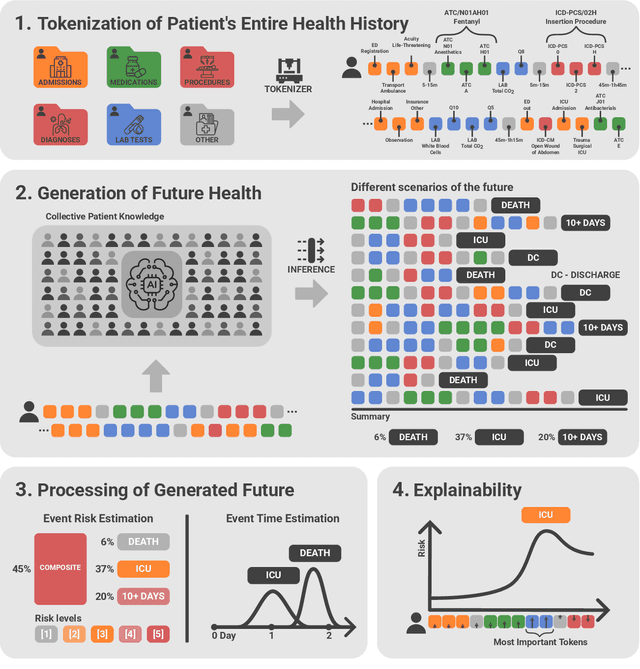
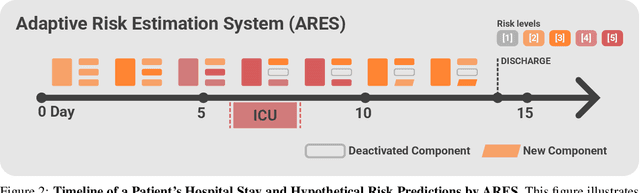
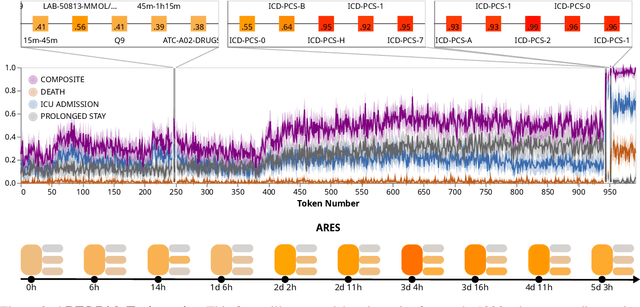
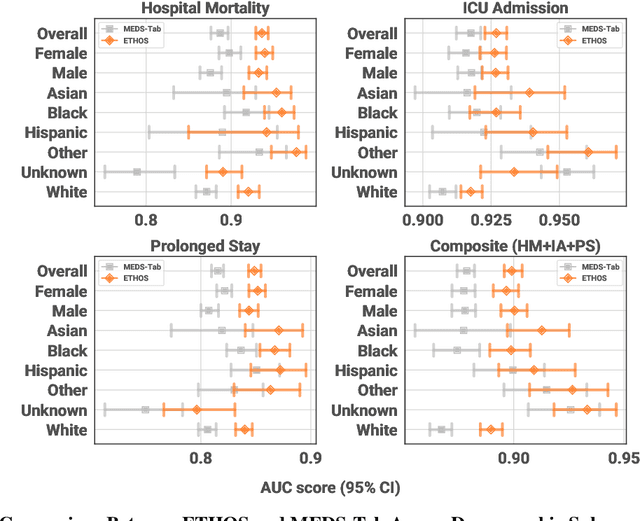
We developed the Enhanced Transformer for Health Outcome Simulation (ETHOS), an AI model that tokenizes patient health timelines (PHTs) from EHRs. ETHOS predicts future PHTs using transformer-based architectures. The Adaptive Risk Estimation System (ARES) employs ETHOS to compute dynamic and personalized risk probabilities for clinician-defined critical events. ARES incorporates a personalized explainability module that identifies key clinical factors influencing risk estimates for individual patients. ARES was evaluated on the MIMIC-IV v2.2 dataset in emergency department (ED) settings, benchmarking its performance against traditional early warning systems and machine learning models. We processed 299,721 unique patients from MIMIC-IV into 285,622 PHTs, with 60% including hospital admissions. The dataset contained over 357 million tokens. ETHOS outperformed benchmark models in predicting hospital admissions, ICU admissions, and prolonged hospital stays, achieving superior AUC scores. ETHOS-based risk estimates demonstrated robustness across demographic subgroups with strong model reliability, confirmed via calibration curves. The personalized explainability module provides insights into patient-specific factors contributing to risk. ARES, powered by ETHOS, advances predictive healthcare AI by providing dynamic, real-time, and personalized risk estimation with patient-specific explainability to enhance clinician trust. Its adaptability and superior accuracy position it as a transformative tool for clinical decision-making, potentially improving patient outcomes and resource allocation in emergency and inpatient settings. We release the full code at github.com/ipolharvard/ethos-ares to facilitate future research.
Zero Shot Health Trajectory Prediction Using Transformer
Jul 30, 2024Integrating modern machine learning and clinical decision-making has great promise for mitigating healthcare's increasing cost and complexity. We introduce the Enhanced Transformer for Health Outcome Simulation (ETHOS), a novel application of the transformer deep-learning architecture for analyzing high-dimensional, heterogeneous, and episodic health data. ETHOS is trained using Patient Health Timelines (PHTs)-detailed, tokenized records of health events-to predict future health trajectories, leveraging a zero-shot learning approach. ETHOS represents a significant advancement in foundation model development for healthcare analytics, eliminating the need for labeled data and model fine-tuning. Its ability to simulate various treatment pathways and consider patient-specific factors positions ETHOS as a tool for care optimization and addressing biases in healthcare delivery. Future developments will expand ETHOS' capabilities to incorporate a wider range of data types and data sources. Our work demonstrates a pathway toward accelerated AI development and deployment in healthcare.
Using Twitter Data to Understand Public Perceptions of Approved versus Off-label Use for COVID-19-related Medications
Jun 29, 2022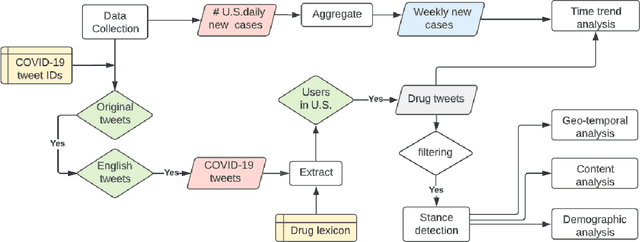

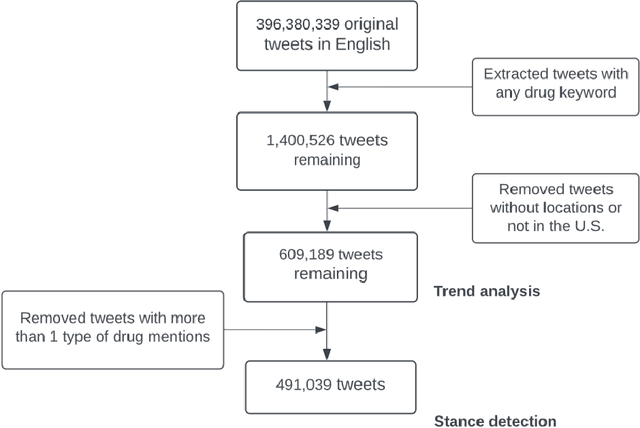
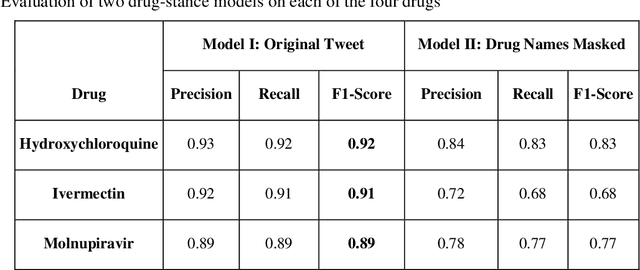
Understanding public discourse on emergency use of unproven therapeutics is essential to monitor safe use and combat misinformation. We developed a natural language processing (NLP)-based pipeline to understand public perceptions of and stances on COVID-19-related drugs on Twitter across time. This retrospective study included 609,189 US-based tweets between January 29th, 2020 and November 30th, 2021 on four drugs that gained wide public attention during the COVID-19 pandemic: 1) Hydroxychloroquine and Ivermectin, drug therapies with anecdotal evidence; and 2) Molnupiravir and Remdesivir, FDA-approved treatment options for eligible patients. Time-trend analysis was used to understand the popularity and related events. Content and demographic analyses were conducted to explore potential rationales of people's stances on each drug. Time-trend analysis revealed that Hydroxychloroquine and Ivermectin received much more discussion than Molnupiravir and Remdesivir, particularly during COVID-19 surges. Hydroxychloroquine and Ivermectin were highly politicized, related to conspiracy theories, hearsay, celebrity effects, etc. The distribution of stance between the two major US political parties was significantly different (p<0.001); Republicans were much more likely to support Hydroxychloroquine (+55%) and Ivermectin (+30%) than Democrats. People with healthcare backgrounds tended to oppose Hydroxychloroquine (+7%) more than the general population; in contrast, the general population was more likely to support Ivermectin (+14%). We make all the data, code, and models available at https://github.com/ningkko/COVID-drug.
* This is a preliminary version. For full paper please refer to JAMIA