 Add to Chrome
 Add to Firefox
 Add to Edge
LIVE-RIS: Real-Time In-Flight Actuation of UAV-Mounted RIS
Jul 16, 2026
Reconfigurable intelligent surfaces (RIS) are emerging as a key technology for sixth-generation (6G) wireless networks due to their ability to dynamically control the propagation environment. To ensure favorable Line-of-Sight (LoS) conditions in real-world applications, the RIS is mounted on an unmanned aerial vehicle (UAV). While the potential of UAV-mounted RIS has been extensively studied in theoretical works, experimental validation with real-world data remains limited. Such validation is particularly important, as UAV motion and disturbances may degrade the performance of the RIS-enabled link. In this paper, we present the first fully functional, real-time capable UAV-mounted RIS prototype and validate its performance through experimental measurements under realistic disturbances and hardware constraints. We show that the RIS pose can be predicted based on the UAV's extended Kalman filter (EKF) and onboard sensors. By utilizing this estimation, we demonstrate that the RIS can be reconfigured in real time, effectively mitigating disturbance effects and preserving the performance gains of the RIS-enabled link. Furthermore, we systematically evaluate different deployment locations to provide insights into RIS performance in real-world scenarios.

Design and Deployment Guidelines for UAV-Mounted RIS Under Position Uncertainty
Jul 08, 2026UAV-mounted reconfigurable intelligent surfaces (RIS) are a promising enabler for 6G networks, offering dynamic control of wireless propagation for coverage enhancement, integrated sensing and communication (ISAC), and localization. By exploiting UAV mobility, RIS can maintain favorable line-of-sight links, improving channel quality in dynamic environments. However, UAV positioning uncertainties introduce channel distortions that degrade RIS phase alignment and coherent combining. This work develops a GUM-based uncertainty propagation framework for UAV-mounted RIS channels, mapping UAV position uncertainty through the geometric Tx-RIS-Rx model into the complex cascaded channel. We derive a closed-form stochastic propagation model capturing nonlinear phase uncertainty effects and quantify their impact on channel coherence. The results show that phase uncertainty induces exponential coherence loss, dominating performance degradation. To characterize this transition, we introduce a performance-driven coherence threshold (PCT) that defines the boundary where incoherent combining results in a predetermined performance loss. Results based on analytical scaling laws and Monte Carlo simulations confirm the tightness of the PCT in accurately capturing the coherence transition. This validated threshold is then leveraged to derive optimal UAV-mounted RIS placement, revealing that realistic positioning conditions significantly deviate from the conventional RIS intuition, which typically favors placement close to either the transmitter or receiver.
BFMTrack: Latent Sequence Optimization for Physics-Based Motion Tracking with Behavioral Foundation Models
Jun 23, 2026Behavioral Foundation Models (BFMs) offer a promising path toward universal physics-based character control by organizing a rich repertoire of physically plausible behaviors into a latent space, guided by a large-scale motion dataset. While these models excel at time-invariant tasks, such as goal-reaching and state-based reward optimization, their latent space does not directly support time-varying objectives, such as tracking a motion sequence. For tracking, existing heuristics rely on moving-window-averaging that fails to capture the nuances of highly dynamic motions. In this work, we propose a novel Latent Sequence Optimization (LSO) to address these shortcomings. Our approach combines simulation rollouts with a policy gradient update to optimize over a sequence of latents, extending the capabilities of BFMs toward precise motion tracking without requiring reward engineering and tuning. To guide the optimization toward smooth, coherent latent trajectories, we model the latent sequence using temporally correlated noise. We validate our approach across dense tracking, sparse keyframing, and direct deployment onto a real humanoid robot.
CoCo-InEKF: State Estimation with Learned Contact Covariances in Dynamic, Contact-Rich Scenarios
May 14, 2026Robust state estimation for highly dynamic motion of legged robots remains challenging, especially in dynamic, contact-rich scenarios. Traditional approaches often rely on binary contact states that fail to capture the nuances of partial contact or directional slippage. This paper presents CoCo-InEKF, a differentiable invariant extended Kalman filter that utilizes continuous contact velocity covariances instead of binary contact states. These learned covariances allow the method to dynamically modulate contact confidence, accounting for more nuanced conditions ranging from firm contact to directional slippage or no contact. To predict these covariances for a set of predefined contact candidate points, we employ a lightweight neural network trained end-to-end using a state-error loss. This approach eliminates the need for heuristic ground-truth contact labels. In addition, we propose an automated contact candidate selection procedure and demonstrate that our method is insensitive to their exact placement. Experiments on a bipedal robot demonstrate a superior accuracy-efficiency tradeoff for linear velocity estimation, as well as improved filter consistency compared to baseline methods. This enables the robust execution of challenging motions, including dancing and complex ground interactions -- both in simulation and in the real world.
ReActor: Reinforcement Learning for Physics-Aware Motion Retargeting
May 07, 2026Retargeting human kinematic reference motion onto a robot's morphology remains a formidable challenge. Existing methods often produce physical inconsistencies, such as foot sliding, self-collisions, or dynamically infeasible motions, which hinder downstream imitation learning. We propose a bilevel optimization framework that jointly adapts reference motions to a robot's morphology while training a tracking policy using reinforcement learning. To make the optimization tractable, we derive an approximate gradient for the upper-level loss. Our framework requires only a sparse set of semantic rigid-body correspondences and eliminates the need for manual tuning by identifying optimal values for a parameterization expressive enough to preserve characteristic motion across different embodiments. Moreover, by integrating retargeting directly with physics simulation, we produce physically plausible motions that facilitate robust imitation learning. We validate our method in simulation and on hardware, demonstrating challenging motions for morphologies that differ significantly from a human, including retargeting onto a quadruped.
Kamino: GPU-based Massively Parallel Simulation of Multi-Body Systems with Challenging Topologies
Mar 17, 2026We present Kamino, a GPU-based physics solver for massively parallel simulations of heterogeneous highly-coupled mechanical systems. Implemented in Python using NVIDIA Warp and integrated into the Newton framework, it enables the application of data-driven methods, such as large-scale reinforcement learning, to complex robotic systems that exhibit strongly coupled kinematic and dynamic constraints such as kinematic loops. The latter are often circumvented by practitioners; approximating the system topology as a kinematic tree and incorporating explicit loop-closure constraints or so-called mimic joints. Kamino aims at alleviating this burden by natively supporting these types of coupling. This capability facilitates high-throughput parallelized simulations that capture the true nature of mechanical systems that exploit closed kinematic chains for mechanical advantage. Moreover, Kamino supports heterogeneous worlds, allowing for batched simulation of structurally diverse robots on a single GPU. At its core lies a state-of-the-art constrained optimization algorithm that computes constraint forces by solving the constrained rigid multi-body forward dynamics transcribed as a nonlinear complementarity problem. This leads to high-fidelity simulations that can resolve contact dynamics without resorting to approximate models that simplify and/or convexify the problem. We demonstrate RL policy training on DR Legs, a biped with six nested kinematic loops, generating a feasible walking policy while simulating 4096 parallel environments on a single GPU.
Olaf: Bringing an Animated Character to Life in the Physical World
Dec 18, 2025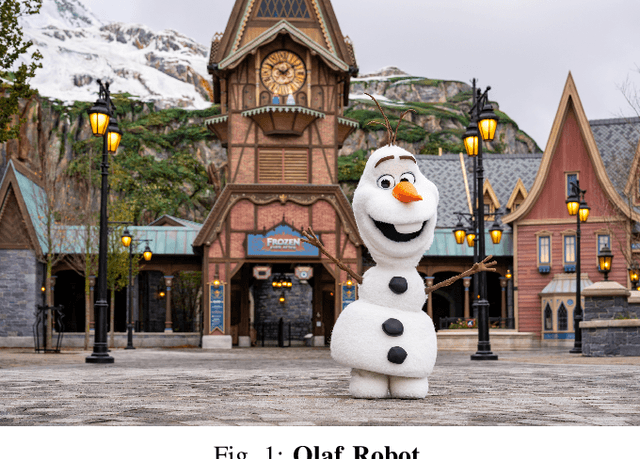
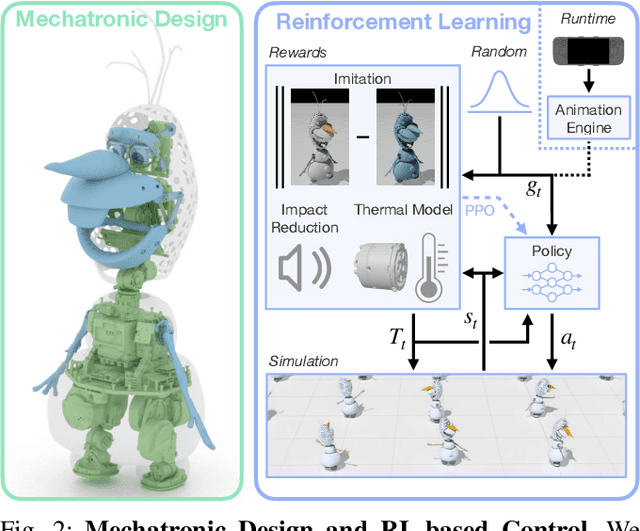
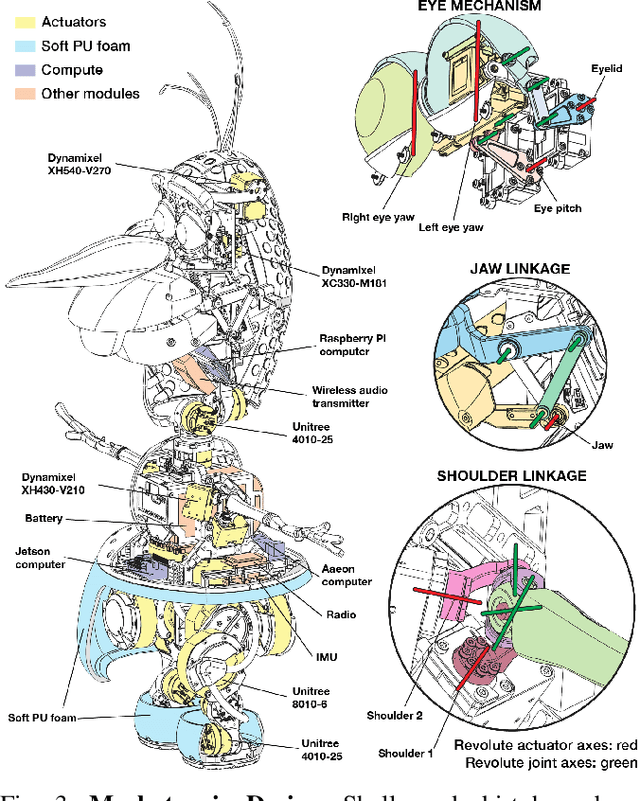
Animated characters often move in non-physical ways and have proportions that are far from a typical walking robot. This provides an ideal platform for innovation in both mechanical design and stylized motion control. In this paper, we bring Olaf to life in the physical world, relying on reinforcement learning guided by animation references for control. To create the illusion of Olaf's feet moving along his body, we hide two asymmetric legs under a soft foam skirt. To fit actuators inside the character, we use spherical and planar linkages in the arms, mouth, and eyes. Because the walk cycle results in harsh contact sounds, we introduce additional rewards that noticeably reduce impact noise. The large head, driven by small actuators in the character's slim neck, creates a risk of overheating, amplified by the costume. To keep actuators from overheating, we feed temperature values as additional inputs to policies, introducing new rewards to keep them within bounds. We validate the efficacy of our modeling in simulation and on hardware, demonstrating an unmatched level of believability for a costumed robotic character.
Robot Crash Course: Learning Soft and Stylized Falling
Nov 13, 2025Despite recent advances in robust locomotion, bipedal robots operating in the real world remain at risk of falling. While most research focuses on preventing such events, we instead concentrate on the phenomenon of falling itself. Specifically, we aim to reduce physical damage to the robot while providing users with control over a robot's end pose. To this end, we propose a robot agnostic reward function that balances the achievement of a desired end pose with impact minimization and the protection of critical robot parts during reinforcement learning. To make the policy robust to a broad range of initial falling conditions and to enable the specification of an arbitrary and unseen end pose at inference time, we introduce a simulation-based sampling strategy of initial and end poses. Through simulated and real-world experiments, our work demonstrates that even bipedal robots can perform controlled, soft falls.
AMOR: Adaptive Character Control through Multi-Objective Reinforcement Learning
May 29, 2025Reinforcement learning (RL) has significantly advanced the control of physics-based and robotic characters that track kinematic reference motion. However, methods typically rely on a weighted sum of conflicting reward functions, requiring extensive tuning to achieve a desired behavior. Due to the computational cost of RL, this iterative process is a tedious, time-intensive task. Furthermore, for robotics applications, the weights need to be chosen such that the policy performs well in the real world, despite inevitable sim-to-real gaps. To address these challenges, we propose a multi-objective reinforcement learning framework that trains a single policy conditioned on a set of weights, spanning the Pareto front of reward trade-offs. Within this framework, weights can be selected and tuned after training, significantly speeding up iteration time. We demonstrate how this improved workflow can be used to perform highly dynamic motions with a robot character. Moreover, we explore how weight-conditioned policies can be leveraged in hierarchical settings, using a high-level policy to dynamically select weights according to the current task. We show that the multi-objective policy encodes a diverse spectrum of behaviors, facilitating efficient adaptation to novel tasks.
Autonomous Human-Robot Interaction via Operator Imitation
Apr 03, 2025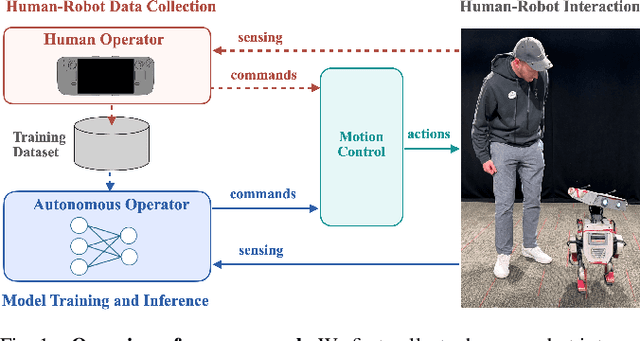
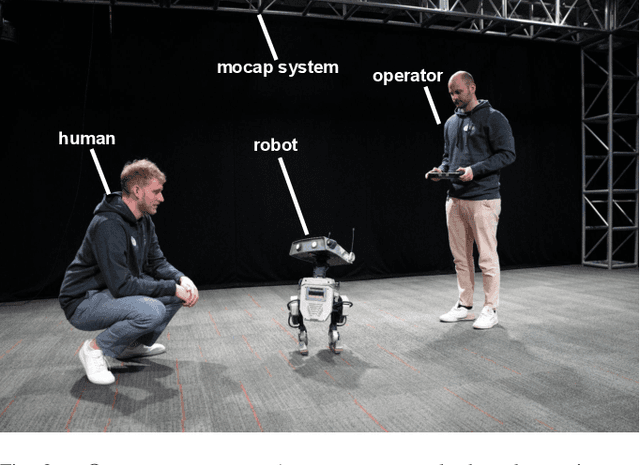
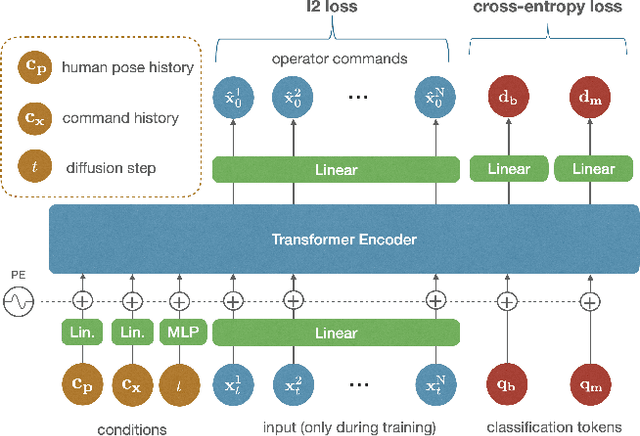
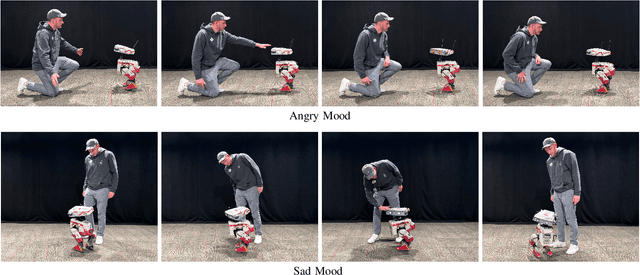
Teleoperated robotic characters can perform expressive interactions with humans, relying on the operators' experience and social intuition. In this work, we propose to create autonomous interactive robots, by training a model to imitate operator data. Our model is trained on a dataset of human-robot interactions, where an expert operator is asked to vary the interactions and mood of the robot, while the operator commands as well as the pose of the human and robot are recorded. Our approach learns to predict continuous operator commands through a diffusion process and discrete commands through a classifier, all unified within a single transformer architecture. We evaluate the resulting model in simulation and with a user study on the real system. We show that our method enables simple autonomous human-robot interactions that are comparable to the expert-operator baseline, and that users can recognize the different robot moods as generated by our model. Finally, we demonstrate a zero-shot transfer of our model onto a different robotic platform with the same operator interface.