 Add to Chrome
 Add to Firefox
 Add to Edge
Kamino: GPU-based Massively Parallel Simulation of Multi-Body Systems with Challenging Topologies
Mar 17, 2026
We present Kamino, a GPU-based physics solver for massively parallel simulations of heterogeneous highly-coupled mechanical systems. Implemented in Python using NVIDIA Warp and integrated into the Newton framework, it enables the application of data-driven methods, such as large-scale reinforcement learning, to complex robotic systems that exhibit strongly coupled kinematic and dynamic constraints such as kinematic loops. The latter are often circumvented by practitioners; approximating the system topology as a kinematic tree and incorporating explicit loop-closure constraints or so-called mimic joints. Kamino aims at alleviating this burden by natively supporting these types of coupling. This capability facilitates high-throughput parallelized simulations that capture the true nature of mechanical systems that exploit closed kinematic chains for mechanical advantage. Moreover, Kamino supports heterogeneous worlds, allowing for batched simulation of structurally diverse robots on a single GPU. At its core lies a state-of-the-art constrained optimization algorithm that computes constraint forces by solving the constrained rigid multi-body forward dynamics transcribed as a nonlinear complementarity problem. This leads to high-fidelity simulations that can resolve contact dynamics without resorting to approximate models that simplify and/or convexify the problem. We demonstrate RL policy training on DR Legs, a biped with six nested kinematic loops, generating a feasible walking policy while simulating 4096 parallel environments on a single GPU.

Isaac Lab: A GPU-Accelerated Simulation Framework for Multi-Modal Robot Learning
Nov 06, 2025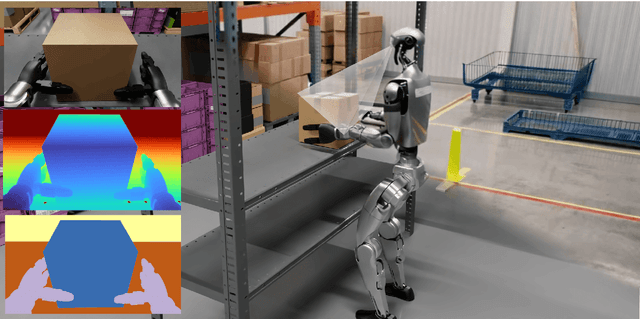
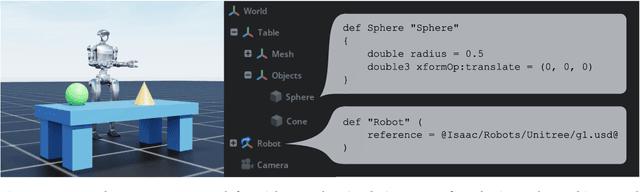
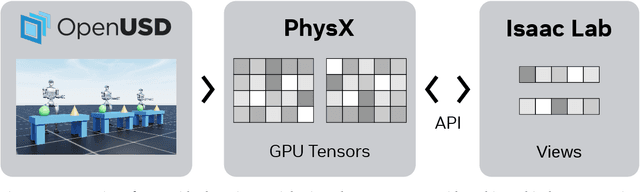
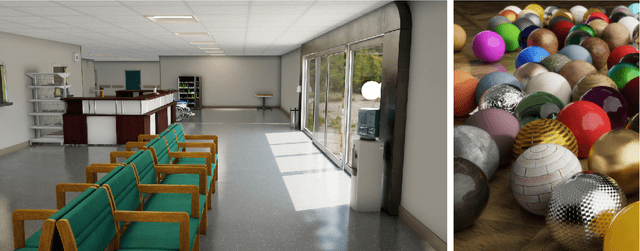
We present Isaac Lab, the natural successor to Isaac Gym, which extends the paradigm of GPU-native robotics simulation into the era of large-scale multi-modal learning. Isaac Lab combines high-fidelity GPU parallel physics, photorealistic rendering, and a modular, composable architecture for designing environments and training robot policies. Beyond physics and rendering, the framework integrates actuator models, multi-frequency sensor simulation, data collection pipelines, and domain randomization tools, unifying best practices for reinforcement and imitation learning at scale within a single extensible platform. We highlight its application to a diverse set of challenges, including whole-body control, cross-embodiment mobility, contact-rich and dexterous manipulation, and the integration of human demonstrations for skill acquisition. Finally, we discuss upcoming integration with the differentiable, GPU-accelerated Newton physics engine, which promises new opportunities for scalable, data-efficient, and gradient-based approaches to robot learning. We believe Isaac Lab's combination of advanced simulation capabilities, rich sensing, and data-center scale execution will help unlock the next generation of breakthroughs in robotics research.