 Add to Chrome
 Add to Firefox
 Add to Edge
Olaf: Bringing an Animated Character to Life in the Physical World
Dec 18, 2025
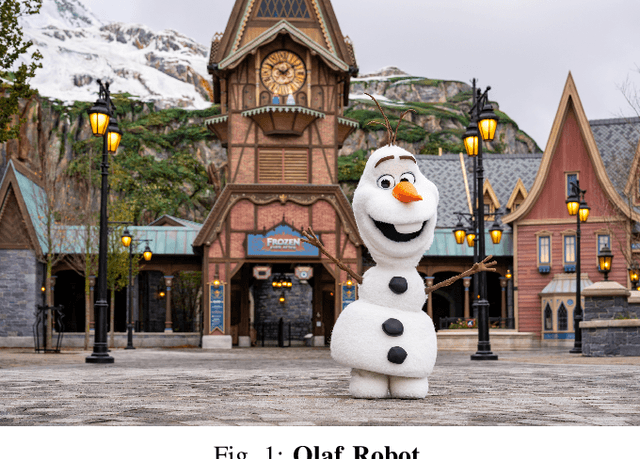
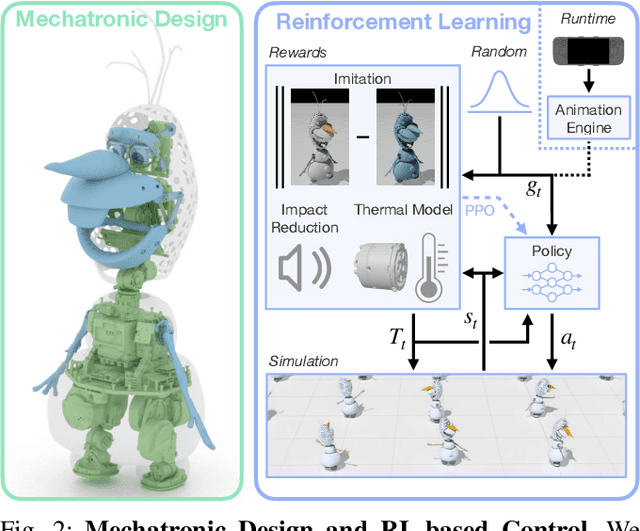
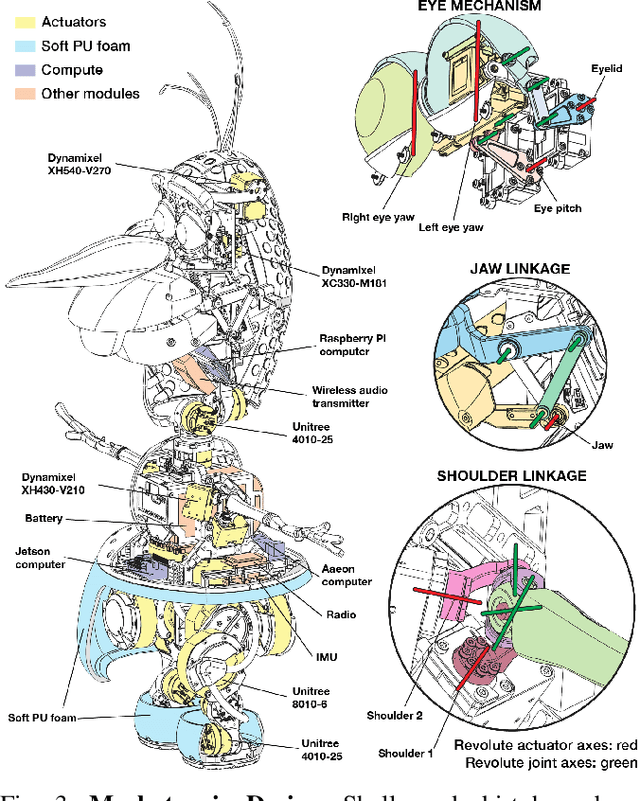
Animated characters often move in non-physical ways and have proportions that are far from a typical walking robot. This provides an ideal platform for innovation in both mechanical design and stylized motion control. In this paper, we bring Olaf to life in the physical world, relying on reinforcement learning guided by animation references for control. To create the illusion of Olaf's feet moving along his body, we hide two asymmetric legs under a soft foam skirt. To fit actuators inside the character, we use spherical and planar linkages in the arms, mouth, and eyes. Because the walk cycle results in harsh contact sounds, we introduce additional rewards that noticeably reduce impact noise. The large head, driven by small actuators in the character's slim neck, creates a risk of overheating, amplified by the costume. To keep actuators from overheating, we feed temperature values as additional inputs to policies, introducing new rewards to keep them within bounds. We validate the efficacy of our modeling in simulation and on hardware, demonstrating an unmatched level of believability for a costumed robotic character.

Autonomous Human-Robot Interaction via Operator Imitation
Apr 03, 2025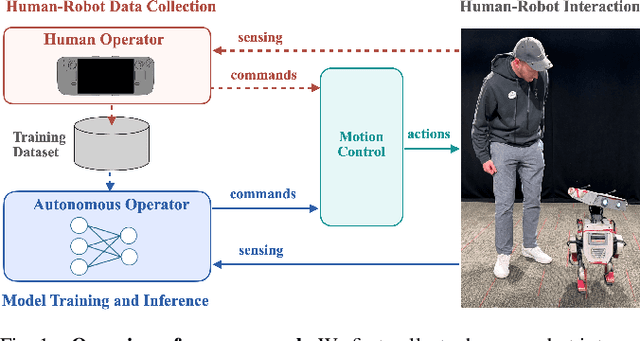
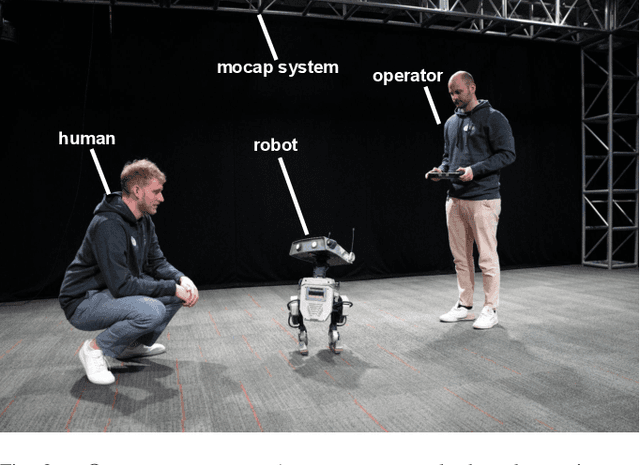
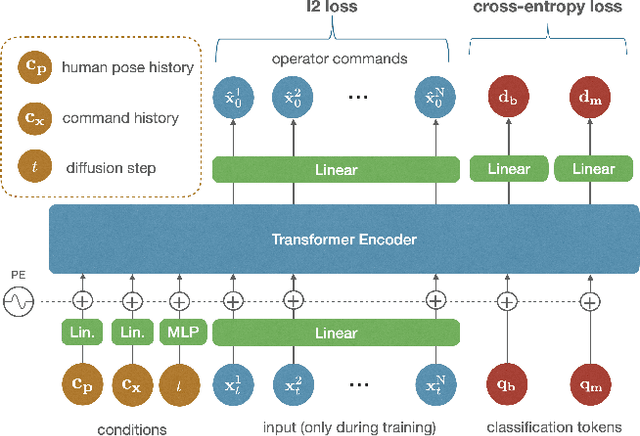
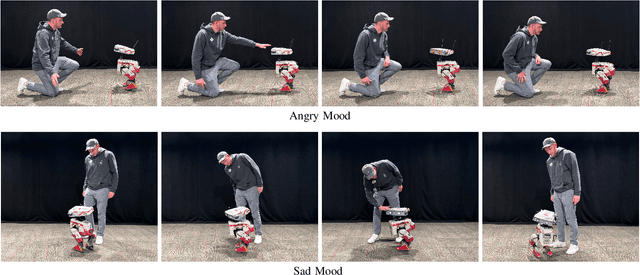
Teleoperated robotic characters can perform expressive interactions with humans, relying on the operators' experience and social intuition. In this work, we propose to create autonomous interactive robots, by training a model to imitate operator data. Our model is trained on a dataset of human-robot interactions, where an expert operator is asked to vary the interactions and mood of the robot, while the operator commands as well as the pose of the human and robot are recorded. Our approach learns to predict continuous operator commands through a diffusion process and discrete commands through a classifier, all unified within a single transformer architecture. We evaluate the resulting model in simulation and with a user study on the real system. We show that our method enables simple autonomous human-robot interactions that are comparable to the expert-operator baseline, and that users can recognize the different robot moods as generated by our model. Finally, we demonstrate a zero-shot transfer of our model onto a different robotic platform with the same operator interface.
Design and Control of a Bipedal Robotic Character
Jan 09, 2025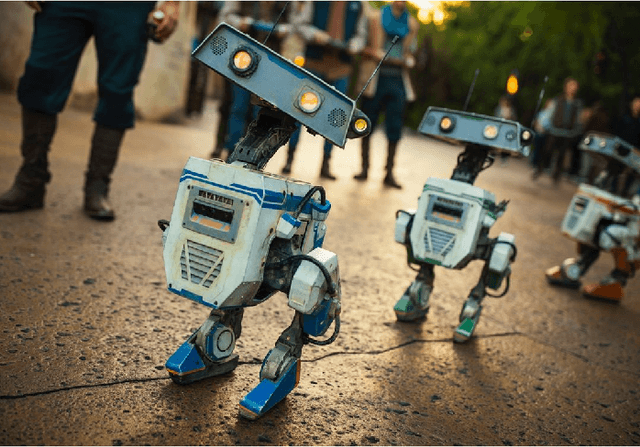
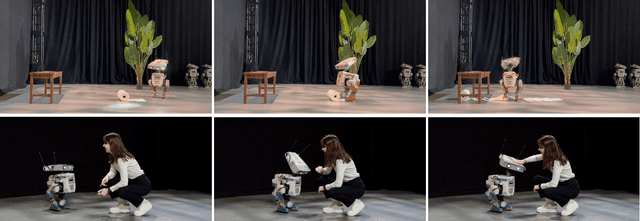
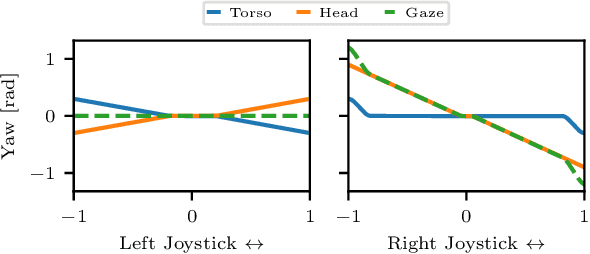

Legged robots have achieved impressive feats in dynamic locomotion in challenging unstructured terrain. However, in entertainment applications, the design and control of these robots face additional challenges in appealing to human audiences. This work aims to unify expressive, artist-directed motions and robust dynamic mobility for legged robots. To this end, we introduce a new bipedal robot, designed with a focus on character-driven mechanical features. We present a reinforcement learning-based control architecture to robustly execute artistic motions conditioned on command signals. During runtime, these command signals are generated by an animation engine which composes and blends between multiple animation sources. Finally, an intuitive operator interface enables real-time show performances with the robot. The complete system results in a believable robotic character, and paves the way for enhanced human-robot engagement in various contexts, in entertainment robotics and beyond.