 Add to Chrome
 Add to Firefox
 Add to Edge
Quantifying System Level KPI Deviations of Sionna RT: Material and Near-Field Error Analysis Using a 5G OAI Testbed
May 11, 2026
Ray tracing (RT) has recently gained renewed interest in wireless communications, driven by its integration into digital twin (DT) frameworks for site specific channel modeling. Several previous studies have validated RT at the channel level, yet how these errors propagate into real 5G system level key performance indicators (KPIs) on actual hardware remains unquantified. This paper addresses this gap by comparing Sionna RT simulated channels against vector network analyzer (VNA) measured channels using an OpenAirInterface (OAI) 5G NR testbed. Channel measurements are conducted at 20 receiver positions in an indoor laboratory, with both channel types injected into a hardware in the loop channel emulator interfacing an OAIBOX MAX base station and a Quectel UE. RSRP, PUCCH SNR, and SINR are evaluated under both conditions. The results identify antenna near-field transition effects as a critical position-dependent error source, alongside material property mismatch, providing a quantitative benchmark for digital twin-based 5G and beyond network planning.

Exploiting Near-Field Dynamics with Movable Antennas to Enhance Discrete Transmissive RIS
Mar 16, 2026The design of low-complexity transceivers is crucial for the deployment of next-generation wireless systems. In this work, we combine two emerging concepts, movable antennas (MA) and transmissive reconfigurable intelligent surfaces (TRIS), which have recently attracted significant attention for enhancing wireless communication performance. In particular, we propose a compact base station (BS) architecture that integrates a single MA with a TRIS operating in their near-field region. We address the joint optimization of the MA location and the quantized TRIS phase configuration. Due to the non-convex coupling between spatial positioning and discrete phase constraints, an alternating optimization (AO) framework is developed, where the MA position is updated via gradient ascent (GA) and the TRIS phases are optimized through quantized phase alignment. Simulation results demonstrate that the proposed architecture significantly outperforms conventional BS designs equipped with fixed fully-active antenna arrays under the same channel model and transmit power constraint. Moreover, MA repositioning effectively mitigates the performance degradation caused by discrete TRIS phase quantization in near-field propagation environments. This reveals a favorable trade-off between hardware complexity and spatial signal processing, where the spatial adaptability of the MA can compensate for low-resolution TRIS phase control.
Measurement-Based Validation of Geometry-Driven RIS Beam Steering in Industrial Environments
Feb 17, 2026Reconfigurable intelligent surfaces (RISs) offer programmable control of radio propagation for future wireless systems. For configuration, geometry-driven analytical approaches are appealing for their simplicity and real-time operation, but their performance in challenging environments such as industrial halls with dense multipath and metallic scattering is not well established. To this end, we present a measurement-based evaluation of geometry-driven RIS beam steering in a large industrial hall using a 5 GHz RIS prototype. A novel RIS configuration is proposed in which four patch antennas are mounted in close proximity in front of the RIS to steer the incident field and enable controlled reflection. For this setup, analytically computed, quantized configurations are implemented. Two-dimensional received power maps from two measurement areas reveal consistent, spatially selective focusing. Configurations optimized near the receiver produce clear power maxima, while steering to offset locations triggers a rapid 20-30 dB reduction. With increasing RIS-receiver distance, elevation selectivity broadens due to finite-aperture and geometric constraints, while azimuth steering remains robust. These results confirm the practical viability of geometry-driven RIS beam steering in industrial environments and support its use for spatial field control and localization under non-ideal propagation.
RIS-Assisted Rank Enhancement With Commodity WiFi Transceivers: Real-World Experiments
Feb 10, 2026Reconfigurable intelligent surfaces (RISs) are a promising enabling technology for the sixth-generation ($6$G) of wireless communications. RISs, thanks to their intelligent design, can reshape the wireless channel to provide favorable propagation conditions for information transfer. In this work, we experimentally investigate the potential of RISs to enhance the effective rank of multiple-input multiple-output (MIMO) channels, thereby improving spatial multiplexing capabilities. In our experiment, commodity WiFi transceivers are used, representing a practical MIMO system. In this context, we propose a passive beam-focusing technique to manipulate the propagation channel between each transmit-receive antenna pair and achieve a favorable propagation condition for rank improvement. The proposed algorithm is tested in two different channel scenarios: low and medium ranks. Experimental results show that, when the channel is rank-deficient, the RIS can significantly increase the rank by $112\%$ from its default value without the RIS, providing a rank increment of $1.5$. When the rank has a medium value, a maximum of $61\%$ enhancement can be achieved, corresponding to a rank increment of $1$. These results provide the first experimental evidence of RIS-driven rank manipulation with off-the-shelf WiFi hardware, offering practical insights into RIS deployment for spatial multiplexing gains.
A Lightweight Framework for Integrated Sensing and Communications with RIS
Nov 06, 2025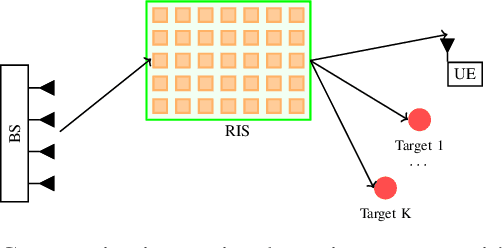
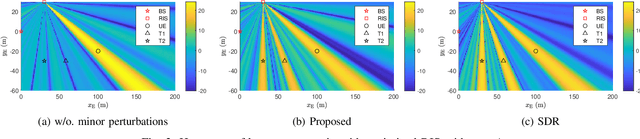
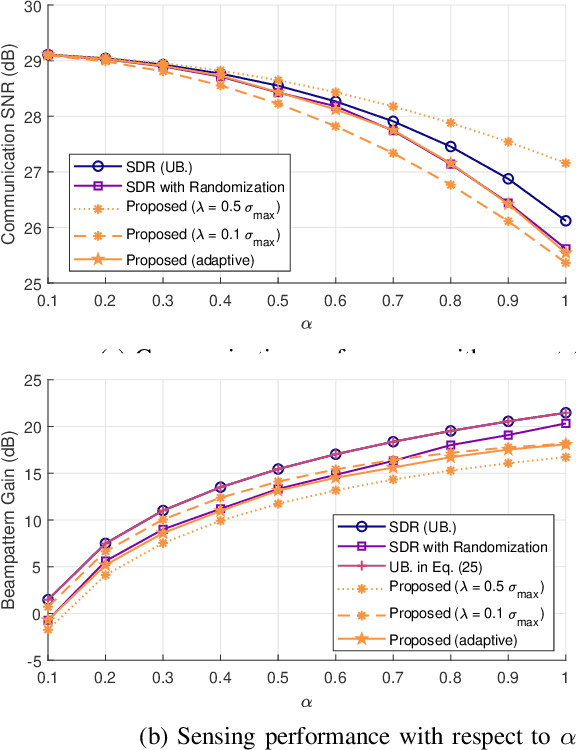
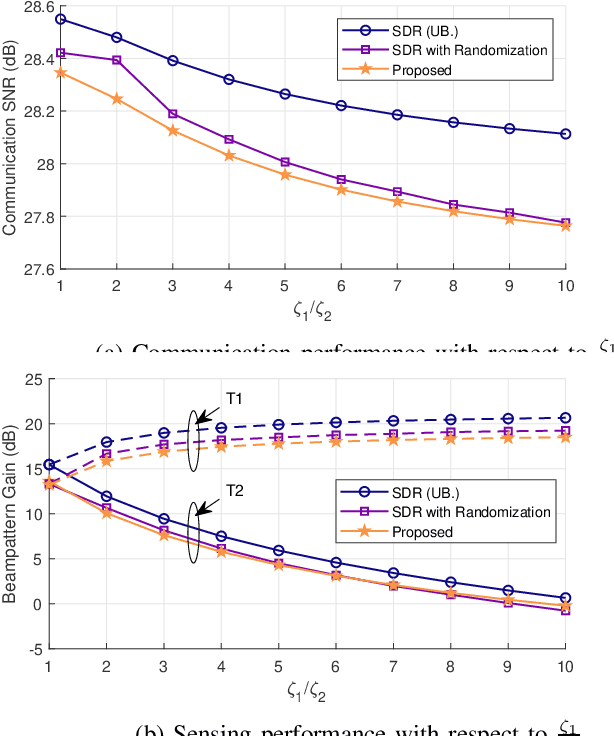
Reconfigurable Intelligent Surfaces (RIS) have been recognized as a promising technology to enhance both communication and sensing performance in integrated sensing and communication (ISAC) systems for future 6G networks. However, existing RIS optimization methods for improving ISAC performance are mainly based on semidefinite relaxation (SDR) or iterative algorithms. The former suffers from high computational complexity and limited scalability, especially when the number of RIS elements becomes large, while the latter yields suboptimal solutions whose performance depends on initialization. In this work, we introduce a lightweight RIS phase design framework that provides a closed-form solution and explicitly accounts for the trade-off between communication and sensing, as well as proportional beam gain distribution toward multiple sensing targets. The key idea is to partition the RIS configuration into two parts: the first part is designed to maximize the communication performance, while the second introduces small perturbations to generate multiple beams for multi-target sensing. Simulation results validate the effectiveness of the proposed approach and demonstrate that it achieves performance comparable to SDR but with significantly lower computational complexity.
Hardware-Efficient Cognitive Radar: Multi-Target Detection with RL-Driven Transmissive RIS
Sep 17, 2025Cognitive radar has emerged as a key paradigm for next-generation sensing, enabling adaptive, intelligent operation in dynamic and complex environments. Yet, conventional cognitive multiple-input multiple-output (MIMO) radars offer strong detection performance but suffer from high hardware complexity and power demands. To overcome these limitations, we develop a reinforcement learning (RL)-based framework that leverages a transmissive reconfigurable intelligent surface (TRIS) for adaptive beamforming. A state-action-reward-state-action (SARSA) agent tunes TRIS phase shifts to improve multi-target detection in low signal-to-noise ratio (SNR) conditions while operating with far fewer radio frequency (RF) chains. Simulations confirm that the proposed TRIS-RL radar matches or, for large number of elements, even surpasses MIMO performance with reduced cost and energy requirements.
6G Resilience -- White Paper
Sep 10, 2025
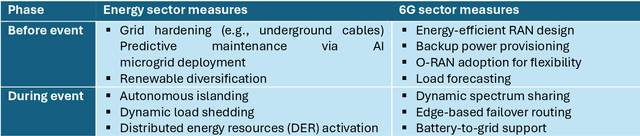


6G must be designed to withstand, adapt to, and evolve amid prolonged, complex disruptions. Mobile networks' shift from efficiency-first to sustainability-aware has motivated this white paper to assert that resilience is a primary design goal, alongside sustainability and efficiency, encompassing technology, architecture, and economics. We promote resilience by analysing dependencies between mobile networks and other critical systems, such as energy, transport, and emergency services, and illustrate how cascading failures spread through infrastructures. We formalise resilience using the 3R framework: reliability, robustness, resilience. Subsequently, we translate this into measurable capabilities: graceful degradation, situational awareness, rapid reconfiguration, and learning-driven improvement and recovery. Architecturally, we promote edge-native and locality-aware designs, open interfaces, and programmability to enable islanded operations, fallback modes, and multi-layer diversity (radio, compute, energy, timing). Key enablers include AI-native control loops with verifiable behaviour, zero-trust security rooted in hardware and supply-chain integrity, and networking techniques that prioritise critical traffic, time-sensitive flows, and inter-domain coordination. Resilience also has a techno-economic aspect: open platforms and high-quality complementors generate ecosystem externalities that enhance resilience while opening new markets. We identify nine business-model groups and several patterns aligned with the 3R objectives, and we outline governance and standardisation. This white paper serves as an initial step and catalyst for 6G resilience. It aims to inspire researchers, professionals, government officials, and the public, providing them with the essential components to understand and shape the development of 6G resilience.
Anomaly Detection for Sensing Security
Jun 12, 2025Various approaches in the field of physical layer security involve anomaly detection, such as physical layer authentication, sensing attacks, and anti-tampering solutions. Depending on the context in which these approaches are applied, anomaly detection needs to be computationally lightweight, resilient to changes in temperature and environment, and robust against phase noise. We adapt moving average filters, autoregression filters and Kalman filters to provide predictions of feature vectors that fulfill the above criteria. Different hypothesis test designs are employed that allow omnidirectional and unidirectional outlier detection. In a case study, a sensing attack is investigated that employs the described algorithms with various channel features based on commodity WiFi devices. Thereby, various combinations of algorithms and channel features show effectiveness for motion detection by an attacker. Countermeasures only utilizing transmit power randomization are shown insufficient to mitigate such attacks if the attacker has access to channel state information (CSI) measurements, suggesting that mitigation solutions might require frequency-variant randomization.
Accelerated Recovery with RIS: Designing Wireless Resilience in Mission-Critical Environments
Apr 15, 2025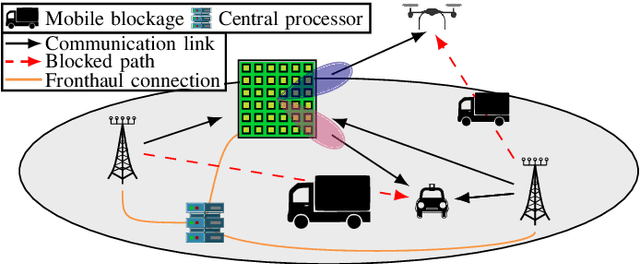
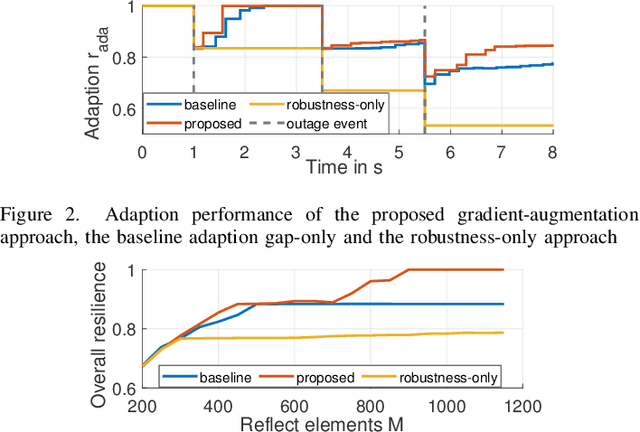
As 6G and beyond redefine connectivity, wireless networks become the foundation of critical operations, making resilience more essential than ever. With this shift, wireless systems cannot only take on vital services previously handled by wired infrastructures but also enable novel innovative applications that would not be possible with wired systems. As a result, there is a pressing demand for strategies that can adapt to dynamic channel conditions, interference, and unforeseen disruptions, ensuring seamless and reliable performance in an increasingly complex environment. Despite considerable research, existing resilience assessments lack comprehensive key performance indicators (KPIs), especially those quantifying its adaptability, which are vital for identifying a system's capacity to rapidly adapt and reallocate resources. In this work, we bridge this gap by proposing a novel framework that explicitly quantifies the adaption performance by augmenting the gradient of the system's rate function. To further enhance the network resilience, we integrate Reconfigurable Intelligent Surfaces (RISs) into our framework due to their capability to dynamically reshape the propagation environment while providing alternative channel paths. Numerical results show that gradient augmentation enhances resilience by improving adaptability under adverse conditions while proactively preparing for future disruptions.
Towards Smarter Sensing: 2D Clutter Mitigation in RL-Driven Cognitive MIMO Radar
Feb 07, 2025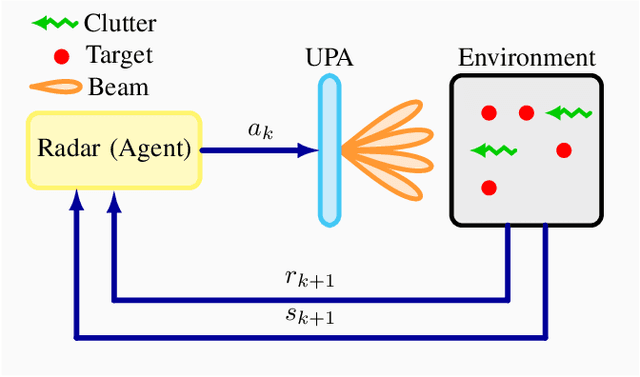
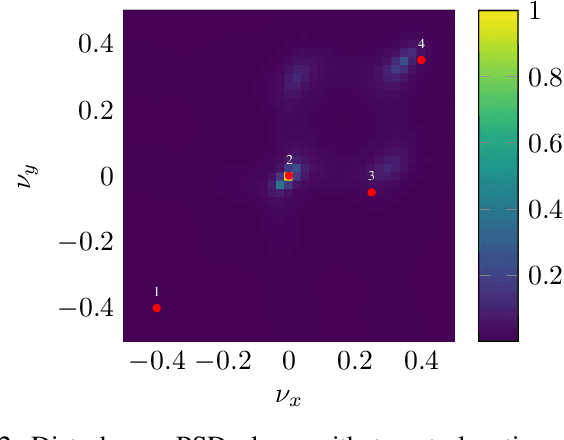
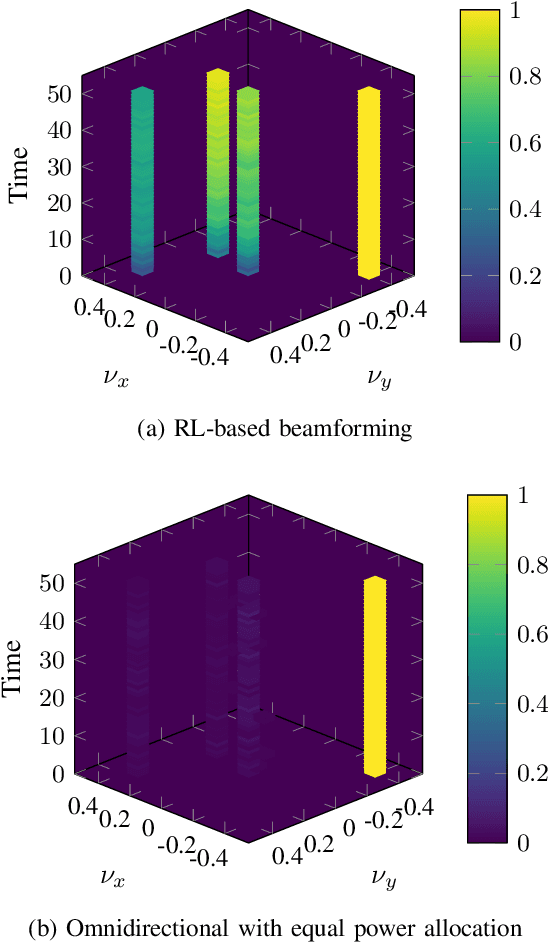
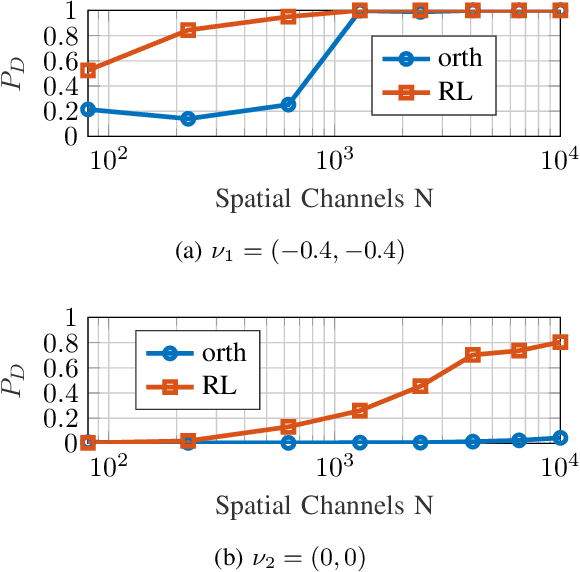
Motivated by the growing interest in integrated sensing and communication for 6th generation (6G) networks, this paper presents a cognitive Multiple-Input Multiple-Output (MIMO) radar system enhanced by reinforcement learning (RL) for robust multitarget detection in dynamic environments. The system employs a planar array configuration and adapts its transmitted waveforms and beamforming patterns to optimize detection performance in the presence of unknown two-dimensional (2D) disturbances. A robust Wald-type detector is integrated with a SARSA-based RL algorithm, enabling the radar to learn and adapt to complex clutter environments modeled by a 2D autoregressive process. Simulation results demonstrate significant improvements in detection probability compared to omnidirectional methods, particularly for low Signal-to-Noise Ratio (SNR) targets masked by clutter.