 Add to Chrome
 Add to Firefox
 Add to Edge
Beyond correlation: The impact of human uncertainty in measuring the effectiveness of automatic evaluation and LLM-as-a-judge
Oct 03, 2024
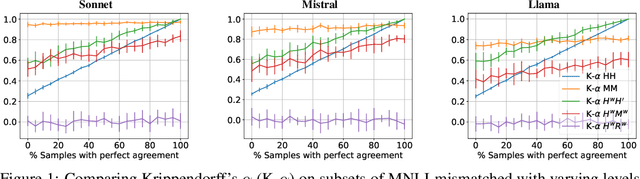


The effectiveness of automatic evaluation of generative models is typically measured by comparing it to human evaluation using correlation metrics. However, metrics like Krippendorff's $\alpha$ and Randolph's $\kappa$, originally designed to measure the reliability of human labeling, make assumptions about human behavior and the labeling process. In this paper, we show how *relying on a single aggregate correlation score* can obscure fundamental differences between human behavior and automatic evaluation methods, including LLM-as-a-Judge. Specifically, we demonstrate that when the proportion of samples with variation or uncertainty in human labels (gathered during human evaluation) is relatively high, machine labels (generated by automatic evaluation methods) may superficially appear to have similar or better correlation with the human majority label compared to human-to-human (HH) correlation. This can create the misleading impression that automatic evaluation is accurate enough to approximate the human majority label. However, as the proportion of samples with consistent human labels increases, the correlation between machine labels and human majority labels declines, falling below HH correlation. Based on these findings, we first propose stratifying results by human label uncertainty to provide a more robust analysis of automatic evaluation performance. Second, recognizing that uncertainty and variation are inherent in perception-based human evaluations, such as those involving attitudes or preferences, we introduce a new metric - *binned Jensen-Shannon Divergence for perception* for such scenarios to better measure the effectiveness of automatic evaluations. Third, we present visualization techniques -- *perception charts*, to compare the strengths and limitations of automatic evaluation and to contextualize correlation measures appropriately

Model Tells Itself Where to Attend: Faithfulness Meets Automatic Attention Steering
Sep 16, 2024


Large language models (LLMs) have demonstrated remarkable performance across various real-world tasks. However, they often struggle to fully comprehend and effectively utilize their input contexts, resulting in responses that are unfaithful or hallucinated. This difficulty increases for contexts that are long or contain distracting information, which can divert LLMs from fully capturing essential evidence. To address this issue, many works use prompting to help LLMs utilize contextual information more faithfully. For instance, iterative prompting highlights key information in two steps that first ask the LLM to identify important pieces of context and then derive answers accordingly. However, prompting methods are constrained to highlighting key information implicitly in token space, which is often insufficient to fully steer the model's attention. To improve model faithfulness more reliably, we propose AutoPASTA, a method that automatically identifies key contextual information and explicitly highlights it by steering an LLM's attention scores. Like prompting, AutoPASTA is applied at inference time and does not require changing any model parameters. Our experiments on open-book QA demonstrate that AutoPASTA effectively enables models to grasp essential contextual information, leading to substantially improved model faithfulness and performance, e.g., an average improvement of 7.95% for LLAMA3-70B-Instruct. Code will be publicly available at https://github.com/QingruZhang/AutoPASTA .
MAPWise: Evaluating Vision-Language Models for Advanced Map Queries
Aug 30, 2024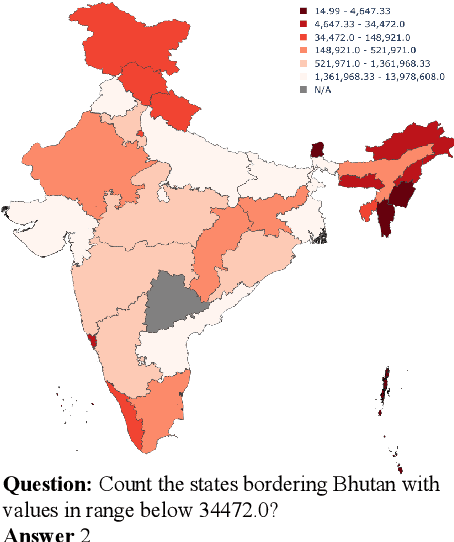
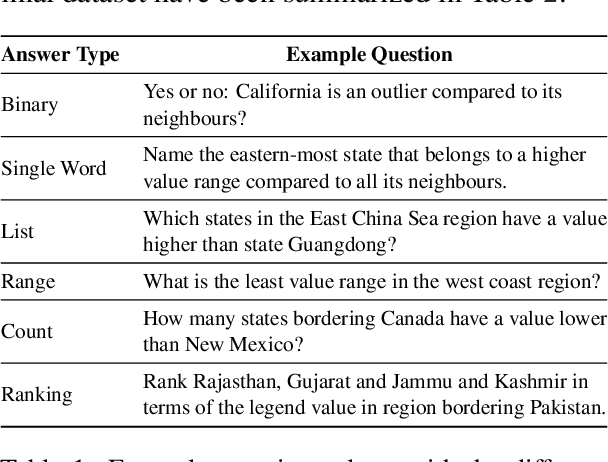
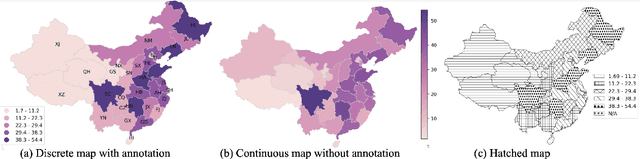
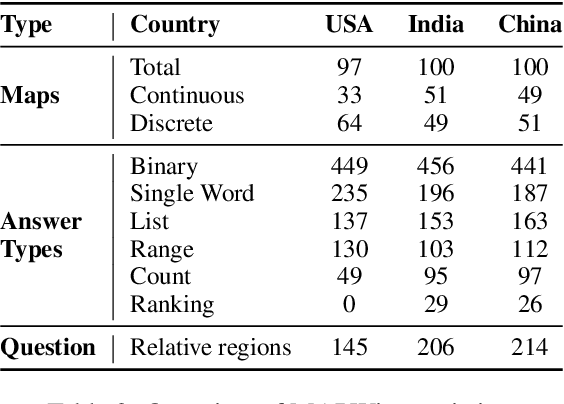
Vision-language models (VLMs) excel at tasks requiring joint understanding of visual and linguistic information. A particularly promising yet under-explored application for these models lies in answering questions based on various kinds of maps. This study investigates the efficacy of VLMs in answering questions based on choropleth maps, which are widely used for data analysis and representation. To facilitate and encourage research in this area, we introduce a novel map-based question-answering benchmark, consisting of maps from three geographical regions (United States, India, China), each containing 1000 questions. Our benchmark incorporates 43 diverse question templates, requiring nuanced understanding of relative spatial relationships, intricate map features, and complex reasoning. It also includes maps with discrete and continuous values, encompassing variations in color-mapping, category ordering, and stylistic patterns, enabling comprehensive analysis. We evaluate the performance of multiple VLMs on this benchmark, highlighting gaps in their abilities and providing insights for improving such models.
Knowledge-Aware Reasoning over Multimodal Semi-structured Tables
Aug 25, 2024Existing datasets for tabular question answering typically focus exclusively on text within cells. However, real-world data is inherently multimodal, often blending images such as symbols, faces, icons, patterns, and charts with textual content in tables. With the evolution of AI models capable of multimodal reasoning, it is pertinent to assess their efficacy in handling such structured data. This study investigates whether current AI models can perform knowledge-aware reasoning on multimodal structured data. We explore their ability to reason on tables that integrate both images and text, introducing MMTabQA, a new dataset designed for this purpose. Our experiments highlight substantial challenges for current AI models in effectively integrating and interpreting multiple text and image inputs, understanding visual context, and comparing visual content across images. These findings establish our dataset as a robust benchmark for advancing AI's comprehension and capabilities in analyzing multimodal structured data.
Enhancing Temporal Understanding in LLMs for Semi-structured Tables
Jul 22, 2024
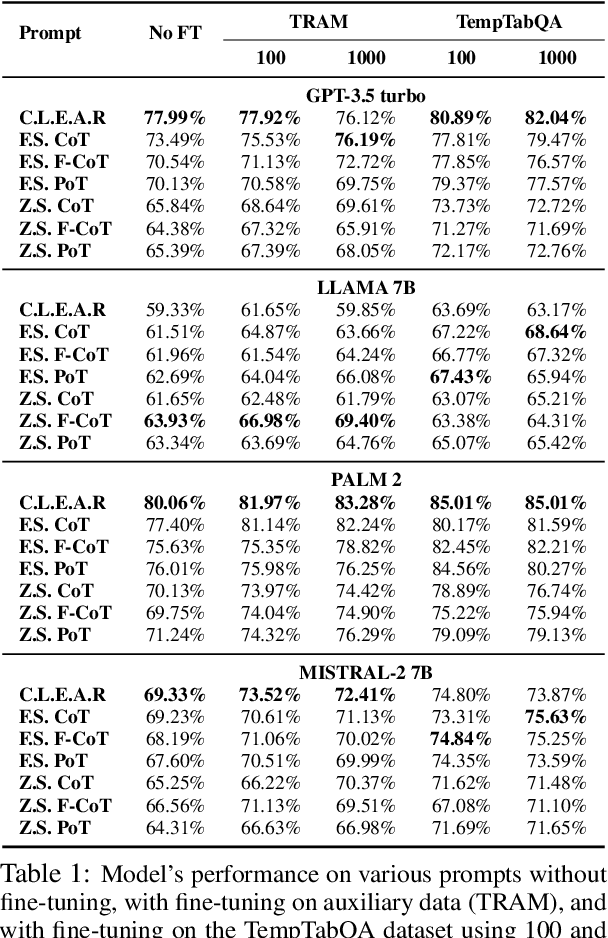
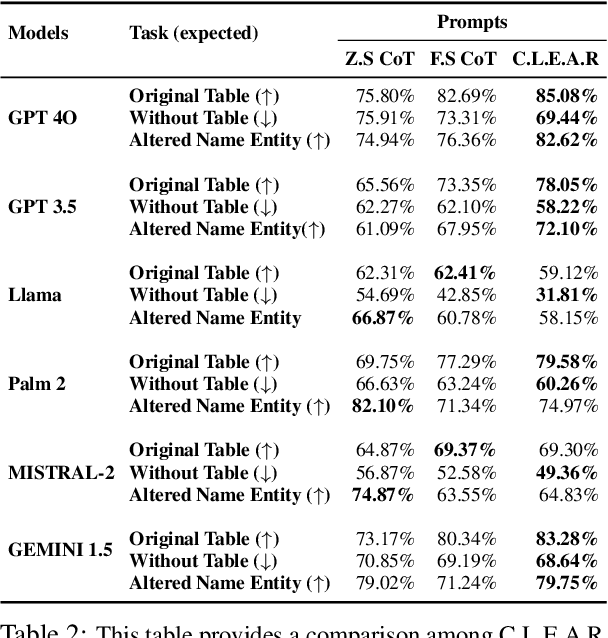

Temporal reasoning over tabular data presents substantial challenges for large language models (LLMs), as evidenced by recent research. In this study, we conduct a comprehensive analysis of temporal datasets to pinpoint the specific limitations of LLMs. Our investigation leads to enhancements in TempTabQA, a dataset specifically designed for tabular temporal question answering. We provide critical insights for improving LLM performance in temporal reasoning tasks with tabular data. Furthermore, we introduce a novel approach, C.L.E.A.R to strengthen LLM capabilities in this domain. Our findings demonstrate that our method significantly improves evidence-based reasoning across various models. Additionally, our experimental results reveal that indirect supervision with auxiliary data substantially boosts model performance in these tasks. This work contributes to a deeper understanding of LLMs' temporal reasoning abilities over tabular data and promotes advancements in their application across diverse fields.
Unraveling the Truth: Do LLMs really Understand Charts? A Deep Dive into Consistency and Robustness
Jul 15, 2024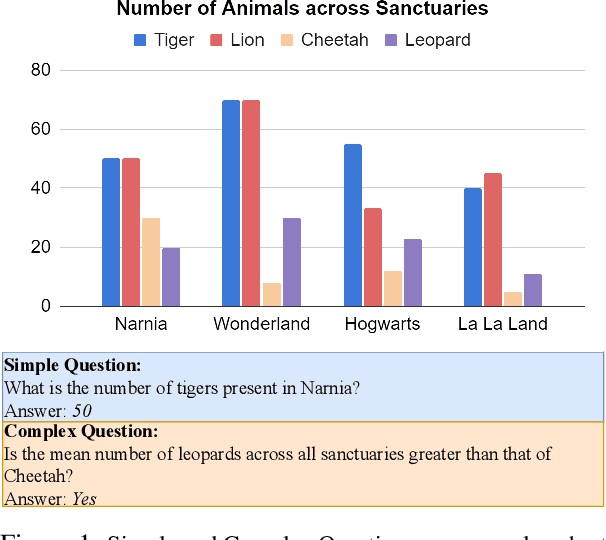
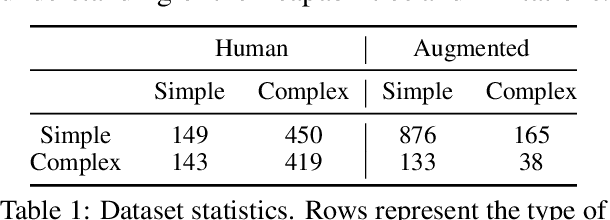
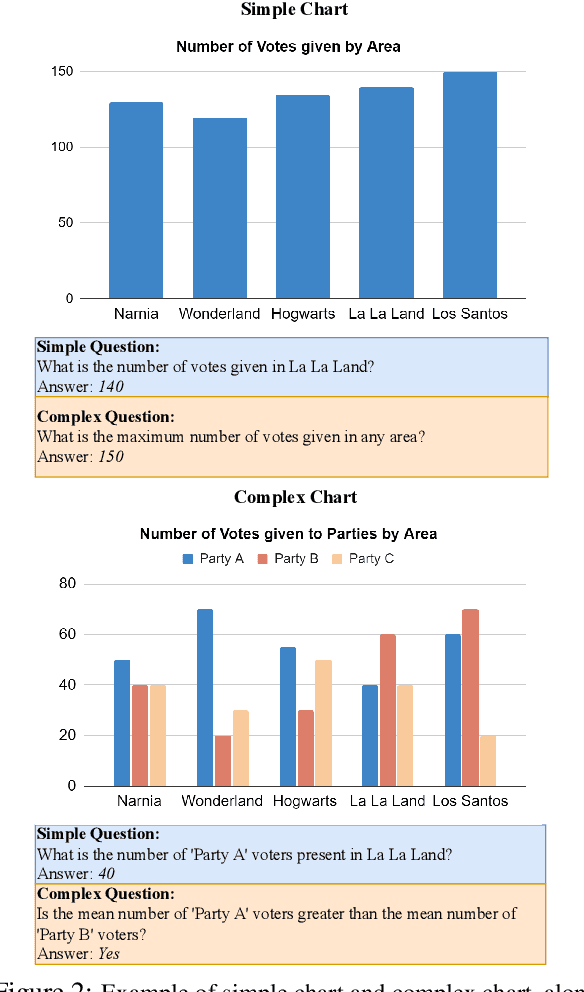
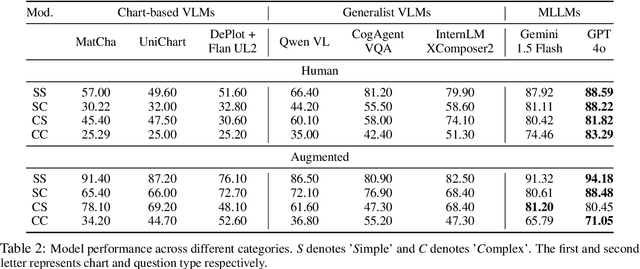
Chart question answering (CQA) is a crucial area of Visual Language Understanding. However, the robustness and consistency of current Visual Language Models (VLMs) in this field remain under-explored. This paper evaluates state-of-the-art VLMs on comprehensive datasets, developed specifically for this study, encompassing diverse question categories and chart formats. We investigate two key aspects: 1) the models' ability to handle varying levels of chart and question complexity, and 2) their robustness across different visual representations of the same underlying data. Our analysis reveals significant performance variations based on question and chart types, highlighting both strengths and weaknesses of current models. Additionally, we identify areas for improvement and propose future research directions to build more robust and reliable CQA systems. This study sheds light on the limitations of current models and paves the way for future advancements in the field.
NTSEBENCH: Cognitive Reasoning Benchmark for Vision Language Models
Jul 15, 2024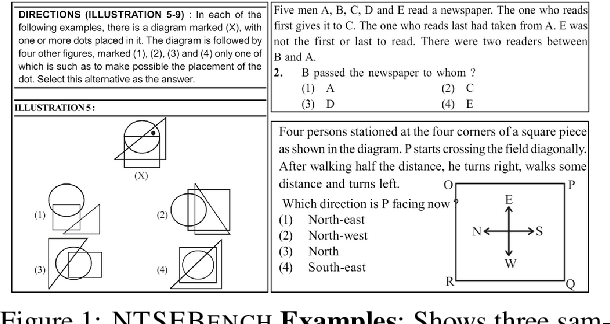
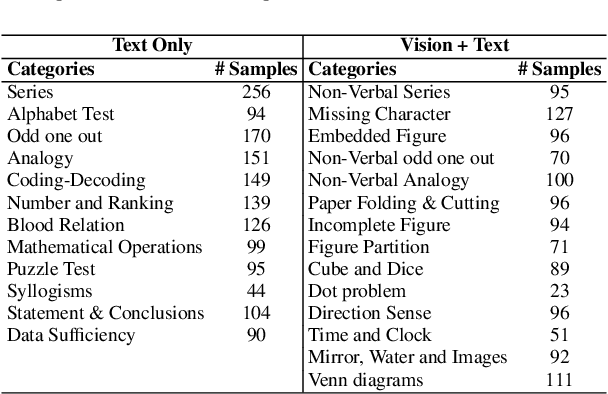
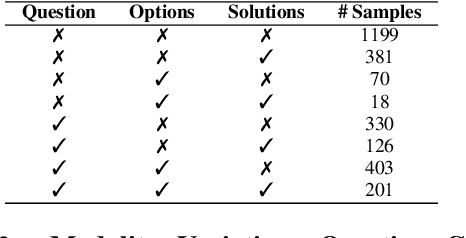
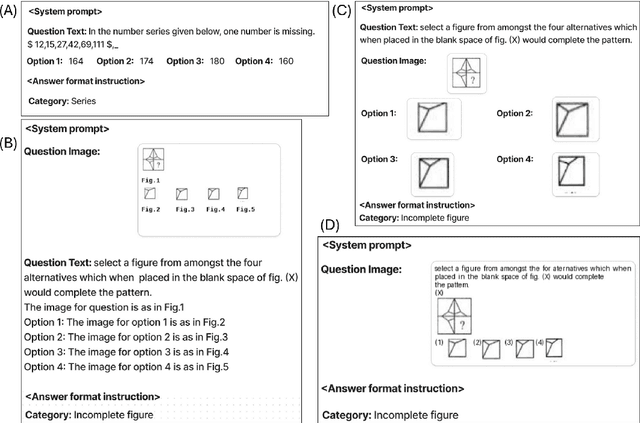
Cognitive textual and visual reasoning tasks, such as puzzles, series, and analogies, demand the ability to quickly reason, decipher, and evaluate patterns both textually and spatially. While LLMs and VLMs, through extensive training on large amounts of human-curated data, have attained a high level of pseudo-human intelligence in some common sense reasoning tasks, they still struggle with more complex reasoning tasks that require cognitive understanding. In this work, we introduce a new dataset, NTSEBench, designed to evaluate the cognitive multi-modal reasoning and problem-solving skills of large models. The dataset comprises 2,728 multiple-choice questions comprising of a total of 4,642 images across 26 categories sampled from the NTSE examination conducted nationwide in India, featuring both visual and textual general aptitude questions that do not rely on rote learning. We establish baselines on the dataset using state-of-the-art LLMs and VLMs. To facilitate a comparison between open source and propriety models, we propose four distinct modeling strategies to handle different modalities (text and images) in the dataset instances.
On Characterizing and Mitigating Imbalances in Multi-Instance Partial Label Learning
Jul 13, 2024Multi-Instance Partial Label Learning (MI-PLL) is a weakly-supervised learning setting encompassing partial label learning, latent structural learning, and neurosymbolic learning. Differently from supervised learning, in MI-PLL, the inputs to the classifiers at training-time are tuples of instances $\textbf{x}$, while the supervision signal is generated by a function $\sigma$ over the gold labels of $\textbf{x}$. The gold labels are hidden during training. In this paper, we focus on characterizing and mitigating learning imbalances, i.e., differences in the errors occurring when classifying instances of different classes (aka class-specific risks), under MI-PLL. The phenomenon of learning imbalances has been extensively studied in the context of long-tail learning; however, the nature of MI-PLL introduces new challenges. Our contributions are as follows. From a theoretical perspective, we characterize the learning imbalances by deriving class-specific risk bounds that depend upon the function $\sigma$. Our theory reveals that learning imbalances exist in MI-PLL even when the hidden labels are uniformly distributed. On the practical side, we introduce a technique for estimating the marginal of the hidden labels using only MI-PLL data. Then, we introduce algorithms that mitigate imbalances at training- and testing-time, by treating the marginal of the hidden labels as a constraint. The first algorithm relies on a novel linear programming formulation of MI-PLL for pseudo-labeling. The second one adjusts a model's scores based on robust optimal transport. We demonstrate the effectiveness of our techniques using strong neurosymbolic and long-tail learning baselines, discussing also open challenges.
H-STAR: LLM-driven Hybrid SQL-Text Adaptive Reasoning on Tables
Jun 29, 2024Tabular reasoning involves interpreting unstructured queries against structured tables, requiring a synthesis of textual understanding and symbolic reasoning. Existing methods rely on either of the approaches and are constrained by their respective limitations. Textual reasoning excels in semantic interpretation unlike symbolic reasoning (SQL logic), but falls short in mathematical reasoning where SQL excels. In this paper, we introduce a novel algorithm H-STAR, comprising table extraction and adaptive reasoning, integrating both symbolic and semantic (text-based) approaches. To enhance evidence extraction, H-STAR employs a multi-view approach, incorporating step-by-step row and column retrieval. It also adapts reasoning strategies based on question types, utilizing symbolic reasoning for quantitative and logical tasks, and semantic reasoning for direct lookup and complex lexical queries. Our extensive experiments demonstrate that H-STAR significantly outperforms state-of-the-art methods across three tabular question-answering (QA) and fact-verification datasets, underscoring its effectiveness and efficiency.
FlowVQA: Mapping Multimodal Logic in Visual Question Answering with Flowcharts
Jun 27, 2024Existing benchmarks for visual question answering lack in visual grounding and complexity, particularly in evaluating spatial reasoning skills. We introduce FlowVQA, a novel benchmark aimed at assessing the capabilities of visual question-answering multimodal language models in reasoning with flowcharts as visual contexts. FlowVQA comprises 2,272 carefully generated and human-verified flowchart images from three distinct content sources, along with 22,413 diverse question-answer pairs, to test a spectrum of reasoning tasks, including information localization, decision-making, and logical progression. We conduct a thorough baseline evaluation on a suite of both open-source and proprietary multimodal language models using various strategies, followed by an analysis of directional bias. The results underscore the benchmark's potential as a vital tool for advancing the field of multimodal modeling, providing a focused and challenging environment for enhancing model performance in visual and logical reasoning tasks.